When you click on links to various merchants on this site and make a purchase, this can result in this site earning a commission. Affiliate programs and affiliations include, but are not limited to, the eBay Partner Network.
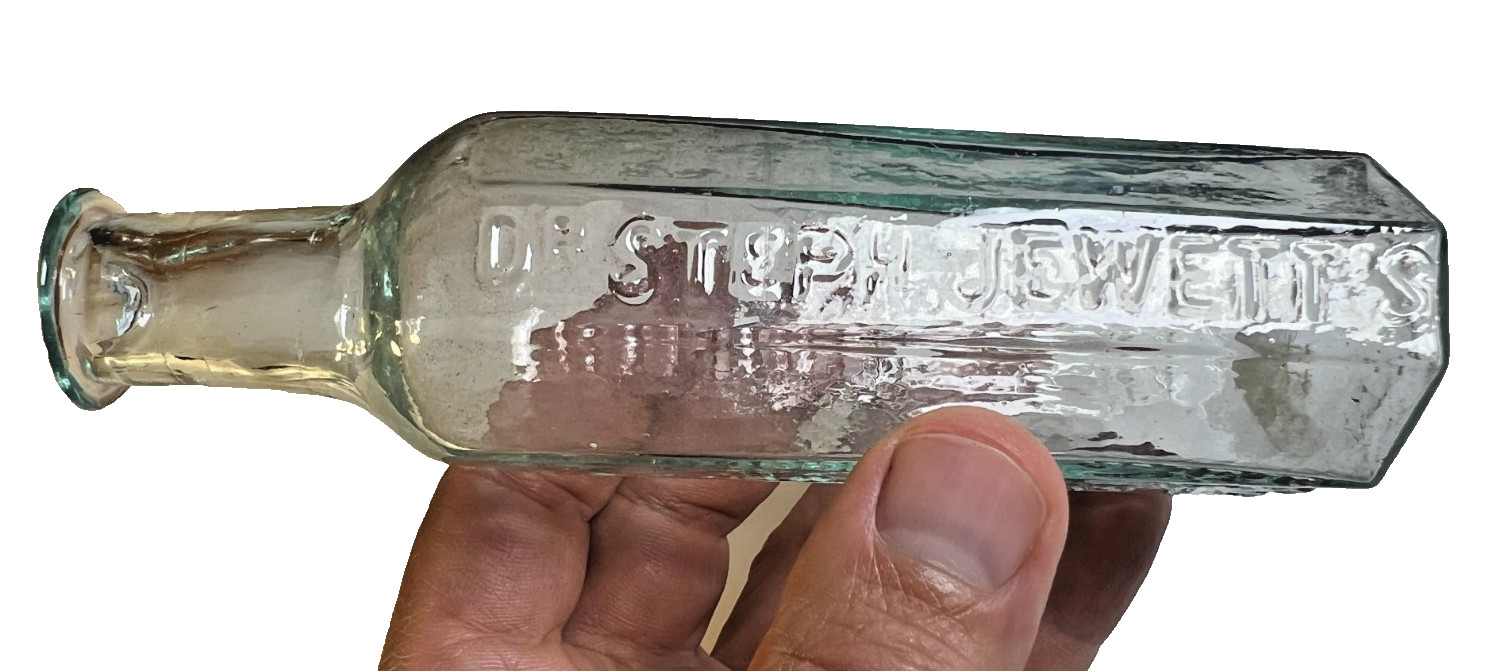
Dr. Steph. Jewett’s Celebrated Pulmonary Elixir – Rindge, New HampshireBest Date: Circa 1850–1852
I would date this bottle circa 1850–1852, with a cautious manufacturing range of approximately 1848–1855.
That dating rests on several converging pieces of evidence:
- A large, rough open pontil scar, showing that the bottle was held on a pontil rod while the mouth was finished.
- A remarkably thin, uneven, hand-fashioned flared lip rather than a standardized applied collar.
- Heavy hammered whittle, entrapped bubbles and irregular glass distribution typical of early mold-blown New England bottles.
- Period newspaper advertising confirms that Jewett’s Pulmonary Elixir was being actively promoted by 1852.
- The New Hampshire Historical Society dates a related Dr. Stephen Jewett medicine bottle to 1840–1850. That museum example is attributed to Stoddard, New Hampshire, an important regional glassmaking center.
- The standard proprietary-medicine-bottle reference catalogs this form as J-53: rectangular, deep aqua, flared lip and open pontil.
“Circa 1850–1852”, rather than merely “1840s.” Its manufacturing characteristics could begin in the late 1840s, but the documented 1852 advertising makes the opening years of the 1850s especially persuasive.
Who Was Dr. Stephen Jewett?
Dr. Stephen Jewett was born in Rindge in 1764 and became a locally prominent physician whose reputation extended beyond his small New Hampshire community. He died in 1818, decades before this particular bottle was manufactured.
That reveals the wonderfully slippery part of the story: the “Dr. Stephen Jewett” on the bottle was the honored medical name and brand—not necessarily the man personally supervising the bottling.
His son, Stephen Jewett Jr. (1801–1862), was not a practicing physician. Rindge’s published town history specifically records that the younger Jewett spent many years manufacturing and selling his father’s proprietary medicines, which enjoyed considerable popularity.
In modern language, Dr. Jewett developed the reputation and formula; his son turned that reputation into a commercial brand.
What Was Pulmonary Elixir?
“Pulmonary” referred broadly to the lungs and respiratory system. Jewett’s elixir was marketed as a cough and lung medicine for ailments described at the time as:
- Persistent coughs
- Colds
- Hoarseness
- Sore or irritated throat
- Bronchial complaints
- Asthma-like breathing trouble
- “Weakness of the lungs”
- Early symptoms associated with consumption, now called tuberculosis
An 1852 advertisement called Jewett’s Pulmonary Elixir the “best cough medicine ever known” and promoted it throughout the regional newspaper market.
The exact complete recipe has not been firmly established from the surviving bottle evidence. Like many proprietary remedies, it was almost certainly a bottled botanical preparation carried in an alcohol- or syrup-based liquid. It should be described as a period proprietary or patent medicine, not as a scientifically proven cure.
How It Was Marketed
This was a surprisingly sophisticated little commercial product for rural New Hampshire.
The bottle itself was part of the advertising. Its three embossed panels permanently announced:
DR. STEPH. JEWETT’S
CELEBRATED PULMONARY ELIXIR
RINDGE, N.H.
“Celebrated” was Victorian marketing shorthand for famous, trusted and widely praised. Embossing the doctor’s name, claimed purpose and place of origin directly into the glass made the package recognizable even after its paper label disappeared.
Jewett’s medicines were promoted through newspaper advertisements, agents, apothecaries and general stores. Testimonials and sweeping claims carried enormous weight in an era before radio, television, federal drug regulation or clinical trials. The original label would have supplied dosage directions and a much longer recital of diseases the elixir supposedly relieved.
Who Made the Bottle?
The medicine itself was manufactured and marketed at Rindge, Cheshire County, New Hampshire, by the business of Stephen Jewett Jr., using his late father’s medical name and formulations.
The actual glasshouse is not identified by a factory mark. Its brilliant blue-aqua color, open pontil, crude mold construction and strongly whittled surface are consistent with mid-19th-century New England glassmaking. A related Jewett bitters bottle in the New Hampshire Historical Society is attributed to Stoddard, New Hampshire, making a Stoddard-area glasshouse a credible possibility.
However, I would not state Stoddard as a proven maker. The honest wording is:
Probably blown at a New Hampshire or neighboring New England glasshouse, possibly in the Stoddard glassmaking district; the specific factory remains unconfirmed.
That preserves the exciting regional connection without inventing a maker the bottle cannot conclusively name.
About the Glass and Construction
This is an especially attractive example of the J-53 Jewett Pulmonary Elixir form.
It stands 5 3/8 inches tall and has a rectangular body with broad beveled corners, creating an eight-sided footprint. Three panels carry unusually bold embossing.
The thin flared mouth is particularly desirable. It was individually fashioned while the glass remained hot, and its delicate, slightly irregular form is completely different from the uniform machine-made mouths of the following century.
The base retains a prominent open pontil scar. After the mold-blown bottle was removed from the blowpipe, a pontil rod was attached to the base so the glassworker could reheat and finish the mouth. Breaking away that rod left the rough circular scar visible today.
The brilliantly luminous blue aqua originated from the natural iron content of the batch, moderated by the glassmaker’s formula and furnace conditions. Stronger blue-green color concentrates around the thick heel, beveled corners and flared rim. In transmitted light it practically glows.
The extraordinary hammered texture is not damage. It is the prized result of uneven mold temperature and the hot glass cooling before it could completely settle against the mold wall. Collectors call this rippling appearance whittle—and this example has it in glorious abundance.
Life in Rindge Around 1850
Rindge was not a city but a small, elevated farming and mill town in southwestern New Hampshire. By 1859 it had only about 1,274 residents. The landscape consisted of farms, woodlots, ponds, rough roads, village shops, meetinghouses and numerous small water-powered industries.
The town’s economy included gristmills, sawmills, shingle mills, stave mills, planing mills and clapboard production. Waterpower did the heavy industrial work; most homes still depended upon fireplaces or stoves, candles and oil lamps. Electricity would not reach Rindge for generations.
A bottle of Jewett’s Elixir might have been purchased at a general store or from a traveling agent and carried home by horse, wagon or sleigh. Winter isolation was real. A persistent cough could be alarming because pneumonia and tuberculosis remained frequent killers, and professional medical help was neither immediate nor uniformly effective.
This helps explain the appeal of a familiar regional remedy bearing the name of a respected local doctor. For a Rindge household, Jewett’s medicine was not some anonymous product from a distant metropolis—it was a hometown cure carrying a name neighbors already knew.
America When This Bottle Was New
Around 1850–1852, America stood midway between the agrarian world of the early republic and the rapidly industrializing nation that would soon fight the Civil War.
Technology
- Telegraph lines were spreading rapidly following Samuel Morse’s successful demonstration in 1844.
- Railroads were transforming travel and commerce, although many rural goods still moved by wagon and stage.
- Steam-powered factories were expanding, while Rindge continued to rely heavily upon water-powered mills.
- Photography was still young and required long exposures on metal plates.
- Bottles were blown one at a time by skilled workmen; fully automatic bottle machines remained roughly half a century away.
Medicine
- Surgical anesthesia was a revolutionary recent development following the public ether demonstration of 1846.
- Germ theory had not yet been accepted in American medicine.
- Antibiotics, X-rays and effective tuberculosis drugs did not exist.
- Physicians and families relied upon botanical compounds, alcohol-based preparations, opiates, expectorants, bleeding, purging and accumulated personal experience.
- Proprietary medicines occupied the enormous space between domestic remedies and limited professional treatment.
Politics
- The Compromise of 1850 attempted to contain the national crisis over slavery.
- Its Fugitive Slave Act deeply angered many Northerners and intensified abolitionist activity across New England.
- New Hampshire native Franklin Pierce was elected president in 1852.
- The political tensions visible when this bottle was sold would ultimately erupt into the Civil War less than a decade later.
This bottle therefore belongs to a fascinating transitional moment: modern communications and industrial production were arriving, but medicine, packaging and daily rural life still retained much of the hand-worked character of the early republic.
ConditionExtraordinary Attic-Mint Condition
This bottle survives in genuinely exceptional condition, especially considering its approximately 175-year age and its remarkably thin, vulnerable hand-flared mouth.
- No chips
- No cracks
- No bruises
- No flashes
- No dings
- No scratches
- No abrasions
- No repairs
- No haze
The bottle remains wonderfully clean and brilliant. Its entrapped bubbles, irregularities, pontil scar and heavy hammered whittle are original manufacturing characteristics, not condition problems. The exceedingly fragile flared lip is intact—a minor miracle for this form.


 ABOUT
ABOUT