When you click on links to various merchants on this site and make a purchase, this can result in this site earning a commission. Affiliate programs and affiliations include, but are not limited to, the eBay Partner Network.
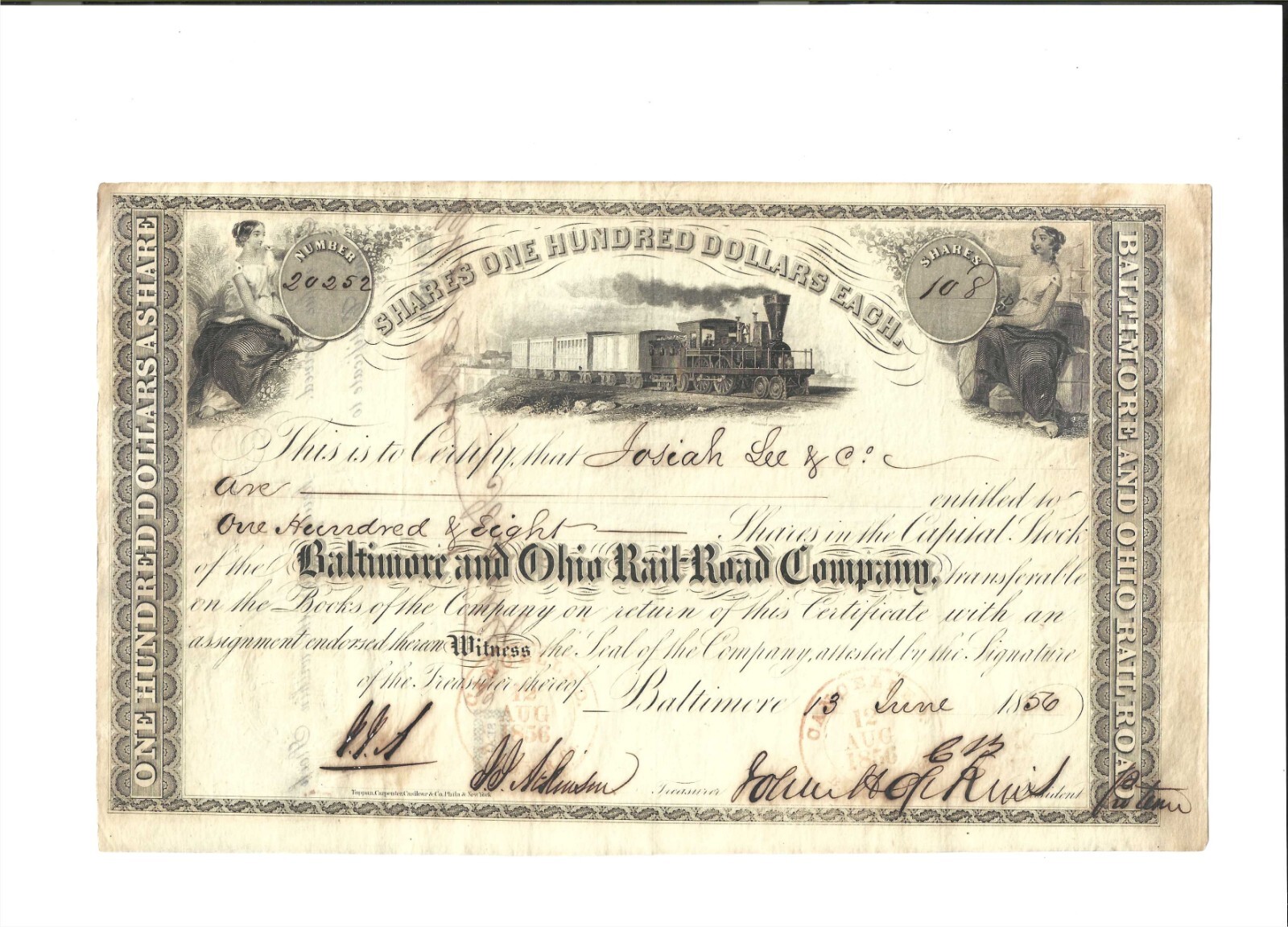
Johns Hopkins Signed / Autographed Baltimore and Ohio Railroad Co. stock certificate No. 20252 issued June 13, 1856 to Josiah Lee & Co. for 108 shares. Johns Hopkins was Chairman of the powerful Finance Committee of B&O and signed the certificate as President Pro Tem. The certificate was printed by Toppan, Carpenter, Casilear & Co. The excellent signature of Johns Hopkins is bold and legible and without holes as is common for cancellation. The signature location on the front of the document is very attractive and ideal for framing. The initials CB immediately above the Johns Hopkins signature are those of B&O President Chauncey Brooks.
Johns Hopkins, philanthropist, born in Anne Arundel County, Maryland, May 19, 1795; died in Baltimore, December 24, 1873. His parents were Quakers, and their son was trained to a farming life, but received a fair education. At seventeen years of age he went to Baltimore, became a clerk in his uncle's wholesale grocery store, and in a few years accumulated sufficient capital to establish himself in the grocery trade with a partner. Three years later, in 1822, he founded, with his two brothers, the house of Hopkins and Brothers. He rapidly added to his fortune until he had amassed large wealth.
Retiring from business as a grocer in 1847, he engaged in banking and railroad enterprises, became a Director in The Baltimore and Ohio Railroad Company, and, in 1855, chairman of its finance committee. Two years afterward, when the company was seriously embarrassed, he volunteered to endorse its notes, and risked his private fortune in its extrication.
In March, 1873, he gave property valued at $3,500,000 to found The Johns Hopkins Hospital which, by its charter, is free to all, regardless of race or color, presented the City of Baltimore with a public park, and gave $3,500,000 to found The Johns Hopkins University, which was first proposed by him in 1867, and was opened in 1876, embracing schools of law, medicine, science, and agriculture, and publishing the results of research by professors and students. At his death he left a fortune of $10,000,000, including the sums set apart for the endowment of the university and hospital, which were devised to the trustees in his will.


 ABOUT
ABOUT