When you click on links to various merchants on this site and make a purchase, this can result in this site earning a commission. Affiliate programs and affiliations include, but are not limited to, the eBay Partner Network.
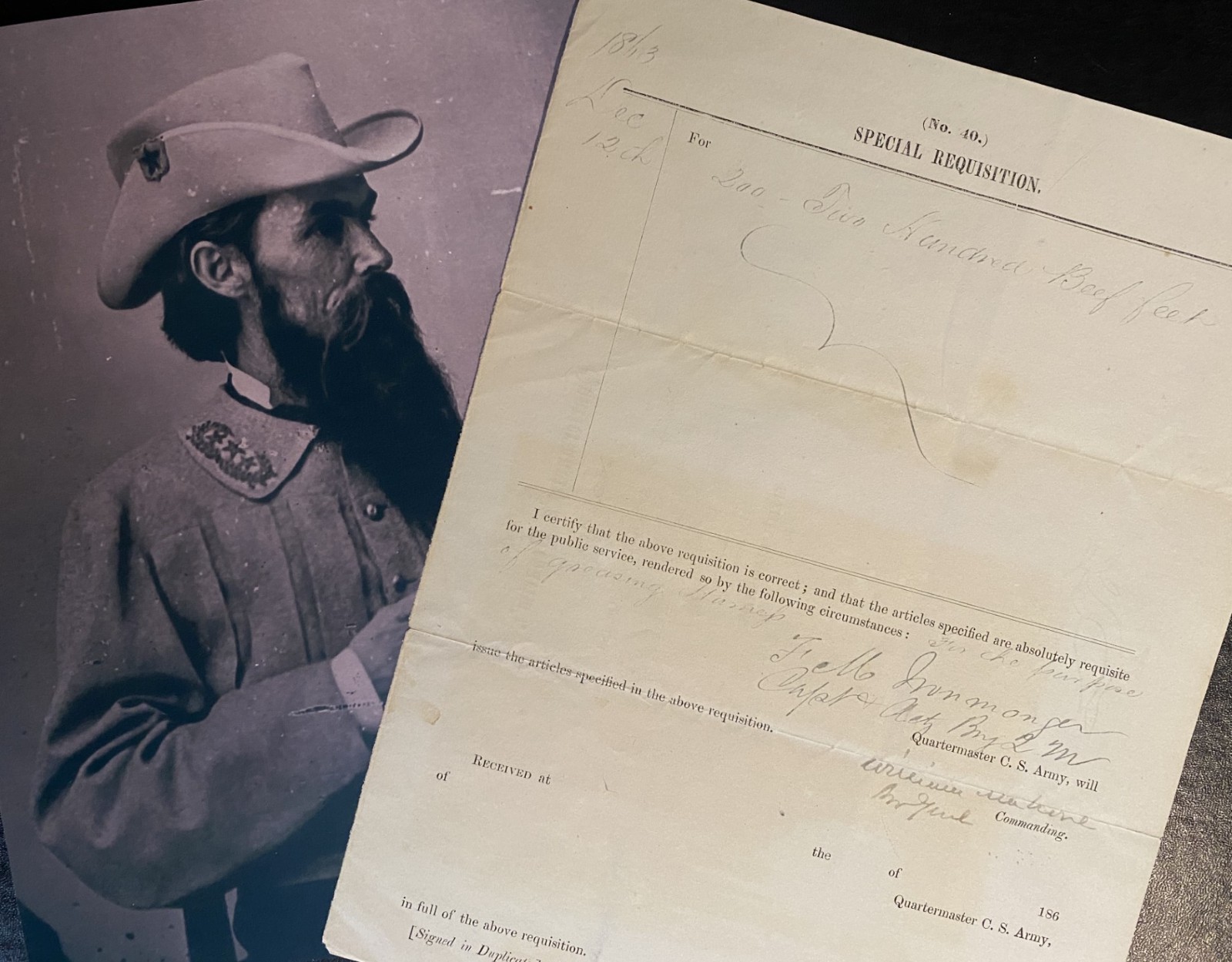
Rare 1863Confederate General William Mahone Signed Requisition
Up for auction is an extremely rare Civil Wardated requisition signed by Confederate General William Mahone, the “hero ofthe Battle of the Crater.” War dated signatures of Mahone are hard to by andactively sought. There are more than a dozen Mahone signatures listed on Ebayat present and all are post war railroad bonds. This is a war-datepartly-printed D.S., 1p. 4to., [n.p.], Dec. 12, 1863, a ‘Special Requisition'for ‘200 – Two Hundred Beef Feet… For the purpose of greasing Harnesses'.Signed at the conclusion by Captain F. M. Ironmonger, quartermaster, with Mahone countersigning hisapproval in black ink, adding his rank ‘Br Genl'. Captain (later Major) Francis M. Ironmonger was Mahone’s BrigadeQuartermaster. Interesting enough, Captain Ironmonger’s son Francis Jr. wassaid to be the youngest Confederate enlistee at the age of 10.This requisition was submitted a little over a week since Mahone's brigade took part in the Battle of Mine Run.
Document shows original mailing folds and some additional faint folds,slightly toned at the edges, otherwise in fine condition overall.
Confederate General William Mahone Biography
William "Billy" Mahone was agenuine character, and his life was as unique as his stature. Although arising star in the Army of Northern Virginia by the end of the war, hispost-war political career in the darkness of Reconstruction and Redemption isperhaps his true shining moment. “Bantam” Billy Mahone revealed hischaracter not only as a fighter on the battlefield, but as a progressive on thepolitical stage.
So much has been written about the AmericanCivil War that surely much of William Mahone’s contributions within thatviolent conflict have been covered sufficiently. Moreover, while we oftenfocus on the war itself here at Civil Discourse, Reconstructiondeservesexploration and understanding as well. The latter has always seemed especiallyimportant to me. While the Civil War enacted a many great changes andwiped the slate clean, Reconstruction determined what would then bewritten. So today I want to focus not on Billy Mahone's wartime exploits,but rather post-war political career and the struggles of ReconstructionVirginia.
Born in Southampton County, Virginia in1826, William Mahone was the son of a tavern-keeper. The tavern may haveshaped Billy significantly, for by all accounts he was a wild child.Mahone was a “sandy-haired, freckled-faced little imp” who “smoked, chewed,cussed like a pirate, gambled like a Mississippi planter.” Despite hissinful impetuousness,Mahone did manage to enter the Virginia MilitaryInstitute when he was eighteen, but he predictably struggled, especially in hisfirst year.He was described as “a youngster of precocious judgment,boundless enterprise, great ambition to win…and indomitable grit.” VMImay have educated Mahone, but it apparently did not change his free-spirited,fiery nature.
After graduating from VMI in 1847 andserving his obligatory year teaching school at Rappahannock Academy nearFredericksburg, Billy Mahone began a career as a railroad engineer.Beginning with simple survey jobs, he rose to chief engineer for the Norfolkand Petersburg Railroad by 1853. By 1858, the thirty-one-year-old Mahonewas not only the chief engineer but also the president of the railroad.Secession (which Mahone welcomed) and impending civil war called Mahone awayfrom his railroad duties. By April of 1861, Billy Mahone found himself anofficer in the Virginia infantry.
Mahone’s early war record as a brigadecommander is solid but hardly spectacular. Mahone’s men helped constructand defend Drewry’s Bluff near Richmond and got their first real taste ofaction during the Peninsula Campaign. They fought hard at SecondManassas, and there General Mahone was wounded in the chest. When hiswife was notified of his flesh wound, she commented that it must be serious,since little William had no flesh. Mahone recuperated in time to takepart in the Battle of Fredericksburg in the winter of 1862, where he helpedconstruct the defensive lines along General Longstreet’s front. Thebrigade fought at Chancellorsville and Salem Church, saw light action atGettysburg, and squared off with the Federals at bloody Bristoe Station andMine Run in late 1863.
To this point, Mahone had servedcommendably, even so far as to having been recommended for promotion. But“Bantam” Billy Mahone had yet to show his true capabilities. They becameapparent in the thickets of the Wilderness.
Mahone’s brigade took part in thesuccessful flank attack against the Army of the Potomac's left flank on May6. General Longstreet’s wounding that day (eerily similar to Jackson’swounding in the same vicinity almost exactly a year prior) led to Mahone takingcommand of a full division, which he led throughout the ensuing Battle ofSpotsylvania Courthouse and the back-and-forth clashes southward towardsPetersburg.
Just before 5 o’clock in the morning onJuly 30, 1864, approximately 8,000 pounds of gunpowder erupted in the midst ofthe Confederate trenches surrounding Petersburg, Virginia. Severalhundred men were killed instantly. Federal soldiers charged into theirterrible creation, a gaping crater that had blown a 135-ft. wide hole in theenemy line. Taking charge of the desperate situation, Mahone directed astout defense that ensured that the Federals would never get beyond theCrater. Charles Venable, aide to General Lee, recalled after the war that“every message sent that day by General Lee (who was nearby), was sent to Gen.Mahone, as commander of the troops engaged repelling the enemy at the Craterand the adjacent line.” For his efforts, he was rewarded with the rank ofmajor-general and the well-earned sobriquet “Hero of the Crater.” Mahonewould command his division through the final months of the war all the wayuntil Appomattox.
The end of the war brought Mahone back tothe railroad business. From 1865 through 1876 Mahone presided over and helpedrun the Atlantic, Mississippi and Ohio Railroad—a conglomeration of smallerlines that Mahone helped forge together in 1870. These business mergersgave Mahone his first taste of politics as he attempted to muster support forhis business plans. He worked his way around the Conservatives (moderateRepublicans and Democrats) and younger business leaders to gain the backing heneeded to from the AM&O Railroad. All of his work came to naught,however, because economic crises in the early 1870’s forced Mahone out ofbusiness by 1876. Deciding to start a new track, Billy Mahone enteredpolitics.
WilliamMahone offered himself up as a gubernatorial candidate for the Conservatives in1877. The great issue of the day for Virginia was debt (an issue thatresonates with us today). Mahone led a faction of the Conservative Partywho wanted to “readjust” the debt levels. Much of Virginia’s debt camefrom the antebellum years, when West Virginia was still part of the OldDominion. Mahone and his “Readjusters” wanted to see that portion of debtthat belonged to new West Virginia struck down. By reducing the debtVirginia owed, funds would be freed up to pursue other public projects—notablyschools. Mahone’s Readjuster faction lost the gubernatorial nomination tothose who wanted to pay all the debt in full—“Funders.” Dismayed by theirloss, Mahone and his followers split from the Conservatives in 1879 to formtheir own Readjuster Party.
From1879 to 1883, Billy Mahone’s radical Readjuster Party would dominate Virginiapolitics. It was a party forged from a surprising and eclectic coalitionof blacks, white Republicans, and moderate Democrats. This broadcoalition translated into political power. Six of the ten VirginiaCongressional districts lay in Readjuster hands. Two Readjusters weresent to the United States Senate…including, of course, Billy Mahone, who serveduntil 1887. In 1882, both the Virginia General Assembly and the gubernatorialseat lay in Readjuster hands. Truly, the Readjusters possessed a uniqueopportunity to reshape the political landscape of Virginia and perhaps theSouth.
Andtry they did. The Readjusters advocated increased political suffrage forAfrican Americans—which would, of course, only add more voters to theParty. They worked strenuously to abolish proto-Jim Crow legislation andappoint blacks to state positions. Within the state legislature, threesenators and eleven representatives were black. At a time when mostex-Confederates and conservative Democrats were scrambling to maintain theirstatus as the political and racial elite, Billy Mahone and the Readjusters wereupending the social order and empowering those who had been enslaved just yearsbefore.
Sucha change drew criticism. Mahone was viewed by many as a selfish traitor,betraying the Southern cause and way of life for his own personal gain.As one political opponent decried, Billy cared “not a fig for either aRepublican or a Democrat farther than he can use him for his own benefit.If a man beMahoneite, he needs no other recommendation orqualification.” It was certainly true that Mahone and others ran theParty as a strict, well-oiled political machine. Reporters noted that,“Southern Senators speak as bitterly of General Mahone and his followers asthey did of carpetbaggers, scalawags, and niggers.” Mahone forged asuccessful political alliance, yes, but lost the faith and respect of manySoutherners in doing so.
Althoughthe Readjusters were gone, Mahone stayed active in politics as aRepublican—joining the weathered ranks of other famed Confederates who strayedto the party of Lincoln following the war, men like John Mosby and JamesLongstreet. Never again, however, did Billy Mahone enjoy the politicalpower and success felt during the Readjuster movement.
Thefailure of Mahone’s Readjuster Party in Virginia in many ways represents alarger lost opportunity in the postwar American South. With the fall ofthe Confederacy, Reconstruction offered a brief time when genuine improvementsin race relations could be made. Jim Crow legislation, segregation…thesethings had yet to be firmly entrenched. In short, the war had wiped theslate clean, and there existed a rare opportunity to bring about biracialcooperation and political involvement in the South. Virginia’s Readjustermovement, headed by ex-Confederate general Billy Mahone, represented such anopportunity.
This is a great opportunity to own a CivilWar dated document signed by the legendary General “Billy” Mahone, which wouldmake a nice addition to any Confederate and Civil collection.
Seephotos for condition.
Thanksfor looking and good luck bidding.


 ABOUT
ABOUT