When you click on links to various merchants on this site and make a purchase, this can result in this site earning a commission. Affiliate programs and affiliations include, but are not limited to, the eBay Partner Network.
When Did a Row of Neon Horses Last Stop You in Your Tracks?🎠
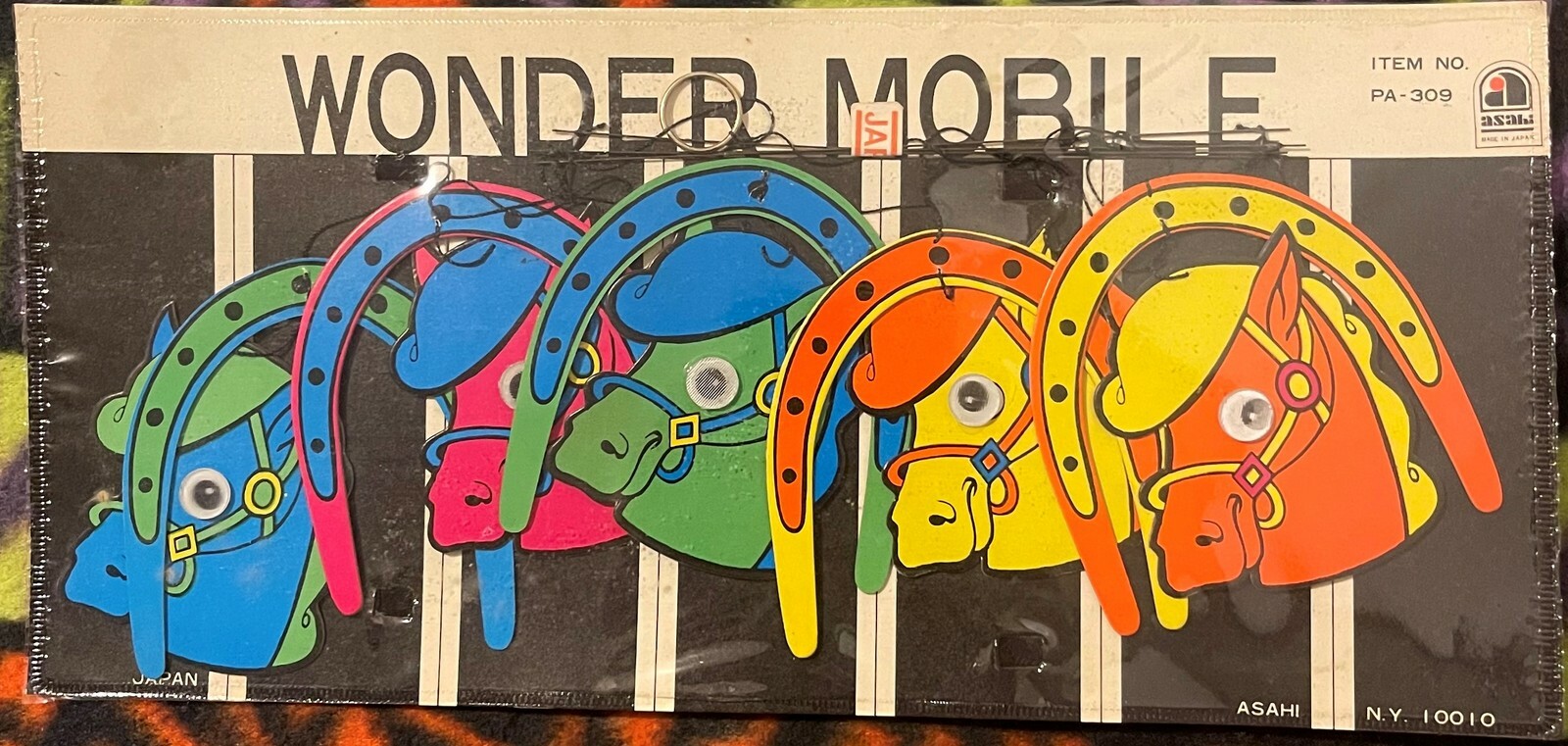
There's a particular kind of magic that lives inside an unopened package from another era. You can see it, you can study every vivid line of it, but it has never once been touched by the world it was made for — and that tension, that perfect suspension between intention and use, is exactly what a great piece of New Old Stock delivers.This Wonder Mobile by Asahi is that kind of piece. Five bold, stylized horse heads — each one framed inside a painted horseshoe, each one staring out at you through a wide, rolling googly eye — hang together in their original blister card exactly as they left the factory, sealed and waiting, in colors so saturated and electric they feel less like ink and more like bottled carnival light.
This is not a reproduction.It is not a later reissue. It is the real thing: a mid-century Japanese-made hanging kinetic mobile, produced under the Wonder Mobile brand name for the American novelty and gift market, marked Item No. PA-309, bearing the Asahi name and a Manhattan, New York distributor address — ZIP code 10010, the old Flatiron and Gramercy corridor that was, in the postwar decades, one of the great crossroads of the American toy and novelty import trade.It has never been assembled. Never been hung. The string, the hooks, the five ornaments — all of it rests inside the original packaging, a color lithograph header card that is itself a small, graphic masterpiece of mid-century commercial printing.
🐴 What It Is — The Object, the Maker, the Moment
At its heart, the Wonder Mobile PA-309 is a hanging kinetic mobile: a set of five flat, die-cut ornaments designed to be suspended from a central ring and allowed to drift and turn gently in the air.Each ornament depicts a cartoon horse head rendered in a bold, graphic style — thick black outlines, flat fills of electric color — with an arched horseshoe rising above it as both visual frame and lucky charm. The five horses cycle through a palette of neon pink, blue, green, yellow, and orange, each one a slightly different color combination of horse-body and horseshoe, so that the assembled mobile reads as a spinning wheel of pure mid-century chromatic energy.The detail that makes every collector stop and look twice: the movable googly eyes, each one a little dome of clear plastic over a floating black pupil, so that the horses seem to watch you no matter where you stand.
The material is printed paperboard — color lithography on card stock, the standard medium for Japanese novelty exports of this era — and the header card that holds everything together is itself a small work of graphic art: black background, bold block lettering spelling out WONDER MOBILE across the top, with the row of horses visible through the blister below.The card reads ITEM NO. PA-309 / asahi / MADE IN JAPAN / JAPAN / ASAHI / N.Y. 10010 — a compact record of the mid-century supply chain that brought thousands of bright, imaginative objects from Japanese factories to American five-and-dimes, gift shops, and department stores.
The maker's name — Asahi (朝日), meaning "morning sun" or "morning light" — was one of the great names of postwar Japanese manufacturing, used by several distinct companies across different industries.The Asahi connected to the toy and novelty trade was part of a generation of Japanese firms that, in the years following World War II, rebuilt their export economy in part by designing original, playful, visually arresting objects specifically for the American taste: bold shapes, bright colors, kinetic elements, a certain cheerful exuberance that the American market recognized and loved.This mobile is a textbook example of that creative and commercial tradition at its most charming.
The piece is New Old Stock (NOS) — meaning it was produced, packaged, and then never sold through, never opened, never assembled. It has sat, sealed, through all the decades between its manufacture and this moment.What you are looking at is the object as it was intended to be seen before it was ever used: complete, intact, and still carrying the full graphic impact of its original presentation.
🏭 The Industry Behind the Object — Japan, New York, and the Postwar Novelty Trade
To understand what this mobile is and why it matters, you have to understand the world that produced it.In the years after World War II, Japan's manufacturing sector — devastated by the conflict and then reorganized under Allied occupation — rebuilt itself with remarkable speed and ingenuity, and one of its most significant channels to the American consumer was the novelty and toy trade. During the Occupation period (roughly 1945–1952), goods exported from Japan were required to carry the mark "Made in Occupied Japan." After the Occupation ended in 1952, that designation disappeared and items were simply marked "Made in Japan" — exactly as this mobile is marked — which gives us a firm post-1952 floor for dating the piece.
Through the 1950s and into the 1960s, Japanese manufacturers produced an extraordinary range of novelty items — mobiles, paper toys, tin toys, holiday decorations, party favors — designed to appeal to American tastes and sold through importers concentrated in Manhattan's toy and gift district.The ZIP code 10010, present on this card's distributor line, places the New York connection in the Flatiron and Gramercy neighborhood, which was historically home to showrooms, wholesale houses, and import offices that served as the American gateway for exactly this kind of product. The ZIP code system itself was introduced in the United States in 1963, which tells us that this particular card printing dates to 1963 or later — situating the piece firmly in that golden mid-decade window when the postwar novelty trade was at full creative flood, when American homes were hungry for color and whimsy, and when the horse-and-horseshoe motif — at once lucky, playful, and unmistakably American in its associations — was a natural choice for a product designed to hang in a child's room or brighten a game room wall.
The seller's own research and long experience in this category adds a layer of history that the printed record doesn't always capture: the Wonder Mobile line, of which this horse mobile is a part, represents the earlier, more playful chapter of a company that would later pivot into the countercultural current of the 1960s — producing peace-movement mobiles for the American market as the decade shifted.The horse mobiles, in this telling, are the sunlit, carnival-colored prelude to that later chapter: same bold graphic language, same kinetic format, same understanding of what makes an object stop a person in their tracks, but aimed squarely at the joy and color-hunger of an earlier, more innocent moment.🌈
Lore passed down among collectors of mid-century Japanese novelties holds that the Wonder Mobile name was chosen specifically for the American market — a name that would feel at home on any dime-store rack from coast to coast, evoking the sense of delight and surprise that a spinning, eye-catching mobile was meant to deliver.Whether the name was coined by the Japanese manufacturer or by the New York importer is a question the surviving record doesn't answer definitively, but either way, it reflects the deep collaboration between the two sides of the Pacific that defined this era of novelty design.🎪
Local legend in the collector community has it that pieces like this one — sealed, complete, never assembled — survived in quantity only because they sat in old stock rooms and warehouse shelves long enough to be overlooked, then rediscovered decades later when the appetite for exactly this kind of mid-century graphic object had grown into something serious.The irony that charm the true collector: the pieces that weren't popular enough to sell out are now the ones that survive intact, and their very unsold-ness is what makes them treasures.🏆
🖼️ Display Ideas
- 🎠 Assemble and hang it as it was always meant to be used — suspend the central ring from a ceiling hook in a child's room, a nursery, or a reading nook and let the five horses drift and turn in every passing current of air, their googly eyes tracking the room.
- 🖼️ Frame the sealed card as ready-made wall art — the header card with its black background, bold lettering, and row of neon horses behind the blister is already a complete graphic composition; float it in a deep shadow box and hang it as mid-century pop art that needs no alteration.
- 🎱 Style it into a game room or rec room vignette — the electric palette and carnival horse motif are natural companions to vintage arcade graphics, neon bar signs, and the broader aesthetic of mid-century American leisure spaces.
- 🌈 Display it under blacklight — the seller confirms that these neon-bright lithographed colors respond beautifully to blacklight, which transforms the sealed card into something that feels almost supernatural: the horses glow, the horseshoes pulse, and the whole composition looks like it belongs in a psychedelic carnival tent.
- 🎶 Hang it above a record player or vintage stereo — the kinetic mobile format and the mid-century graphic style make it a natural companion to a turntable setup, swaying gently to the music and adding movement and color to the listening corner.
- 🏇 Anchor a horse-themed or Americana collector's display — grouped with other equestrian antiques, racing memorabilia, or mid-century novelty items, this mobile brings color, whimsy, and a distinct graphic voice to any curated shelf or wall arrangement.
🎁 Who Collects These
The Wonder Mobile PA-309 sits at a crossroads of several distinct and passionate collector communities, which is part of what makes it such an interesting find. Mid-century design collectors prize it for its graphic clarity — the bold outlines, flat color fills, and kinetic format are all hallmarks of a moment in commercial design that is now studied and celebrated as a high point of popular visual culture. Japanese novelty and toy collectors value it as a documented example of the postwar export trade at its most creative and colorful, a physical artifact of the cross-Pacific design collaboration that shaped American material culture through the 1950s and 1960s. Horse and equestrian collectors are drawn to the motif itself — the stylized horses and lucky horseshoes make this a natural addition to any horse-themed collection, and the NOS condition means it arrives as a genuine vintage find rather than a later reproduction. Blacklight and psychedelic art collectors seek out exactly this kind of neon-lithographed mid-century object, knowing that the inks of this era respond to UV light in ways that modern printing simply doesn't replicate.And then there is the broad community of New Old Stock enthusiasts — collectors who are specifically drawn to the particular magic of an object that has never been used, never been opened, and carries its original packaging as part of its meaning. For that collector, this mobile is exactly what they're looking for: a complete, sealed, never-assembled artifact from a specific and well-defined moment in American commercial and decorative history.🎯
❓ Frequently Asked QuestionsHow many horse ornaments are included, and are they all different?
There are five horse-head ornaments inside the original packaging, and yes — each one is visually distinct.While they all share the same die-cut silhouette (a cartoon horse head with an arched horseshoe frame above), the color combinations vary across the set. Reading across the card, you move through a full spectrum: green-and-blue, pink-and-blue, blue-and-green, orange-and-yellow, and yellow-and-orange. Each horse also has its own bridle color and detail, so the assembled mobile reads as a coordinated but varied set rather than five identical copies.The movable googly eye on each ornament adds an additional element of individual personality.👀
What does "New Old Stock" mean for this piece?
New Old Stock — NOS — means this mobile was manufactured, packaged, and then never sold through the retail channel it was intended for. It has never been opened, never been assembled, and never been hung.Everything that was placed inside the blister card at the factory is still there: all five ornaments, all the string and hardware needed to assemble the mobile, all of it in its original configuration. The sealed blister and printed header card are intact as a unit. What you are looking at is the object as it existed the day it was completed — not as something that has been used and then preserved, but as something that was simply never used at all.🏷️
Will the colors glow under blacklight?
The seller confirms that the neon-bright colors of this mobile respond beautifully to blacklight (UV) illumination. The lithographic inks used in mid-century Japanese novelty production — particularly the hot pinks, electric blues, and acid greens of this palette — often contain compounds that fluoresce under UV light in ways that modern commercial printing does not replicate.The effect is striking: under blacklight, the horses seem to emerge from the black background of the card with an intensity that daylight viewing only hints at. This is one of the qualities that makes pieces like this genuinely special to collectors of blacklight and psychedelic-era decorative objects.🌟
What is the approximate size of the card and assembled mobile?
The seller notes that the header card measures approximately 12 inches wide by 5½ inches tall — a compact, horizontal format that showcases all five horses in a row.When assembled and hung, the mobile would extend vertically as the ornaments drop below the central suspension ring on their individual strings, creating a kinetic cascade of color. The exact hang length would depend on how the assembler chooses to configure the strings, but the card dimensions give a good sense of the overall scale of the piece.📏
Is the "Asahi" on this card the same company as the famous Asahi toy maker?
This is a question worth taking seriously, and honesty is the right approach here. "Asahi" (朝日) is a common Japanese name — it means "morning sun" — and several entirely distinct companies used it in the postwar period, including the well-documented Asahi Toy Co.(ATC), known primarily for tin-plate friction and battery-operated vehicles, and the separate Asahi Trading Co., as well as other unrelated firms. This paper-and-card mobile is a different product category from the tin vehicles for which Asahi Toy Co. is most celebrated. What the label confirms is that the brand name "Asahi" was associated with this product and its New York distributor.The seller's research and long experience in this category connects this Wonder Mobile line to the broader Asahi novelty export tradition — and the piece stands entirely on its own merits as a documented, marked, original mid-century Japanese novelty export regardless of which specific Asahi entity sits behind it.🔍
When exactly was this made?
The dating evidence points clearly to the mid-twentieth century. The "Made in Japan" mark (rather than "Made in Occupied Japan") establishes a post-1952 floor — the Occupied Japan marking period ran roughly 1945 to 1952, and once it ended, goods simply read "Japan." The presence of ZIP code 10010 on the distributor line is significant: the U.S.ZIP code system was introduced in 1963, so any card printed with a ZIP code dates to 1963 or later. Taken together, the evidence places this piece comfortably in the mid-1960s era of the postwar Japanese novelty export boom — a moment of peak creativity and color in this particular category of American popular material culture.The seller's own research and knowledge of this line situates it in the 1950s design tradition, and the graphic style is fully consistent with that lineage even if the specific card printing carries the later ZIP code. ⏳
Can I actually use it as a mobile, or is it better preserved sealed?
That decision belongs entirely to you, and it is one of the genuinely interesting questions that every piece of New Old Stock poses.The mobile was designed to be assembled and hung — that is its purpose, and there is real pleasure in finally giving a seventy-year-old object the use it was always intended for. At the same time, the sealed card is itself a complete artifact: the header card's graphic design, the blister, the row of horses visible through the packaging — all of it together constitutes the object as its makers intended it to be seen at the point of sale, and that presentation has its own integrity and value.Many collectors choose to preserve NOS pieces sealed and display the card itself as wall art, while others feel that the right honoring of an object is to finally let it do what it was made to do. Both approaches are legitimate, and this piece is beautiful either way.🎠


 ABOUT
ABOUT