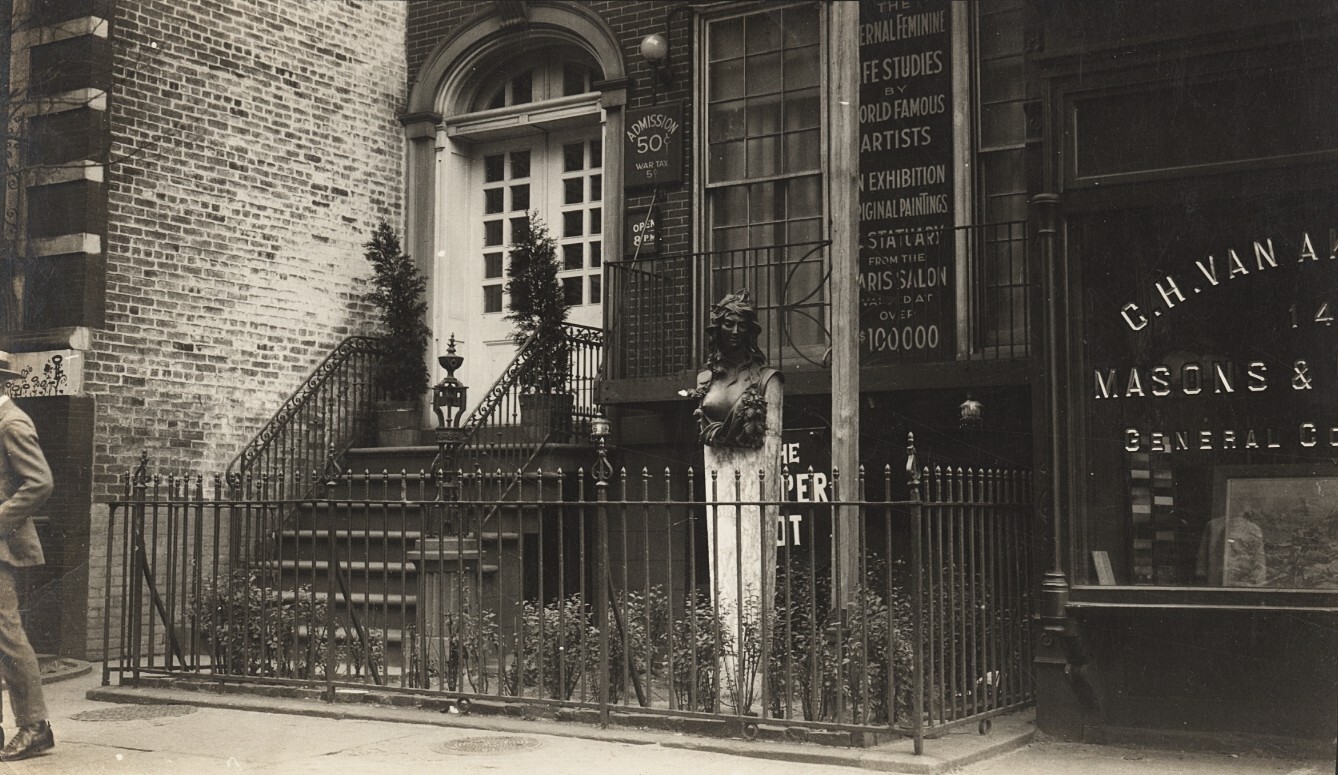
c. 1910's The Pepper Pot Inn Greenwich Village, NYC Photo JESSIE TARBOX BEALS(?) For Sale

When you click on links to various merchants on this site and make a purchase, this can result in this site earning a commission. Affiliate programs and affiliations include, but are not limited to, the eBay Partner Network.

c. 1910's The Pepper Pot Inn Greenwich Village, NYC Photo JESSIE TARBOX BEALS(?):
$800.00
DATE: c. 1910'sPHOTOGRAPHER: Possibly by Jessie Tarbox Beals (see bio below) [Beals photographed the Bohemian scene in Greenwich Village, New York City and, though not attributed, this photo may have been taken by her since she was one of the main photographers of the Bohemian scene during this period. No claim is made that the photograph was actually taken by Beals, I just find it likely that she took the photo].SUBJECT: The Pepper Pot Inn (see bio below)PROCESS: Silver GelatinSIZE:5.75" x 3.5"CONDITION: See photosSHIPPING: Shipping cost is non-negotiable, please consider it when bidding/buying.COMBINED SHIPPING: Yes, I do combine shipping. Additional shipping per item is 20% of the lower shipping cost [For example, if 2 items are purchased that have a $30 and $10 shipping cost each, the combined shipping cost becomes $32 for the 2 items]. If bidding/buying more than 1 item, please wait for an invoice with combined shipping before Tarbox Beals (December 23, 1870 – May 30, 1942) was an American photographer, the first published female photojournalist in the United States and the first female night photographer.She is best known for her freelance news photographs, particularly of the 1904 St. Louis World's Fair, and portraits of places such as Bohemian Greenwich Village.Her trademarks were her self-described "ability to hustle" and her tenacity in overcoming gender barriers in her profession.Early life and educationBeals was born Jessie Richmond Tarbox on December 23, 1870, in Hamilton, Ontario, the youngest child of John Nathaniel Tarbox and Marie Antoinette Bassett. John Tarbox was a sewing machine manufacturer, and his partnership with the largest sewing machine company in Canada made the Tarbox family wealthy. When Beals was seven, however, her father lost all of his savings in a bad investment and began drinking heavily. He eventually left home at the insistence of Beals's mother, who then embroidered and sold some of the family's belongings to keep the family income going.Beals was a "bright and precocious child" and did well in school. At age fourteen she was admitted to the Collegiate Institute of Ontario, and at seventeen received her teaching certificate. Beals began teaching at a one-room schoolhouse in Williamsburg, Massachusetts, where her brother Paul was also living at the time. In 1888, Beals won a subscription prize camera through the Youth's Companion magazine. The camera was small and somewhat rudimentary, but Beals began to use it to take photographs of her students and their surroundings. Beals soon bought a higher quality Kodak camera and set up Williamsburg's first photography studio in front of her house, although photography largely remained her side hobby.Photography careerIn 1893 Beals took a new teaching position in Greenfield, Massachusetts and visited the World's Columbian Exposition in Chicago. At the Exposition, Beals' interest in traveling and photography was sparked having met Frances Benjamin Johnston and Gertrude Käsebier.In 1897, Beals married Alfred Tennyson Beals, an Amherst graduate and factory machinist.In 1899, Beals received her first professional assignment when she was asked by The Boston Post to photograph the Massachusetts state prison. Beals taught Alfred the basics of photography and the couple set out to work as itinerant photographers in 1900, with Alfred as Beals's darkroom assistant. That year, Beals also received her first credit line for her photographs in a publication, the Windham County Reformer.By 1901, the Beals' funds were depleted and they resettled in Buffalo, New York. Later that year, Beals was hired as a staff photographer by the Buffalo Inquirer and The Buffalo Courier, after impressing the editor with a photograph of ducks waddling in a row entitled "On to Albany." This position made her the first female photojournalist and was well-regarded by the papers and citizens of Buffalo and worked at the publications until 1904 when she left to take photos of the World's Fair.Photojournalism was physically demanding, often risky work, but Beals could be seen carrying out assignments in her ankle-length dresses and large hats, with her 8-by-10-inch glass plate camera and 50 pounds of equipment in tow. During one assignment for the lurid murder trial of Edwin L. Burdick in Buffalo, Beals broke a rule that forbade photographs of the trial by climbing a tall bookcase to a window to snap a picture of the courtroom before she was detected.In 1904, Beals was sent to the opening of the Louisiana Purchase Exposition in St. Louis, Missouri. There, Beals persuaded officials to give her a late press permit for the pre-exposition, climbed ladders and jumped into a hot air balloon just to get photographs that interested her. She was greatly interested in the Indigenous peoples which resulted in capturing many spontaneous images that did not necessarily fit into the predominant narrative of racial and developmental progress. She had a different style than most news photographers of the day, focusing on series of pictures that would later be used to write stories, rather than vice versa. Beals's display of her signature "hustle" earned her the position of official Fair photographer for the New York Herald, Leslie's Weekly and the Tribune, as well as the Fair's publicity department, producing over 3,500 photographs and 45,000 prints of the event.In addition to photographing the various exhibits at the Fair, Beals also captured a candid photograph of President Theodore Roosevelt. This initial encounter earned her a special pass to photograph Roosevelt and the Rough Riders at their reunion in San Antonio, Texas in 1905.A studio on Sixth AvenueIn 1905 Beals opened her own studio on Sixth Avenue in New York City. Beals continued to take on a variety of photograph assignments, ranging from shots of auto races and portraits of society figures, to her well-known photographs of Bohemian Greenwich Village and the New York slums. Over the years Beals also photographed several presidents and celebrities, including presidents Coolidge, Hoover and Taft; Mark Twain; Edna St. Vincent Millay; and Emily Post.While Beals' career flourished, her marriage became troubled. In 1911, Beals gave birth to a daughter, Nanette Tarbox Beals, most likely from another relationship. Beals finally left her husband in 1917.A studio and a gallery in Greenwich VillageShe moved to Greenwich Village and opened a new photography studio and gallery in 1920. For a few years, Beals juggled working and caring for Nanette, who also suffered from rheumatoid arthritis and was frequently hospitalized, eventually deciding to send Nanette to camps and private boarding schools throughout the year. Nanette would later go on to live semi-permanently with one of Beals' old friends.Later yearsAs the number of female photographers increased during the 1920s, Beals shifted her focus to giving public talks and specializing in photographing suburban gardens and estates of wealthy East Coasters. By 1928, she and Nanette moved to California, where Beals photographed Hollywood estates. The Great Depression brought Beals and Nanette back to New York in 1933, where Beals lived and worked in Greenwich Village.Despite being born in Canada, Beals declined to return later in life. Following the establishment of her Greenwich Village studio, Beals participated in just one Canadian exhibition, at the Toronto Camera Club International Photo Exhibition, 1921.Beals gradually fell into poverty, and died on May 30, 1942, at Bellevue Hospital, at the age of seventy-one. Thanks to the rescue efforts of Alexander Alland, a contemporaneous photographer, her photographs and prints are in collections at the Library of Congress, Harvard University, the New-York Historical Society, and the American Museum of Natural History. In 1982, the Schlesinger Library at Radcliffe received Beals' papers and pictures from her daughter, Nanette Beals elegant brick-faced, Federal style homes that lined Washington Square by the mid-1830s spilled onto the side streets. One such house rose at 146 West 4th Street, just half a block off the Square towards Sixth Avenue. Three-and-a-half-stories high over a deep English basement, it featured a refined, arched entrance with a delicate fanlight. The red brick was accented with white stone, similar to its high-toned neighbors on the park. In 1871, owner J. J. Lyons added a full fourth floor and a gently sloped roof which his building permit deemed “a mansard roof.”By 1915, the streets once busy with the landaus and coupes of the wealthy saw the first horseless carriages. The wealthiest residents had moved further north and Greenwich Village was now New York’s Bohemia—drawing poets, artists and musicians to its quaint and rambling streets. It was a time of enormous change and the nation was fascinated with a new mode of entertainment--the motion picture.New York was the epicenter of the silent movie industry and one couple, Dr. Carlyle Sherlock and Viola, tried their hand at acting. In 1915, Carlyle played the part of Paul Greer in The Stain of Dishonor. The 23-year old Viola acted in a handful of productions. But before long, they would abandon the silent screen for another endeavor.In 1918, Carlyle Sherlock purchased 146 West 4th Street and renovated it as a restaurant-nightclub, The Pepper Pot Inn. A later promotion would say it was “established by Carlyle Sherlock for his wife, Viola, when they retired from the Motion Picture Screen, as a meeting place for their friends of the motion picture, theatrical, bridge and chess world.” (More than acting, chess was a passion of “Doc” Sherlock.)The former English basement, a few steps below street level, became a restaurant where “Vi” served her homemade cakes, pies and puddings. A postcard would boast, “The chickens and eggs come from ‘Air Castle Acres,’ Viola Sherlock’s 300 acre Orange County estate. The special blend of coffee is percolated and then filtered through Japanese rice paper; the Chili Con Carne is done in real Mexican style; the Virginia Ham, and other Southern Dishes specially prepared by our old Southern chef.”The parlor and second floors of the old house became dance floors. And while the Sherlocks rented rooms in the house directly across the street at 145 West 4th Street, Carlyle reserved the top floor for Viola’s private studio, “the largest in the village.” Flooded with sunlight from the expansive studio windows, the space was decorated in true Edwardian style with wicker furniture, Chinese lanterns and palms.On the third floor was the Bridge Room. The space was rented for private banquets and meetings and soon became home to Frank Marshall’s chess club. Marshall had held the title of United States chess champion since 1909 and the club attracted professional and amateur chess players nationwide. On September 24, 1920, for instance, The Evening World announced, “The chess champion of the United States, Frank J. Marshall, will begin tonight a series of exhibitions of simultaneous play, playing a score or more of experts at once, at the Pepper Pot, the Greenwich Village chess divan conducted by Dr. Sherlock…Mr. Marshall and Dr. Sherlock will also play a match at ‘Kriegslpiel,’ a chess game in which each player moves without knowing the moves of his opponent.” The exhibitions were given every Friday evening and “will be witnessed and participated in by many of the strongest players in the Greater City.”The Pepper Pot was a sensation. Entertainers like Al Jolson stopped in and neighborhood artists called it home. Waitresses, or “hostesses,” were often music or art students from nearby New York University. But it was the bohemian atmosphere as much as the good food that drew the crowds. “The uniqueness and originality, the environment and bonhomie, all serve to make you remember the Pepper Pot when you are away from it and you long to return,” said an ad. “It gets into your heart, too, and you will never be able to lose the magic of it all the days of your life.” Theatre Magazine called it “the realest thing in Bohemian atmosphere” in the country.On the tables of the restaurant were candles—actually globs of wax created by innumerable melted candles—inspired by The Pepper Pot Club in London. The first candles were lit in a glass tumbler. When the initial candle was melted down, another was added, and then another. Before long a tall, volcano-looking mountain of wax resulted, some up to four feet tall. Visiting artists would often sit before the wax at their tables and carve sculptures out of the waxen mound—temporary works of art that would soon be covered in dripping wax.A writer from Theatre Magazine in 1922 described her visit. “We found ‘The Pepper Pot’ jammed . . . that is the main room, several steep steps down from the street level. And it had all the earmarks of your true Bohemia…low ceilings…candle-light . . . a pleasingly irregular shape fitted with nooks and corners and wooden seats along the walls.” The writer, Angelina, noted a large table in the center of the room. “This table was filled with young artists and newspaper men, we were told, and every few minutes someone jumped up from it and went to the piano and played . . . popular stuff, but with a nice feeling for the soft pedal and a full extraction of the rhythm.”Angelina then noticed Metropolitan Opera star Sophie Braslau in one corner, and Chicago Opera tenor Signor Ciccolini at another table. Soprano Marguerita Sylva was there with her aviator husband, Major Smith. The diva said to Angelina “Isn’t this the most interesting place!”The 1920s would bring two major forces to New York and The Pepper Pot: Prohibition and Jazz.Like many of the nightclubs of Manhattan, The Pepper Pot managed to continue business almost-as-usual despite Prohibition. Patrons still managed to have wine or drinks with dinner—and only occasionally did the Sherlocks have to answer for it.But there was that problem of jazz.In the days before air conditioning, open windows let in the night breezes but also let out the blaring music. Inside The Pepper Pot, flappers in fringed dresses danced the Charleston and the Black Bottom with college boys. The Roaring Twenties had arrived and the neighbors were not pleased.On February 11, 1921, two women from across the street--Mrs. Hoolis B. Page of No. 143 West 4th Street and the Sherlocks's landlady, Mrs. Alberting de Creveling of No. 145—filed a complaint with Magistrate Corrigan in the Jefferson Market Court.Mrs. De Cleveling complained, “We can get no sleep. Something has got to be done with these coal mines, these diamond mines, these gold mines and—that Pepper Pot at No. 144 W. 4th Street, directly opposite our homes."When she insinuated that the restaurant sold liquor the magistrate asked, “Do you mean intoxicating?”She replied, “Why, our young girls and boys are picked up unconscious from the stuff they receive at these places.”After calling the patrons “slum seekers,” she turned her attention to the noise. “That jazz music—oh, my! Those funny ditties that they play on the phonograph. I need sleep.”When Carlyle Sherlock arrived in court before the magistrate on February 17, he was armed and ready.“Mrs. Creveling says realty values have depreciated in Greenwich Village because of the foreign element,” he said. “I rent my apartment from her. A year ago I paid $25 a month, and now my rent has been jacket up to $125 a month. Realty may have depreciated, but rents in the Village have not.”The Evening World reported, “the proprietor had on hand a number of witnesses and other evidence to show the place is so quiet chess players make it a headquarters.” The charge of “conducting a noisy place and public nuisance” was dismissed.Jazz continued on West 4th Street, even finding its way to the third floor chess club. On March 14, 1922, The Evening World reported that players, “even get up in the midst of a game, it is alleged, and change a gambit into a gambol, gaily seizing their partners about the waist and tripping all around the place under the inspiration of a jazz band.” The newspaper described the Pepper Pot saying, “It is extremely Greenwich Village—with an automatic piano in the candle-lit basement and a group of furious jazzers two floors above.”A year later Viola, now 28 years old, would be arrested along with two customers by Patrolman Joseph Reilly. Harry Maunbach was a 33-year-old artist from Chicago who was having dinner with a Brooklyn blue print maker, 25-year-old Walker Wacke. “The patrolman testified in Essex Market Court yesterday that he found some liquor at a table occupied by Maunbach and Wacke in the restaurant,” reported The New York Times on January 15, 1923. The trio was held on $500 bail each.Nineteen-year-old Adelaide Miller was in charge of the check room on the evening of December 19, 1925 when 70 sophomores from the City College were holding a smoker in the Bridge Room. What started out as a normal night turned into anything but that when 200 freshmen rushed in and started a riot.“Four or five hundred additional guests were directly or indirectly drawn into the turmoil, and pottery, silverware and chair legs, according to the police, were used by the combatants,” said The New York Times.In the melee, Adelaide was knocked down and received cuts and bruises. Several of the gang broke into Viola's upstairs studio, “breaking several rare Egyptian vases and leaving the place in confusion,” the newspaper reported. Despite reserves of the Mercer Street police station being called in, no arrests were made.At the same time that Adelaide Miller was checking coats, 28-year-old Gerold Schrage worked a few nights a week singing and playing piano. The classically-trained pianist came from Aberdeen, Washington and tried in vain to launch a concert tour. The New York Times noted, “Schrage’s tenor voice was much admired in the Village, where he sang at numerous parties of friends. It was said, however, that his subjects—invariably classical—frequently were ‘over the heads’ of his listeners, and that his efforts to entertain consequently often ‘fell-flat.’ Jazz was not in his repertoire.The young entertainer lived in a second floor room at 289 West 12th Street nearby. Things were going alright until his mother sent word that she was coming for a visit in June 1926. Schrage panicked, realizing that his mother would find out that he was not working as a classical pianist, but as a nightclub entertainer.“I cannot bear the thought of her learning that I am a cabaret singer,” he told friends.A week before his mother’s scheduled arrival, Schrage left the Pepper Pot and returned to his room. He ripped his bed sheets, stuffing the fabric into the crevices of the doors. Newspaper and strips of cloth were pushed into the keyholes and cracks along the windows. He then turned on the gas jets.By the time his landlady, Veronica Flanagan, smelled the odor of gas and the door was broken down, the young man was dead.Greenwich Village was still the center of art in the 1930s and Washington Square became an impromptu outdoor gallery in 1932. But winter weather threatened to end the struggling artists’ exhibitions. “Doc” Sherlock came to their rescue by offering two floors of The Pepper Pot as an indoor, year-round gallery. By December 9, fifty of what The New York Times called “needy artists” had taken advantage of the offer. About 300 oil paintings, water colors and etchings were hung here to be admired—and bought—by patrons.Exactly a year later, on December 5, 1933, Prohibition was repealed. Finally, New Year’s Eve could be rung in with a toast. On January 1, 1934, The Times said, “The lid was off last night in the city’s hundreds of hotels, restaurants and night clubs. Not since the beginning of the dry era fourteen years ago was there so great a New Year’s crowd as that which turned out to greet 1934.” The newspaper reported on the cost of celebrating in the Village. “At the Pepper Pot, liquor-licensed, the charge was $10 a couple, with a bottle of wine and dinner.”By 1938, the Carlyles had retired to their country home and Harry Schecter took over the Pepper Pot. The New York Times described the club “which boasts it is the Village’s oldest night spot and certainly has been in business a lot of years.” The newspaper said it had, ...a certain feeling as of the old speakeasy days, dim lights, intimate surroundings, a small dance floor, no regular show but an m.c. (Boyd Heathen) who sings. Also, Works of Art on the walls, a fortuneteller and, over in one corner, the patriarchal John Henry Titus, author of one version of ‘The Face on the Bar Room Floor;’ if not Mr. Titus, then another neighborhood celebrity, of whom there have been many in the proud Pepper Pot past. It is that kind of place, and it gets livelier as the evening goes on. The club now had “the famed Voodoo Room, which is a sort of Greenwich Village version of Small’s Paradise in Harlem.” Here were singing waiters, a tap dancer named Little Baby Bangs, “songstresses who dispense the torch, sophisticated and rowdy-dow,” and the hostess, Dotty Keane, whom The Times deemed, “attractive and courteous.”The Pepper Pot, once the most popular eating place in the Village and a nation-wide destination, would not last forever. In 1965 there was still a bar and restaurant in the basement and first floor, but the upper floors had been renovated into apartments. The 1830s Federal-style entrance had been obliterated for a modern, nondescript doorway.Where jazz music once played, an illicit after-hours club called The New Showcase was run by the Mafia family of Carlo Gambino. It was shut down by Federal and NYPD officers on July 18, 1971 in a predawn raid.Today all traces of Viola and Carlyle’s jazz-age nightclub are gone. The upper floors have been renovated into luxury co-ops and the Pepper Pot’s dining room below sidewalk level is now the Campus Laundry & Cleaners. One floor above, where young girls with bobbed hair and rolled-down hose danced to the annoyance of neighbors, the Beauty Jewel Spa offers laser skin care.
|
|
Other Related Items:
Related Items:
c1910's View Atkinson Corner Maine ME RPPC Photo Postcard COPY $4.95
c. 1910's René Frilson Imitating a "Highland Lassie" RPPC by Carles EARLY DRAG $150.00
C 1910s Rare Set of Patriotic Navy Postcards $50.00
|

 ABOUT
ABOUT