When you click on links to various merchants on this site and make a purchase, this can result in this site earning a commission. Affiliate programs and affiliations include, but are not limited to, the eBay Partner Network.
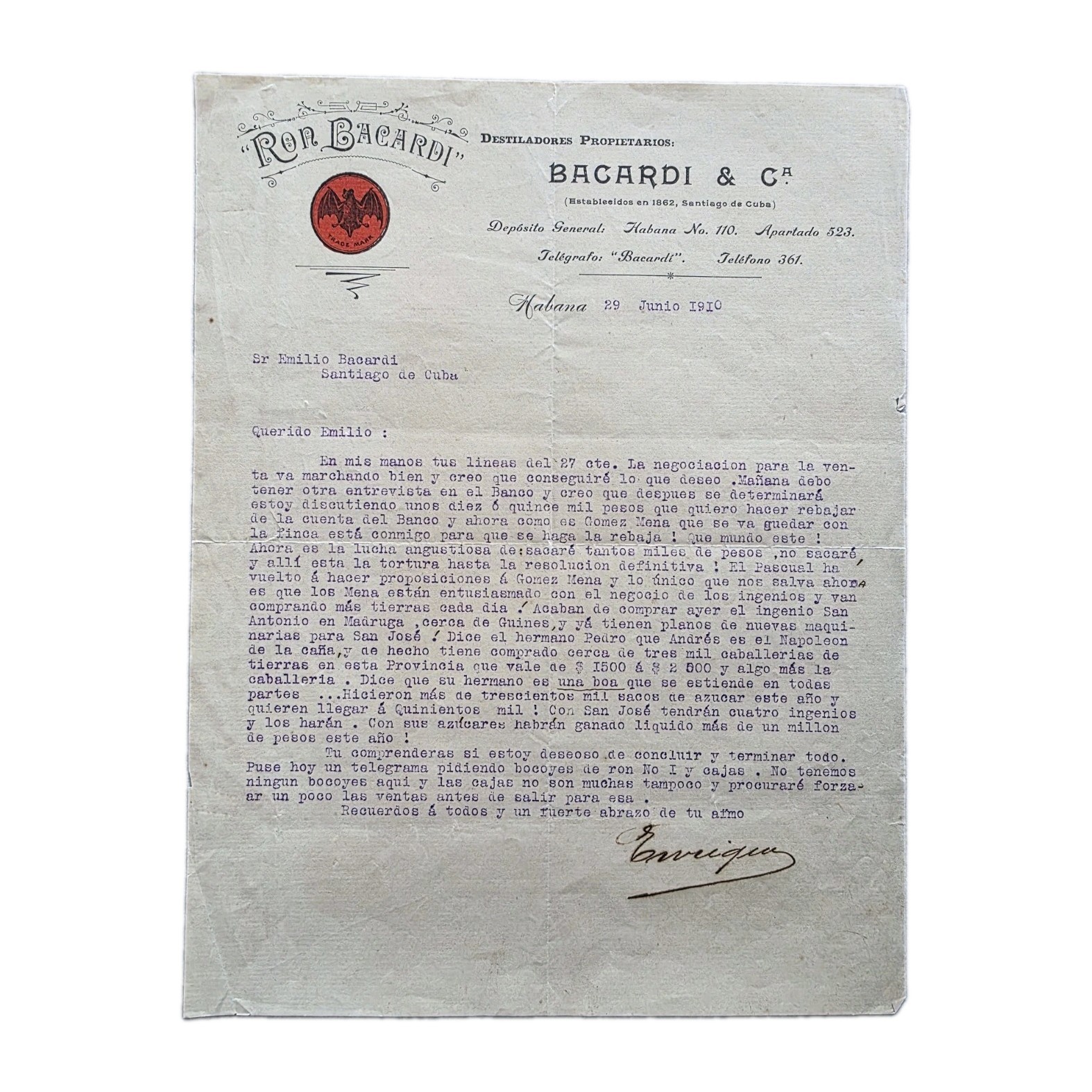
For your consideration is an exceptionally substantive original Bacard & Ca. business letter dated 29 June 1910 at Havana, written by Enrique Schueg y Chassin (18621950) to his brother-in-law Emilio Bacard Moreau (18441922) at Santiago and personally signed Enrique in ink. Typed in Spanish on elaborate Ron Bacardi letterhead incorporating the early red-and-black bat trademark, the sheet identifies the firm as Destiladores Propietarios: Bacardi & C (Establecidos en 1862, Santiago) and gives its Depsito General at Calle Habana No. 110, Apartado 523, telegraphic address Bacardi, and telephone 361. Remarkably, a Bacard advertisement published in Havanas Bohemia only four days earlier, on 25 June 1910, independently gives the identical Habana No. 110 / Telfono 361 coordinates, providing exceptionally close contemporary corroboration of the stationery and Havana operation. Schueg, who had married Emilios sister Amalia Bacard Moreau, was not simply a relative: he had become one of the central executives of the family enterprise, directing foreign sales and the opening of new markets. A National Register historical study credits him with much of Bacards early-20th-century commercial success and specifically records that he negotiated the opening of the companys Barcelona factory in 1910; Bacard itself describes Schueg as its architect of expansion and identifies 1910 as the year the firm became the country's first multinational company through its Barcelona operation. The recipient, Emilio Bacardthe eldest son of founder Facundo Bacard Masswas president of the family concern as well as a prominent independence figure, politician, historian, writer, and former mayor of Santiago. The affectionate salutation Querido Emilio and conclusion, Recuerdos todos y un fuerte abrazo de tu atmo Enrique, establish the unusually intimate character of correspondence exchanged between two senior Bacard principals who were simultaneously brothers-in-law.
The letter opens with a significant financial and property negotiation. Acknowledging Emilios letter of 27 June, Schueg reports that La negociacin para la venta va marchando bien and that he expects another interview at an unidentified bank, where he is attempting to obtain a reduction of approximately 10,00015,000 pesos from the banks account or claim. He explains that a Gmez Mena principal is to take the finca and is supporting the requested reduction, before launching into an extraordinary contemporary report on the expansion of the Gmez-Mena sugar interests. Schueg records that Enrique Pascual, almost certainly the prominent proprietor associated with Central Mercedita in the Melena del Sur district, had again made proposals to Gmez Mena, and observes that los Mena estn entusiasmados con el negocio de los ingenios y van comprando ms tierras cada dathe Menas were enthusiastic about the sugar-mill business and buying more land every day. The University of Floridas important Braga Brothers Collection, a major archive of sugar commerce, independently groups Andrs Gmez-Mena, Pedro Gmez-Mena, the Amistad Sugar Co. and Madruga Sugar Co. under the Gmez-Mena Sugar Company, confirming the familys position within precisely the industrial network described by Schueg. Most importantly, he announces that the Gmez Menas Acaban de comprar ayer el ingenio San Antonio en Madruga, cerca de Gineshave just bought yesterday the San Antonio sugar mill at Madruga, near Gines. Since the letter is dated 29 June, this constitutes contemporary evidence for a probable acquisition date of 28 June 1910, potentially refining the chronology of Central San Antonios transfer into Gmez-Mena control. Schueg then reports plans involving another mill, San Jos, stating that with San Jos they would possess four ingenios. This is particularly revealing because archival evidence shows that Central San Jos instead passed through foreclosure and was reorganized as the Washington Sugar Company in 1911, suggesting that the Gmez-Mena scheme recorded here was an unrealized or superseded acquisition plan preserved only at the negotiation stage.
The central passage provides an unusually vivid firsthand portrait of Andrs and Pedro Gmez-Mena at the height of their expansion. Schueg reports Pedros remarkable characterization of his brother: Andrs es el Napoleon de la caaAndrs is the Napoleon of sugar caneand states that Andrs had acquired cerca de tres mil caballeras de tierras en esta Provincia, nearly 3,000 caballeras of land in Havana Province, valued by Schueg at approximately 1,5002,000 pesos or more per caballera. He immediately adds another reported remark from Pedro, describing Andrs as una boa que se estiende en todas partesa boa constrictor spreading everywhere. Schueg further records that the Gmez-Mena interests had produced more than 300,000 sacks of sugar that year, aspired to 500,000, and, in his estimation, would earn lquido ms de un milln de pesosmore than one million pesos net from their sugar operations. These figures should be understood as Schuegs contemporary commercial intelligence rather than audited accounts, but their scale is entirely consonant with the rapid modernization and concentration of sugar production documented in the Braga archive, one of the richest institutional collections relating to the manufacture, financing, and international marketing of sugar. The letter is consequently important not merely for its colorful language but because it records, from within Havana's business elite, perceptions of land accumulation, mill acquisition, financing, machinery investment, production targets, and profitability during a decisive phase in the consolidation of the Republican-era sugar economy.
The final paragraph returns directly to Bacard operational business, making clear that the preceding discussion was written by an executive actively managing the company rather than by a detached observer. Schueg tells Emilio: Puse hoy un telegrama pidiendo bocoyes de ron No I y cajasthat he had sent a telegram that day requesting casks of Ron No. I and casesbecause no casks remained in Havana and the supply of cases was also low; he intended to forzar un poco las ventas, push sales further, before returning to Santiago. The precise internal meaning of Bacards designation Ron No. I has not been securely established and is best retained verbatim rather than equated speculatively with a later branded expression. This closing passage provides direct evidence for Bacards Havana-to-Santiago inventory, telegraphic ordering, distribution, and sales practices in 1910, while Schuegs documented career independently confirms that foreign sales and market development were precisely his sphere of responsibility. Taken as a whole, the document is considerably more than early Bacard ephemera: it is a research-level primary source connecting Enrique Schueg and Emilio Bacard, Bacards Havana distribution operation, the companys landmark 1910 international expansion, contemporary banking and property negotiations, and the aggressive consolidation of the Gmez-Mena sugar interests. Particularly significant are its apparent near-contemporary dating of the San Antonio acquisition to 28 June 1910, its evidence for an apparently unrealized Gmez-Mena plan involving Central San Jos, and the striking private descriptions of Andrs Gmez-Mena as the Napoleon of sugar cane and a spreading boadetails that give the letter substantial historical importance for both Bacard corporate history and the economic history of the Republic.


 ABOUT
ABOUT