When you click on links to various merchants on this site and make a purchase, this can result in this site earning a commission. Affiliate programs and affiliations include, but are not limited to, the eBay Partner Network.
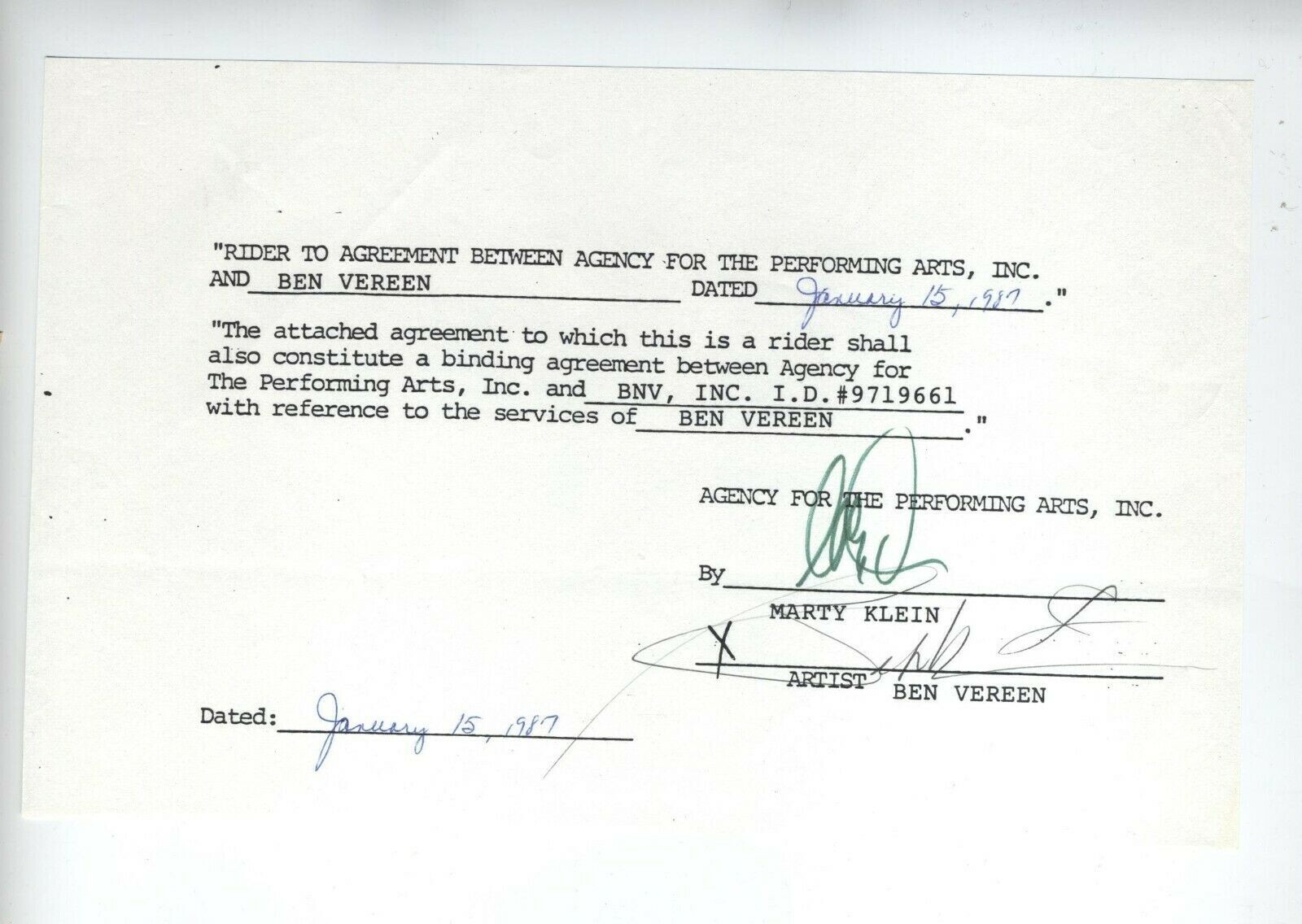
BEN VEREEN 1987 SIGNED CONTRACT RIDER MEASURING APPROXIMATELY 7 3/4 X 4 7/8 INCHES WITH AUTHENTICATION FROM STEVE GRAD WHEN HE WAS WITH MASTRONET
Benjamin Augustus Vereen is an American actor, dancer and singer. Vereen gained prominence for his performances in the original Broadway productions of the musicals Jesus Christ Superstar, for which he received a Tony Award nomination, and Pippin, for which he won the 1973 Tony Award for Best Actor in a Musical.
Effervescent African-American entertainer Ben Vereen attended New York\'s High School of the Performing Arts and Emerson College. Vereen was 18 when he made his New York stage bow in Prodigal Son; shortly thereafter, he was cast in the touring company of Sweet Charity, eventually making his 1969 screen debut in the film version of that Cy Coleman-Dorothy Fields musical. He joined the cast of Hair in 1969, at various junctures playing both Claude and Berger. The following year, he won the Theatre World Award for his portrayal of Judas in Andrew Lloyd Webber\'s Jesus Christ Superstar. After a season with the National Shakespeare Company, Vereen was cast as \"The Leading Player\" in the Broadway musical Pippin, a performance that earned him a Tony Award. While he seemed destined to appear in naught but film musicfests like Funny Lady (1975) and All That Jazz (1979), Vereen proved his dramatic mettle with his unforgettable portrayal of Chicken George in the landmark miniseries Roots. While he didn\'t win the Emmy for this role (as many expected), his 1978 TV special Ben Vereen...His Roots copped the gold statuette. Vereen has also been honored with the American Guild of Variety Artists\' George M. Cohan award, and with the NAACP\'s Image Award. In 1980, he co-starred with Jeff Goldblum in the Steven Cannell-produced TV series Tenspeed and Brownshoe. Though the series failed, Vereen reserved a warm place in his heart for his wheeler-dealer \"Tenspeed Turner\" character, reprising the role on the 1987 TV weekly J. J. Starbuck. His additional TV credits include the 1975 summer series Ben Vereen...Comin\' at Ya, the recurring role of Uncle Phillip on Webster (1986), and the hosting chores for the syndicated talent contest You Write the Songs (1986) At the height of his fame, Vereen ebulliently attributed his success to \"Jesus.\" His faith was sorely tested in the late 1980s; enduring the death of his son, Vereen began contemplating suicide, at one point deliberately standing in the middle of a busy Los Angeles street, allowing himself to be struck down by a passing car. Happily, Vereen recovered both emotionally and professionally; his recent credits include the Broadway musical Jelly\'s Last Jam and the recurring role of Captain Hutchinson in the TV cop series Silk Stalkings (1991- ).
*Multi-talented performer Ben Vereen opens up about his past and his “blood family” in his new autobiography, revealing that he didn’t know he was adopted until he was 25-years-old and needed to apply for a passport to tour Europe with Sammy Davis, Jr.
He told BlogTalkRadio.com:
“I didn’t have a passport so he told me to send for my birth certificate. I didn’t think about the fact that I didn’t have one or there were no baby pictures of me. Turns out they didn’t have my birth certificate under the name Ben Vereen but they had Essie Middleton as the mother of Benjamin Vereen.
“I told my mother about it and she told me she was hoping I’d never know. That’s how I found out, so the story is about my journey of finding them (birth parents) and blessing the woman who raised me.”
Vereen, now 64, admits he’s still coming to terms with his forgotten family after finally tracking them down just four years ago.
“The whole idea of hearing my older sister’s voice for the first time was just amazing. We were both nervous seeing each other for the first time. Now she’s always on my case.
“I also discovered I have a brother, Jimmy, and (another, called) Eugene. Can you imagine you’re sitting at home and one day my sister gets a phone call: ‘Do you know who your brother is?’ She said, ‘Yeah, my brothers are Eugene and Jimmy, why?’
“When they told her you have another brother and his name is Ben Vereen, she said, ‘Get outta here, the guy who plays Chicken George in Roots?’
“Both mothers have since gone on (died), so finding aunts and cousins and a whole slew of people who are now in my life and my children’s lives is wonderful and very rich. We had 110 people come to the family reunion and they embraced us into their family.”Benjamin Augustus Vereen (born October 10, 1946) is an American actor, dancer and singer. Vereen gained prominence for his performances in the original Broadway productions of the musicals Jesus Christ Superstar, for which he received a Tony Award nomination, and Pippin, for which he won the 1973 Tony Award for Best Actor in a Musical.Contents1 Early life2 Career2.1 Stage2.2 Television3 Personal life3.1 Sexual harassment allegations4 Filmography4.1 Film4.2 Television5 Theatre6 Discography6.1 Solo albums6.2 Ensemble albums6.3 Singles and EPs7 Awards and Nominations8 References9 External linksEarly lifeVereen was born Benjamin Augustus Middleton on October 10, 1946 in Laurinburg, North Carolina.[2][3][4] While still an infant, Vereen and his family relocated to the Bedford-Stuyvesant neighborhood in Brooklyn, New York City. He was adopted by James Vereen, a paint-factory worker, and his wife, Pauline, who worked as a maid and theatre wardrobe mistress.[5] He discovered he was adopted when he applied for a passport to join Sammy Davis Jr. on a tour of \"Golden Boy\" to London when he was 25.[6] He was raised Pentecostal.[7]
During his pre-teen years, he exhibited an innate talent for drama and dance and often performed in local variety shows. At the age of 14, Vereen enrolled at the High School of Performing Arts, where he studied under world-renowned choreographers Martha Graham, George Balanchine, and Jerome Robbins. Upon his graduation, he struggled to find suitable stage work and was often forced to take odd jobs to supplement his income.
CareerStageWhen Vereen was 18 years old, he made his New York stage bow off-off Broadway in The Prodigal Son at the Greenwich Mews Theater directed by Stella Holt. By the following year, he was in Las Vegas, performing in Bob Fosse\'s production of Sweet Charity, a show with which he toured in 1967–68. He returned to New York City to play Claude in Hair in the Broadway production, before joining the national touring company.
The following year, he was cast opposite Sammy Davis Jr. in the film adaptation of Sweet Charity. After developing a rapport with Davis, Vereen was cast as his understudy in the upcoming production of Golden Boy, which toured England and ended the run at the Palladium Theatre in London\'s West End.
Vereen was nominated for a Tony Award for Jesus Christ Superstar in 1972 and won a Tony for his appearance in Pippin in 1973. Vereen appeared in the Broadway musical Wicked as the Wizard of Oz in 2005. Vereen has also performed in one-man shows and actively lectures on black history and inspirational topics.
Television
Vereen in 2007Vereen has also starred in numerous television programs, and is well known for the role of \'Chicken\' George Moore in Alex Haley\'s landmark TV miniseries Roots, for which he received an Emmy nomination in 1977.
Vereen\'s four-week summer variety series, Ben Vereen ... Comin\' At Ya, aired on NBC in August 1975 and featured regulars Lola Falana, Avery Schreiber and Liz Torres.
In 1978, on a Boston Pops TV special, Vereen performed a tribute to Bert Williams, complete with period makeup and attire, and reprising Williams\' high-kick dance steps, to Vaudeville standards such as \"Waitin\' for the Robert E. Lee\".
In 1981, Vereen performed at Ronald Reagan\'s first inauguration. The performance generated controversy as Vereen performed the first part of the show in blackface. Before the finale, ABC cut the live performance, generating confusion and anger from viewers at home.[8] According to video artist Edgar Arcenaux, what TV viewers didn’t see was the second part of the performance, in which Vereen mimicked being refused service because of his color while trying to buy the Republican elite a congratulatory drink. As Arceneaux explains, Vereen\'s performance was meant as a critique of Republican civil rights policies, but the TV audience didn\'t get to see it.[9]
Vereen was cast opposite Jeff Goldblum in the short-lived detective series Tenspeed and Brown Shoe (1980). During the late 1980s and early 1990s, Vereen worked steadily on television with projects ranging from the sitcom Webster to the drama Silk Stalkings.
In 1985, Vereen starred in the Faerie Tale Theatre series as Puss in Boots alongside Gregory Hines. He appeared on The Fresh Prince of Bel-Air episode \"Papa\'s Got a Brand New Excuse\", in which he played Will Smith\'s biological father Lou Smith. He made several appearances on the 1980s sitcom Webster as the title character\'s biological uncle.
He also appeared as Mayor Ben (a leopard) on the children\'s program Zoobilee Zoo and as Itsy Bitsy Spider in Mother Goose Rock \'n\' Rhyme. In 1993 he appeared in the Star Trek: The Next Generation episode \"Interface\" as the father of Roots co-star LeVar Burton\'s character Geordi La Forge; fellow Roots star Madge Sinclair appeared in the same episode as Geordi\'s mother. In Roots, Vereen had played \"Chicken George\", the grandson of Burton\'s character Kunta Kinte.[10] He also appeared on the television series The Nanny episode \"Pishke Business\". In 2010, he appeared on the television series How I Met Your Mother episodes \"Cleaning House\" and \"False Positive\" as Sam Gibbs, the long lost father of James Stinson, Barney Stinson\'s brother. He returned in 2013 and 2014 for another two episodes.
Personal lifeVereen has appeared as a public speaker and humanitarian speaking on such topics as black history, overcoming adversity, and the importance of continuing education.
In 2007, he was diagnosed with type 2 diabetes and has a website in which he shares his personal story along with advice from medical experts.
According to The Fayetteville Observer of April 29, 2006, Vereen learned while applying for a passport in the late 1960s that he was adopted. His birth certificate revealed that his birth name was Benjamin Augustus Middleton, that he was the son of Essie Middleton, and that he was born in Laurinburg, North Carolina. In April 2006, Vereen visited Scotland County with a genealogist on a search for family members and learned that his mother\'s name was Essie May Pearson. The Laurinburg Exchange reported: \"Vereen, an adoptee who learned that he was born in Laurinburg and made a celebrated trip to Scotland County in 2006 to reconnect with family. While on the trip he learned his mother had died 24 years before, but that several relatives still lived in the area.\" According to her acquaintances, Essie had gone on a trip when Vereen was a child, and had left her baby in someone\'s care. When she returned, the child was gone. In the April 28, 2006 interview with the \'Laurinburg Exchange\', Vereen said that his visit \"has just all been so overwhelming ... I\'ve finally found my family\".[11] In May 2006, he met his mother\'s daughter, (his sister), Gloria Walker, of Derby, Connecticut.[12][13][14] He also has a brother, James Middleton, who lives in Tucson, Arizona.
In the early 1980s, Vereen moved with his family to Saddle River, New Jersey.[15]
His 16-year-old daughter, Naja, was killed in an auto accident in 1987[16] on the New Jersey Turnpike when a truck overturned on her car.
In 1992, Vereen suffered three accidents in one day, when his car hit a tree causing him to hit his head on the roof of his car, then he suffered a stroke while he was walking on a Malibu highway, apparently veering into the road where he was struck by a car driven by record producer David Foster. His critical injuries (including a broken leg) required him to undergo arduous physical rehabilitation in the ensuing months.[17][18]
Vereen is the godfather of R&B superstar Usher and is also the first cousin once removed of New York Giants running back Shane Vereen. Vereen was the keynote speaker for the Boys & Girls Clubs in St. Petersburg, Florida annual alumni tribute gala held in October 2007.
In August 2011, Vereen was named Co-Artistic Director of Tampa\'s Broadway Theatre Project.[19]
In September 2012, Vereen filed for divorce from his wife Nancy Bruner Vereen of 36 years, citing irreconcilable differences.[20]
He is an active Democrat.[21]
Vereen was inducted as an honorary member of Phi Beta Sigma fraternity on April 9, 2019.[22]
His 55-year old son, Ben Vereen Jr., died in 2020.[23]
Sexual harassment allegationsIn January 2018, four actresses in a Florida production of Hair directed by Vereen in 2015 alleged that he sexually harassed them throughout the production.[24]
According to the New York Daily News, \"the women — part of the Venice Theatre production outside of Tampa — say Vereen forced unwanted kisses, hugged them aggressively, stripped naked during an acting exercise and made degrading comments about their weight, sex appeal and personal lives\". The Daily News published cast members\' claims that he used his position of authority as a director and mentor to pressure them to engage him in unwanted sexual interactions. For example, two of the actresses said he did this by privately luring them on separate occasions to his Florida rental home. One woman willingly admits she and Vereen began a relationship though feels it was ultimately coerced; the other says he sexually molested her and later nonconsensually kissed her and made sexually disparaging remarks.[25]
According to Variety, \"While directing the 2015 production of the musical at the Venice Theatre in Florida, Vereen is alleged to have invited female cast members back to his apartment and goaded them into sex acts. He’s also accused of inappropriate talk and conduct during rehearsals that involved cast members stripping naked, ostensibly as preparation for a show that has, since its original 1967 production, been associated with a famous, full-cast nude scene.\"[26]
Vereen has since apologized for his misconduct.[27]
FilmographyFilmYear Title Role Notes1969 Sweet Charity Dancer 1970 Gas-s-s-s Carlos 1975 Funny Lady Bert Robbins 1979 All That Jazz O\'Connor Flood 1980 This Boxer Wears a Shirt 1982 Cycling Through China Himself Documentary1982 Sabine Stanley 1985 The Zoo Gang The Winch 1988 Buy & Cell Shaka 1993 Once Upon a Forest Phineas voice1998 Why Do Fools Fall in Love Richard Barrett 1999 I\'ll Take You There Mr. Gwin 2001 The Painting Whistlin\' Willie Weston 2006 Idlewild Percy Senior 2007 And Then Came Love Chuck Cooper 2009 Tapioca Nuts 2009 21 and a Wake-Up General Garner 2011 Mama, I Want to Sing! Horace Payne 2013 Khumba Mkhulu, the Elder Zebra voice2014 Top Five Carl 2014 Time Out of Mind Dixon TelevisionYear Title Role Notes1975 Ben Vereen... Comin\' at Ya Host 4 episodes1976 Louis Armstrong – Chicago Style Louis Armstrong Television Movie1976 The Muppet Show Special Guest Star Episode: \"Ben Vereen\"1977 Roots Chicken George Moore 3 episodes1977 The Carol Burnett Show Self 2 episodes1980 Tenspeed and Brown Shoe E.L. \'Tenspeed\' Turner 14 episodes1981 Pippin: His Life and Times The Leading Player Television Movie1982-84 The Love Boat Various roles 3 episodes1983 The Charmkins Dragonweed Voice; Television Short1983-85 Webster Uncle Philip Long 11 episodes1984 SCTV 1984 The Jesse Owens Story Herb Douglas Television Movie1984 Ellis Island Roscoe Haines 3 episodes1985 A.D. Ethiopian 5 part miniseries1985 Lost in London Paul Williams Television Movie1985 Faerie Tale Theatre Puss in Boots Episode: Puss in Boots1986-87 Zoobilee Zoo Mayor Ben 62 episodes1988 Jenny\'s Song Joe Television Movie1988 J.J. Starbuck E.L. \"Tenspeed\" Turner 5 episodes1990 The Kid Who Loved Christmas Performer Television Movie1990 Mother Goose Rock \'n\' Rhyme Itsy Bitsy Spider Television Movie1990 Booker Carl McQueen Episode: \"The Life and Death of Chick Sterling\"1991-93 Silk Stalkings Capt. Ben Hutchinson 11 episodes1992 Intruders Gene Randall 2 episodes1993 Star Trek: The Next Generation Dr. Edward LaForge Episode: \"Interface\"1994 Lois and Clark:The New Adventures of Superman Dr. Andre Novak Episode: \"Illusions of Grandeur\"1994 The Fresh Prince of Bel-Air Lou Smith Episode: \"Papa\'s Got a Brand New Excuse\"1994 The Nanny Ben Vereen Episode: \"Pishke Business\"1995 New York Undercover Louie Episode: \"Eliminate the Middleman\"1996 Touched by an Angel Ulysses Dodd Episode: \"Secret Service\"1997 Second Noah Sweet Billy Episode: \"Desperately Seeking Mickey\"1998 Soldier of Fortune, Inc. Senator Stanford Parks Episode: \"Party Girl\"1999 Promised Land Lawrence Taggert Sr. 3 episodes1999 The Jamie Foxx Show Royal Episode: \"Taps for Royal\"2001 The Feast of All Saints Rudolphe Lermontant Television Movie2002 Oz A.R. Whitworth Episode: \"Good Intentions\"2007 Grey\'s Anatomy Archie Roche Episode: \"Love/Addiction\"2007 Law & Order: Criminal Intent Rev. Jeremiah Morris Episode: \"Senseless\"2008 Accidental Friendship Wes Television Movie2008 Your Mama Don\'t Dance Judge 8 episodes2010 House of Payne Clarence Sanderson Episode: \"Curtis Sings the Blues2010-14 How I Met Your Mother Sam Gibbs 4 episodes2011 Broadway: The Next Generation Himself Documentary Series2014 Love That Girl! Judge Episode: \"Business is Business\"2013 NCIS Lamar Addison Episode: \"Homesick\"2015 Hot in Cleveland Mayor of Cleveland Episode: \"Out of Our Minds\"2016 The Rocky Horror Picture Show:Let\'s Do the Time Warp Again Dr. Everett von Scott Television Special NBC2017 Making History Dr. Theodore Anthony Cobell 3 episodes2017-18 Sneaky Pete Porter 6 episodes2018 Magnum P.I. Henry Barr Episode: \"Death Is Only Temporary\"2018-19 Star Calvin 5 episodes2019 Bull Willie Lambert Episode: \"Forfeiture\"2019 Tales Harry Episode: \"My Life\"2021 The Good Fight Frederick Douglas 4 episodesTheatreYear Production Role Venue Notes1965 The Prodigal Son Dancer Greenwich Mews Theater, Off-Broadway 1967–68 Sweet Charity Dancer US & Canada Tour 1968–72 Hair Hud - Claude Biltmore Theatre, BroadwayNational Tour 1968 Golden Boy Understudy toSammy Davis Jr. London PalladiumInternational Tour 1970 Gurton\'s Apocalyptic Needle Alternate roles The New Troupe/Touring 1970 Don\'t Call Me Toby Singer/Dancer The New Troupe, Touring 1970–71 No Place to be Somebody Alternate roles Touring Company 1971–73 Jesus Christ Superstar Judas Iscariot Mark Hellinger Theatre, Broadway 1972–74 Pippin Leading Player Imperial Theater, Broadway,U.S. tour 1985 Grind LeRoy Mark Hellinger Theatre, Broadway 1992–93 Jelly\'s Last Jam Chimney Man Shubert Theater, Broadway Replacement1995–96 A Christmas Carol Ghost of Christmas Present Madison Square Garden, Broadway 1999 Chicago Billy Flynn U.S. & Canada Tour 2001 Fosse Performer Shubert Theater, Broadway Replacement2002 I\'m not Rappaport Midge Shubert Theater, BroadwayU.S. National tour 2003 The Exonerated Performer Off-Broadway 2005-06 Wicked The Wizard of Oz Gershwin Theatre, Broadway ReplacementDiscographySolo albumsOff-Stage (Buddah Records, 1975)Ben Vereen (Buddah Records, 1976)Signed, Sealed, Delivered! (51 West, 1979)Here I Am (Accord, 1982)Steppin\' Out Live (Ghostlight Records, 2010)Ensemble albumsGrind (Original Cast Recording) (TER, 1985)Pippin (Original Broadway Cast) (Decca Broadway, 2000)Singles and EPsSuperstar (MCA Records, 1971)Could We Start Again Please? / Heaven On Their Minds (Decca, 1972)Stop Your Half-Steppin\' Ma Ma (Buddah Records, 1975)By Your Side (Buddah Records, 1975)Got It Made / Read Between the Lines (Ariola, 1980)Awards and Nominations
The handprints of Ben Vereen in front of Theater of the Stars at Walt Disney World\'s Disney\'s Hollywood Studios theme parkTheaterYear Award Category Title Results1972 Tony Award Best Featured Actor in a Musical Jesus Christ Superstar Nominated1972 Theatre World Award N/A Won1973 Drama Desk Award Outstanding Performance Pippin Won1973 Tony Award Best Actor in a Musical WonTelevisionYear Award Category Title Results1976 Golden Globe Award New Star of the Year – Actor Funny Lady Nominated1977 Primetime Emmy Award Outstanding Supporting Actor in Variety or Music The Bell Telephone Jubilee NominatedOutstanding Lead Actor Drama or Comedy Series Roots Nominated1984 Golden Globe Award Best Supporting Actor - Television Ellis Island Nominated1992 Primetime Emmy Award Outstanding Supporting Actor in a Miniseries Intruders NominatedHonorsThe Community Mental Health Council awarded Vereen with their 2004 Lifeline Celebration Achievement Award. For his humanitarian contributions, he has received a number of awards including Israel\'s Cultural and Humanitarian Awards, three NAACP Image Awards, an Eleanor Roosevelt Humanitarian Award and a Victory Award. He has received honorary doctorates from the University of Arizona, Emerson College, St. Francis College, and Columbia College in Chicago. In 2001, Medgar Evers College created the Ben Vereen Scholarship for the Performing Arts, and in 2004, he received an Achievement in Excellence Award from his alma mater, the High School of the Performing Arts.
He was the first simultaneous winner of the \"Entertainer of the Year,\" “Rising Star,\" and \"Song and Dance Star\" awards from the American Guild of Variety Artists (AGVA). He also earned a coveted spot in the Casino Legends Hall of Fame.
Vereen was nominated for an NAACP Image Award for his performance in the Hallmark movie An Accidental Friendship. In 2004, Vereen was nominated for a \"Career Achievement Award\" by the Le Prix International Film Star Awards Organization.
In 2011, he was inducted into the American Theatre Hall of Fame.[28]
In 2012, Vereen was inducted into the National Museum of Dance\'s Mr. & Mrs. Cornelius Vanderbilt Whitney Hall of Fame.
The Antoinette Perry Award for Excellence in Broadway Theatre,[1] more commonly known as the Tony Award, recognizes excellence in live Broadway theatre. The awards are presented by the American Theatre Wing and The Broadway League[2] at an annual ceremony in Midtown Manhattan.
The awards are given for Broadway productions and performances. One is also given for regional theatre. Several discretionary non-competitive awards are given, as well, including a Special Tony Award, the Tony Honors for Excellence in Theatre, and the Isabelle Stevenson Award.[3]
The awards founded by Brock Pemberton are named after Antoinette \"Tony\" Perry, an actress, producer and theatre director who was co-founder and secretary of the American Theatre Wing. The trophy consists of a medallion, with faces portraying an adaptation of the comedy and tragedy masks, mounted on a black base with a pewter swivel.
The rules for the Tony Awards are set forth in the official document \"Rules and Regulations of The American Theatre Wing\'s Tony Awards\", which applies for that season only.[4] The Tony Awards are considered the highest U.S. theatre honor, the New York theatre industry\'s equivalent to the Academy Awards (Oscars) for film, the Emmy Awards for television, and the Grammy Awards for music. It also forms the fourth spoke in the EGOT, that is, someone who has won all four major annual American entertainment awards. The Tony Awards are also considered the equivalent of the Laurence Olivier Awards in the United Kingdom and the Molière Awards in France.
The 74th annual ceremony was held on September 26, 2021, at Winter Garden Theatre in New York City and was broadcast live on Paramount+. Audra McDonald served as the host.Contents1 Award categories1.1 Performance categories1.2 Show and technical categories1.3 Special awards1.4 Retired awards2 History2.1 Medallion3 Details of the Tony Awards3.1 Rules for a new play or musical3.2 Committees and voters3.3 Eligibility date (Season)3.4 Broadway theatre4 Criticism5 Award milestones5.1 Productions5.2 Individuals5.3 Firsts6 See also7 References8 External linksAward categoriesMost recent Tony Award winners← 2019 2020 Tony Awards 2022 → Mary-Louise Parker by Gage Skidmore.jpgAward Best Leading Actor in a Play Best Leading Actress in a PlayWinner Andrew Burnap(The Inheritance) Mary-Louise Parker(The Sound Inside) Aaron Tveit in Boston.jpg Award Best Leading Actor in a Musical Best Leading Actress in a MusicalWinner Aaron Tveit(Moulin Rouge!) Adrienne Warren(Tina) Stephen Daldry 2013.jpgAward Best Direction of a Musical Best Direction of a PlayWinner Alex Timbers(Moulin Rouge!) Stephen Daldry(The Inheritance)Previous Best MusicalHadestown
Previous Best PlayThe FerrymanBest MusicalMoulin Rouge!
Best PlayThe InheritanceAs of 2014, there were 26 categories of awards, in addition to several special awards. Starting with 11 awards in 1947, the names and number of categories have changed over the years. Some examples: the category Best Book of a Musical was originally called \"Best Author (Musical)\". The category of Best Costume Design was one of the original awards. For two years, in 1960 and 1961, this category was split into Best Costume Designer (Dramatic) and Best Costume Designer (Musical). It then went to a single category, but in 2005 it was divided again. For the category of Best Director of a Play, a single category was for directors of plays and musicals prior to 1960.[5]
A newly established non-competitive award, The Isabelle Stevenson Award, was given for the first time at the awards ceremony in 2009. The award is for an individual who has made a \"substantial contribution of volunteered time and effort on behalf of one or more humanitarian, social service or charitable organizations\".[6]
The category of Best Special Theatrical Event was retired as of the 2009–2010 season.[7] The categories of Best Sound Design of a Play and Best Sound Design of a Musical were retired as of the 2014–2015 season.[8] On April 24, 2017, the Tony Awards administration committee announced that the Sound Design Award would be reintroduced for the 2017–2018 season.[9]
Performance categoriesBest Performance by a Leading Actor in a PlayBest Performance by a Featured Actor in a PlayBest Performance by a Leading Actor in a MusicalBest Performance by a Featured Actor in a MusicalBest Performance by a Leading Actress in a PlayBest Performance by a Featured Actress in a PlayBest Performance by a Leading Actress in a MusicalBest Performance by a Featured Actress in a MusicalShow and technical categoriesBest MusicalBest Revival of a MusicalBest Direction of a MusicalBest Book of a MusicalBest Original ScoreBest OrchestrationsBest ChoreographyBest Scenic Design in a MusicalBest Costume Design in a MusicalBest Lighting Design in a MusicalBest Sound Design of a MusicalBest PlayBest Revival of a PlayBest Direction of a PlayBest Scenic Design in a PlayBest Costume Design in a PlayBest Lighting Design in a PlayBest Sound Design of a PlaySpecial awardsRegional Theatre Tony AwardSpecial Tony Award (includes Lifetime Achievement Award)Tony Honors for Excellence in TheatreIsabelle Stevenson AwardRetired awardsBest AuthorBest Conductor and Musical DirectorBest Costume Design (split into two categories: Best Costume Design in a Musical and Best Costume Design in a Play)Best Lighting Design (split into two categories: Best Lighting Design in a Musical and Best Lighting Design in a Play)Best NewcomerBest Revival (split into two categories: Best Revival of a Musical and Best Revival of a Play)Best Scenic Design (split into two categories: Best Scenic Design in a Musical and Best Scenic Design in a Play)Best Stage TechnicianBest Special Theatrical EventBest Director (split into two categories: Best Direction of a Musical and Best Direction of a Play)HistoryMain article: List of Tony Awards ceremoniesThe award was founded in 1947 by a committee of the American Theatre Wing (ATW) headed by Brock Pemberton. The award is named after Antoinette Perry, nicknamed Tony, an actress, director, producer and co-founder of the American Theatre Wing, who died in 1946.[10] As her official biography at the Tony Awards website states, \"At [Warner Bros. story editor] Jacob Wilk\'s suggestion, [Pemberton] proposed an award in her honor for distinguished stage acting and technical achievement. At the initial event in 1947, as he handed out an award, he called it a Tony. The name stuck.\"[11] Nevertheless, the awards were sometimes referred to as the \"Perry Awards\" in their early years.[12][13]
The 1st Tony Awards was held on April 6, 1947, at the Waldorf Astoria hotel in New York City.[14] The first prizes were \"a scroll, cigarette lighter and articles of jewelry such as 14-carat gold compacts and bracelets for the women, and money clips for the men\".[15] ATW co-founder Louise Heims Beck was responsible for over seeing the organization of the first awards.[16] It was not until the third awards ceremony in 1949 that the first Tony medallion was given to award winners.[15]
Since 1967, the award ceremony has been broadcast on U.S. national television and includes songs from the nominated musicals, and occasionally has included video clips of, or presentations about, nominated plays. The American Theatre Wing and The Broadway League jointly present and administer the awards. Audience size for the telecast is generally well below that of the Academy Awards shows, but the program reaches an affluent audience, which is prized by advertisers. According to a June 2003 article in The New York Times: \"What the Tony broadcast does have, say CBS officials, is an all-important demographic: rich and smart. Jack Sussman, CBS\'s senior vice president in charge of specials, said the Tony show sold almost all its advertising slots shortly after CBS announced it would present the three hours. \'It draws upscale premium viewers who are attractive to upscale premium advertisers,\' Mr. Sussman said...\"[17][18] The viewership has declined from the early years of its broadcast history (for example, the number of viewers in 1974 was 20 million; in 1999, 9.2 million) but has settled into between six and eight million viewers for most of the decade of the 2000s.[19] In contrast, the 2009 Oscar telecast had 36.3 million viewers.[20]
MedallionThe Tony Award medallion was designed by art director Herman Rosse and is a mix of mostly brass and a little bronze, with a nickel plating on the outside; a black acrylic glass base, and the nickel-plated pewter swivel.[21] The face of the medallion portrays an adaptation of the comedy and tragedy masks. Originally, the reverse side had a relief profile of Antoinette Perry; this later was changed to contain the winner\'s name, award category, production and year. The medallion has been mounted on a black base since 1967.[22][23]
A larger base was introduced in time for the 2010 award ceremony. The new base is slightly taller – 5 inches (13 cm), up from 3+1⁄4 inches (8.3 cm) – and heavier – 3+1⁄2 pounds (1.6 kg), up from 1+1⁄2 pounds (680 grams). This change was implemented to make the award \"feel more substantial\" and easier to handle at the moment the award is presented to the winners. According to Howard Sherman, the executive director of the American Theatre Wing:
We know the physical scale of the Oscars, Emmys and Grammys. While we\'re not attempting to keep up with the Joneses, we felt this is a significant award, and it could feel and look a bit more significant... By adding height, now someone can grip the Tony, raise it over their head in triumph and not worry about keeping their grip. Believe me, you can tell the difference.[24]
For the specific Tony Awards presented to a Broadway production, awards are given to the author and up to two of the producers free of charge. All other members of the above-the-title producing team are eligible to purchase the physical award. Sums collected are designed to help defray the cost of the Tony Awards ceremony itself. An award cost $400 as of at least 2000, $750 as of at least 2009, and, as of 2013, had been $2,500 \"for several years\", according to Tony Award Productions.[25]
Details of the Tony AwardsSource: Tony Awards Official Site, Rules[26]
Rules for a new play or musicalFor the purposes of the award, a new play or musical is one that has not previously been produced on Broadway and is not \"determined… to be a \'classic\' or in the historical or popular repertoire\", as determined by the Administration Committee (per Section (2g) of the Rules and Regulations).[4] The rule about \"classic\" productions was instituted by the Tony Award Administration Committee in 2002, and stated (in summary) \"A play or musical that is determined ... to be a \'classic\' or in the historical or popular repertoire shall not be eligible for an award in the Best Play or Best Musical Category but may be eligible in that appropriate Best Revival category.\"[27] Shows transferred from Off-Broadway or the West End are eligible as \"new\", as are productions based closely on films.
This rule has been the subject of some controversy, as some shows, such as Hedwig and the Angry Inch and Violet,[28] have been ruled ineligible for the \"new\" category, meaning that their authors did not have a chance to win the important awards of Best Play or Best Musical (or Best Score or Best Book for musicals). On the other hand, some people[who?] feel that allowing plays and musicals that have been frequently produced to be eligible as \"new\" gives them an unfair advantage because they will have benefited from additional development time as well as additional familiarity with the Tony voters.
Committees and votersThe Tony Awards Administration Committee has twenty-four members: ten designated by the American Theatre Wing, ten by The Broadway League, and one each by the Dramatists Guild, Actors\' Equity Association, United Scenic Artists and the Society of Stage Directors and Choreographers. This committee, among other duties, determines eligibility for nominations in all awards categories.[29]
The Tony Awards Nominating Committee makes the nominations for the various categories. This rotating group of theatre professionals is selected by the Tony Awards Administration Committee. Nominators serve three-year terms and are asked to see every new Broadway production.[30] The Nominating Committee for the 2012–13 Broadway season (named in June 2012) had 42 members;[31] the Nominating Committee for the 2014–2015 season has 50 members and was appointed in June 2014.[30]
There are approximately 868 eligible Tony Award voters (as of 2014),[26] a number that changes slightly from year to year. The number was decreased in 2009 when the first-night critics were excluded as voters.[32][33] That decision was changed, and members of the New York Drama Critics\' Circle were invited to be Tony voters beginning in the 2010–2011 season.[34]
The eligible Tony voters include the board of directors and designated members of the advisory committee of the American Theatre Wing, members of the governing boards of Actors\' Equity Association, the Dramatists Guild, the Society of Stage Directors and Choreographers, United Scenic Artists, and the Association of Theatrical Press Agents and Managers, members of the Theatrical Council of the Casting Society of America and voting members of The Broadway League (in 2000, what was then The League of American Theaters and Producers changed membership eligibility and Tony voting status from a lifetime honor to all above-the-title producers, to ones who had been active in the previous 10 years. This action disenfranchised scores of Tony voters, including Gail Berman, Harve Brosten, Dick Button, Tony Lo Bianco, and Raymond Serra).
Eligibility date (Season)To be eligible for Tony Award consideration, a production must have officially opened on Broadway by the eligibility date that the Management Committee establishes each year. For example, the cut-off date for eligibility the 2013–2014 season was April 24, 2014.[35] The season for Tony Award eligibility is defined in the Rules and Regulations.
In 2020, the 74th Annual Tony Awards were postponed due to the -19 pandemic.[36] On August 21, 2020, it was announced that the 74th Annual Tony Awards would take place digitally later in 2020.[37]
Broadway theatreA Broadway theatre is defined as having 500 or more seats, among other requirements. While the rules define a Broadway theatre in terms of its size, not its geographical location, the list of Broadway theatres is determined solely by the Tony Awards Administration Committee. As of the 2016–2017 season, the list consisted solely of the 41 theaters located in the vicinity of Times Square in New York City and Lincoln Center\'s Vivian Beaumont Theater.[38][39]
CriticismWhile the theatre-going public may consider the Tony Awards to be the Oscars of live theatre, critics have suggested that the Tony Awards are primarily a promotional vehicle for a small number of large production companies and theatre owners in New York City.[40][41] In a 2014 Playbill article, Robert Simonson wrote that \"Who gets to perform on the Tony Awards broadcast, what they get to perform, and for how long, have long been politically charged questions in the Broadway theatre community...\" The producers \"accept the situation ... because just as much as actually winning a Tony, a performance that lands well with the viewing public can translate into big box-office sales.\" Producer Robyn Goodman noted that, if the presentation at the ceremony shows well and the show wins a Tony, \"you’re going to spike at the box office\".[42]
The awards met further criticism when they eliminated the sound design awards in 2014.[43] In 2014, a petition calling for the return of the Sound Design categories received more than 30,000 signatures.[44] Addressing their previous concerns over Tony voters[45] in the category, it was announced that upon the awards\' return for the 2017–2018 season, they would be decided by a subset of voters based on their expertise.[9][46][47]
Some advocates of gender equality and non-binary people have criticized the separation of male and female acting categories in the Tony Awards, Academy Awards, and Emmy Awards. Though some commentators worry that gender discrimination would cause men to dominate unsegregated categories, other categories are unsegregated. The Grammy Awards went gender-neutral in 2012, while the Daytime Emmy Awards introduced a single Outstanding Younger Performer in a Drama Series category in 2019 to replace their two gender-specific younger actor and actress categories.[48][49]
Award milestones
This section needs additional citations for verification. Please help improve this article by adding citations to reliable sources. Unsourced material may be challenged and removed.Find sources: \"Tony Awards\" – news · newspapers · books · scholar · JSTOR (January 2021) (Learn how and when to remove this template message)Some notable records and facts about the Tony Awards include the The most Tony nominations ever received by a single production was the musical Hamilton (2016) with 16 nominations in 13 categories, narrowly passing the previous holders of this record, The Producers (2001; 15 nominations in 12 categories) and Billy Elliot (2009; 15 nominations in 13 categories). The most Tony nominations for a non-musical play was Slave Play (2020; 12 nominations in 10 categories).Wins: The most Tony Awards ever received by a single production was the musical The Producers (2001) with 12 awards, including Best Musical.Non-musical wins: The most Tonys ever received by a non-musical play was The Coast of Utopia (2007) with 7 awards, including Best Play.Most nominations with fewest wins: Musicals Mean Girls (2018) and The Scottsboro Boys (2011), as well as non-musical play Slave Play (2020) are tied: all three were nominated for 12 Tony Awards but did not win any.[51]Four productions, all musicals, have won all \"big six\" awards for their category: South Pacific (1950 awards), Sweeney Todd: The Demon Barber of Fleet Street (1979 awards), Hairspray (2003 awards)[52] and The Band\'s Visit (2018 awards); each won the Best Musical, Best Score, Best Book, Best Performance by a Leading Actor, Best Performance by a Leading Actress, and Best Direction awards.Acting Awards: Only one production, South Pacific (1950 awards), has won all four of the acting awards in a single year.Words and Music: Only six musicals have won the Tony Award for Best Musical when a person had (co-)written the Book (non-sung dialogue and storyline) and the Score (music and lyrics): 1958 winner The Music Man (Meredith Willson – award for Book and Score did not exist that year), 1986 winner The Mystery of Edwin Drood (Rupert Holmes – who also won for Book and Score), 1996 winner Rent (Jonathan Larson posthumously – who also won for Book and Score), 2011 winner The Book of Mormon (Trey Parker, Robert Lopez, and Matt Stone also won for Book and Score), 2016 winner Hamilton (Lin-Manuel Miranda also won for Book and Score), and 2019 winner Hadestown (Anaïs Mitchell also won for Score).Design Awards: Eleven shows have swept the Design Awards (original 3 of Best Scenic Design, Best Costume Design, Best Lighting Design – joined by Best Sound Design starting in 2008): Follies (1972), The Phantom of the Opera (1986), The Lion King (1998), The Producers (2001), The Light in the Piazza (2005), The Coast of Utopia (2007), the 2008 revival of South Pacific (first to sweep the expanded four awards for Creative Arts), Peter and the Starcatcher (first straight play to sweep the expanded four awards for Creative Arts) (2012), Harry Potter and the Cursed Child (2018), A Christmas Carol and Moulin Rouge! (both 2020).Revivals: Death of a Salesman by Arthur Miller in 2012 became the first show (play or musical) to win as Best Production in four different years, Best Play at the 1949 awards, Best Revival at the 1984 awards (before the Best Revival award was split into two categories for Play and Musical in 1994), and Best Revival of a Play at the 1999 and 2012 awards. La Cage aux Folles made history as the first musical to win as Best Production in three different years, Best Musical at the 1984 awards and Best Revival of a Musical at both the 2005 awards and the 2010 awards. The King and I has also garnered 3 Tony Awards, one for each time it has been produced on Broadway, first as Best Musical and then twice as Best Revival of a Musical.IndividualsWins: Harold Prince has won 21 Tony Awards, more than anyone else, including eight for Best Direction of a Musical, eight for Best Musical, two for Best Producer of a Musical, and three special Tony Awards. Tommy Tune has won ten Tony Awards including three for direction, four for choreography, two for performing, and one special Tony Award. Stephen Sondheim has won more music Tony Awards than any other individual, with eight awards (six for Best Original Score, one for Best Composer, and one for Best Lyricist). Bob Fosse has won the most Tonys for choreography, also eight. Oliver Smith has won a record eight scenic design Tony Awards. Jules Fisher has won the most lighting design awards, with nine. Audra McDonald has the most performance Tony Awards with six. Terrence McNally and Tom Stoppard are the most awarded writers with four Tonys each; McNally has won Best Play twice and Best Book of a Musical twice, while Stoppard has won Best Play four times.Most nominations: Julie Harris and Chita Rivera have been nominated more often than any other performer, ten apiece.[53][54]Performers in two categories: Six performers have been nominated in two acting categories in the same year: Amanda Plummer, Dana Ivey, Kate Burton, Jan Maxwell, Mark Rylance, and Jeremy Pope. Plummer in 1982 was nominated for Best Actress in a Play for A Taste of Honey and Best Featured Actress in a Play for Agnes of God, for which she won. Ivey in 1984 was nominated as Best Featured Actress in Musical for Sunday in the Park with George and Best Featured Actress in a Play for Heartbreak House. In 2002, Burton was nominated for Best Actress in Play for Hedda Gabler and Best Featured Actress in a Play for The Elephant Man. Maxwell was nominated in 2010 for Best Actress in a Play for The Royal Family and Best Featured Actress in a Play for Lend Me a Tenor. Rylance was nominated in 2014 for Best Actor in a Play for Richard III and Best Featured Actor in a Play for Twelfth Night, for which he won. Pope was nominated in 2019 for Best Actor in a Play for Choir Boy and Best Featured Actor in a Musical for Ain\'t Too Proud.Performers in all categories: Five performers have been nominated for all four performance awards for which a performer is eligible.Boyd Gaines was the first performer to be nominated for each of Best Featured Actor in a Play in The Heidi Chronicles (1989), Best Actor in a Musical for She Loves Me (1994), Best Featured Actor in a Musical for Contact (2000) and Gypsy (2008) and Best Actor in a Play for Journey\'s End (2007). Gaines won in three of the categories (and four of the five nominations), missing only for the performance in Journey\'s End.Raúl Esparza was the second performer to be nominated in all four categories (no wins), achieving this over a mere six seasons: Best Featured Actor in a Musical for Taboo (2004), Best Actor in a Musical for Company (2007), Best Featured Actor in a Play for The Homecoming (2008), and Best Actor in a Play for Speed-the-Plow (2009).Angela Lansbury was the third performer to be nominated for all four performance awards. She won Best Actress in a Musical for Mame (1966), Dear World (1969), Gypsy (1975), and Sweeney Todd (1979). She was nominated for Best Actress in a Play for Deuce (2007). She won Best Featured Actress in a Play for Blithe Spirit (2009). She was nominated for Featured Actress in a Musical for A Little Night Music (2010).Jan Maxwell became the fourth performer to achieve this distinction by being nominated (no wins) for Best Featured Actress in a Musical for Chitty Chitty Bang Bang (2005), Best Featured Actress in a Play for Coram Boy (2007) and Lend Me a Tenor (2010), Best Actress in a Play for The Royal Family (2010), and Best Actress in a Musical for Follies (2012).Audra McDonald became the fifth performer to accomplish the feat and the first to win in all four categories, winning Best Performance by a Featured Actress in a Musical for Carousel (1994) and Ragtime (1998), Best Performance by a Featured Actress in a Play for Master Class (1996) and A Raisin in the Sun (2004), Best Performance by a Leading Actress in a Musical for Porgy and Bess (2012), and Best Performance by a Leading Actress in a Play for Lady Day at Emerson\'s Bar and Grill (2014). She was nominated for Best Performance by a Leading Actress in a Musical for Marie Christine (2000) and 110 in the Shade (2007) and for Best Performance by a Leading Actress in a Play for Frankie and Johnny in the Clair de Lune (2020/21).Performers Playing Opposite Sex: While several performers have won Tonys for roles that have involved cross-dressing, only four have won for playing a character of the opposite sex: Mary Martin in the title role of Peter Pan (1955), Harvey Fierstein as Edna Turnblad in Hairspray (2003), Mark Rylance as Olivia in Twelfth Night (2014), and Lena Hall as Yitzhak in Hedwig and the Angry Inch (2014). In 2000, Australian actor Barry Humphries won the Special Tony Award for a live theatrical event at the 55th Annual Tony Awards for Dame Edna: The Royal Tour.Shared Performances: All three of the young actors who shared the duties of performing the lead character in Billy Elliot the Musical (2009 awards) – David Alvarez, Trent Kowalik and Kiril Kulish – also shared a single nomination, then shared the win, for Best Actor in a Musical. Previously, the only prior joint winners were John Kani and Winston Ntshona, who shared the Best Actor in a Play award in 1975 for Sizwe Banzi is Dead and The Island, two plays they co-wrote and co-starred in.Both sexes in one role: Ben Vereen and Patina Miller both won, respectively, Best Actor in a Musical in 1972 and Best Actress in a Musical in 2013 for the role of the Leading Player in Pippin, marking the first time the same role has been won by both a male and a female in a Broadway production.Writing and performing: Two people have won Tonys as an author and as a performer. Harvey Fierstein won Best Play and Best Lead Actor in a Play for Torch Song Trilogy (1983), Best Book of a Musical for La Cage aux Folles, and Best Lead Actor in a Musical for Hairspray. Tracy Letts, the author of 2008 Best Play August: Osage County, won Best Lead Actor in a Play for Who\'s Afraid of Virginia Woolf? (2013).Youngest and oldest composers to win: Lin-Manuel Miranda is the youngest person to win the award; he was 28 when he won for In The Heights. If T. S. Eliot had been alive when he won for Cats, he would have been 94. Eliot is one of two people to receive the award posthumously, the other being Jonathan Larson, who won for Rent. He would have been 36.Youngest and oldest actors to win: Dick Latessa is the oldest actor to win a Tony for his performance in Hairspray aged 72, whilst Lois Smith holds the record for oldest actress for her performance in The Inheritance, which she won at age 90. The youngest actor to win the Best Supporting Actor Tony Award was Frankie Michaels, a record he broke in 1966 aged 11 which still stands today, for his performance in Mame. 25 years later, Daisy Eagan took home a Tony Award for Best Featured Actress in a Musical for her performance in The Secret Garden at 11 and a half years old, cementing her place in Tony history as the youngest ever woman to win the award.In 2013, the four girls who alternated for the title role in Matilda the Musical (Sophia Gennusa, aged 9; Bailey Ryon, aged 10; Oona Laurence, aged 10; and Milly Shapiro, aged 10) won a joint Tony Honors award, making Gennusa the youngest to ever win a Tony, albeit non-competitive.FirstsFirst African-American to win Best Performance by a Featured Actress in a Musical: Juanita Hall for South Pacific in 1950.First African-American to win Best Performance by a Featured Actor in a Musical: Harry Belafonte for John Murray Anderson\'s Almanac in 1954.First female author to win Best Play: Frances Goodrich with her partner (and husband) Albert Hackett for The Diary of Anne Frank in 1956.First African-American to win Best Performance by a Leading Actress in a Musical: Diahann Carroll for No Strings in 1962.First African-American to win Best Performance by a Leading Actor in a Play: James Earl Jones for The Great White Hope in 1969.First African-American to win Best Performance by a Leading Actor in a Musical: Cleavon Little for Purlie in 1970.First African-American author to win Best Play: Joseph A. Walker for The River Niger in 1974.First African-American composer to solely win Tony Award for Best Score: Charlie Smalls for The Wiz in 1975.First female to win Tony Award for Best Score: Betty Comden for On the Twentieth Century in 1978. (In 1968, she became the first female to win the previous version of the Best Score Award, the Tony Award for Best Composer And Lyricist for Hallelujah, Baby!First Asian-American author to win Best Play: David Henry Hwang for M Butterfly in 1988.First Asian-American to win Best Performance by a Featured Actor in a Play: BD Wong for M Butterfly in 1988.First female author to solely win Best Play: Wendy Wasserstein for The Heidi Chronicles in 1989.First Asian to win Best Performance by a Leading Actress in a Musical: Lea Salonga for Miss Saigon in 1991.First female to win Best Direction of a Musical: Julie Taymor for The Lion King in 1998.First female to win Best Direction of a Play: Garry Hynes for The Beauty Queen of Leenane in 1998.First African-American to win Best Performance by a Leading Actress in a Play: Phylicia Rashad for A Raisin in the Sun in 2004.First Brazilian to win Best Performance by a Leading Actor in a Musical: Paulo Szot for South Pacific in 2008.First female to solely win Tony Award for Best Score: Cyndi Lauper for Kinky Boots in 2013.First Asian-American to win Best Performance by a Featured Actress in a Musical: Ruthie Ann Miles for The King and I in 2015.First female team to win Tony Award for Best Score and Tony Award for Best Book: Jeanine Tesori & Lisa Kron for Fun Home in 2015.First Lebanese-American to win Tony Award for Best Performance by a Leading Actor in a Musical: Tony Shalhoub for The Band\'s Visit in 2018.First Yemeni-American to win Tony Award for Best Performance by a Featured Actor in a Musical: Ari\'el Stachel for The Band\'s Visit in 2018.First person who uses a wheelchair to be nominated for and to receive a Tony Award for acting: Ali Stroker with the Tony Award for Best Featured Actress in a Musical for Oklahoma! in 2019.[55][56]First female to be nominated for and to win Best Sound Design of a Musical: Jessica Paz for Hadestown in 2019.[57]See also
Jesus Christ Superstar is a rock opera with music by Andrew Lloyd Webber and lyrics by Tim Rice. It is loosely based on the Gospels\' accounts of the last week of Jesus\'s life, beginning with the preparation for the arrival of Jesus and his disciples in Jerusalem and ending with the crucifixion.
The work interprets the psychology of Jesus and other characters. Much of the plot centers on Judas, who is dissatisfied with the direction in which Jesus is steering his disciples. Contemporary attitudes, sensibilities and slang pervade the rock opera\'s lyrics, and ironic allusions to modern life are scattered throughout the depiction of political events. Stage and film productions accordingly contain many intentional anachronisms.
Initially unable to get backing for a stage production, the composers released it as a rock opera album musical. The success of the album led to the show\'s Broadway on-stage debut in 1971. By 1980, the musical had grossed more than $237 million worldwide.[1] Running for over eight years in London between 1972 and 1980 it held the record for longest-running West End musical before it was overtaken by Cats in 1989.[2]Contents1 Plot1.1 Act I1.2 Act II2 Principal roles3 Musical numbers4 Production4.1 Original Broadway production4.2 Controversy4.3 Other 1970s and 1980s productions4.4 1990s and 2000s4.5 2010s4.6 Notable international productions5 Recordings and radio broadcasts6 Films7 Television8 Usage9 Principal roles and casting history10 Awards and nominations10.1 Original Broadway production10.2 1996 London revival10.3 2000 Broadway revival10.4 2012 Broadway revival10.5 2016 London revival11 Further reading12 References13 External linksPlotAct IJudas Iscariot, one of the Twelve Apostles, worries that the followers of Jesus are getting out of control and may be seen as a threat by the Roman Empire, who might harshly suppress them (\"Heaven on Their Minds\").
The other apostles anticipate going to Jerusalem with Jesus and ask him about his plans, but Jesus tells them not to worry about the future (\"What\'s the Buzz\"). Mary Magdalene tries to help Jesus relax. Judas tells Jesus that he should not associate with Mary, because a relationship with a sex-worker could be seen as inconsistent with his own teachings and be used against him (\"Strange Thing Mystifying\"). Jesus tells Judas that he should not judge others unless he is without sin. Jesus then reproaches the apostles and complains that none of them truly cares about him. Mary Magdalene tries to reassure Jesus while anointing him with oil (\"Everything\'s Alright\"). Judas angrily says that the money spent on oil should have been used to help the poor. Jesus answers that they do not have the resources to end poverty, and that they should be glad for what comforts they have.
Meanwhile, Caiaphas, the High Priest of Israel, assembles the Pharisees and priests. Like Judas they fear that Jesus\'s followers will be seen as a threat by the Romans, and that many Jews might suffer the consequences. Caiaphas concludes that for the greater good, Jesus must be killed (\"This Jesus Must Die\"). As Jesus and his followers arrive exultantly in Jerusalem, they are confronted by Caiaphas, who demands that Jesus disperse the crowd. Jesus instead greets the happy crowd (\"Hosanna\"). Then Simon the Zealot suggests that Jesus lead his mob in a war against Rome and gain absolute power. Jesus rejects this, stating that none of his followers understand what true power is (\"Simon Zealotes/Poor Jerusalem\").
Pontius Pilate, the governor of Judea, has a dream in which he meets a Galilean and then receives the blame for the man\'s violent death at the hands of a mob (\"Pilate\'s Dream\"). Jesus arrives at the Temple and finds that it is being used as a marketplace; angered by this, he drives everyone out (\"The Temple\"). A group of lepers ask Jesus to heal them. Their number increases, and overwhelmed, Jesus rejects them. Mary Magdalene sings him to sleep (\"Everything\'s Alright (Reprise)\"). While he sleeps, Mary acknowledges that she is in love with him, and it frightens her (\"I Don\'t Know How to Love Him\").
Conflicted, Judas seeks out the Pharisees and proposes helping them arrest Jesus, believing that Jesus is out of control and that Jesus himself would approve of his action. In exchange for his help, Judas is offered thirty pieces of silver. Judas initially refuses, then accepts when Caiaphas suggests that he can use the money to help the poor (\"Damned for All Time/Blood Money\").
Act IIAt the Last Supper, Jesus is stung when the others get drunk and pay little attention to him. He remarks that \"for all you care\" the wine they are drinking could be his blood and the bread his body. He asks them to remember him, then frustrated by their lack of understanding, he predicts that Peter will deny him three times that night, and that another one of them will betray him. Judas admits that he is the one who will betray Jesus and, saying that he does not understand why Jesus did not plan things better, leaves (\"The Last Supper\").
The remaining apostles fall asleep, and Jesus retreats to the Garden of Gethsemane to pray (\"Gethsemane (I Only Want to Say)\"). He tells God his doubts about whether his mission has had any success, and angrily demands to know why he should continue and suffer the horrible death that awaits him. Receiving no answer, he realises that he cannot defy God\'s will, and surrenders to God.
Judas arrives with Roman soldiers and identifies Jesus by kissing him on the cheek (\"The Arrest\"). When Jesus is brought to trial before the Sanhedrin, Caiaphas demands to know if he calls himself the Son of God, and Jesus responds merely \"That\'s what you say\". Caiaphas says that this is sufficient evidence and sends him to Pilate. Meanwhile, Peter is confronted by three people, to whom he denies that he knows Jesus (\"Peter\'s Denial\"). Mary observes that Jesus had predicted this.
Pilate asks Jesus if he is the King of the Jews. Jesus again answers \"That\'s what you say\". Since Jesus is from Galilee, Pilate says that he is not under his jurisdiction and sends him to King Herod (\"Pilate and Christ\"). The flamboyant King Herod asks Jesus to prove his divinity by performing miracles (\"King Herod\'s Song\"), but Jesus ignores him. Herod angrily sends him back to Pilate. Mary Magdalene, Peter, and the apostles remember when they first began following Jesus, and wish that they could return to a time of peace (\"Could We Start Again, Please?\").
Judas is horrified at Jesus\'s harsh treatment. He expresses regret to the Pharisees, fearing that he will forever be remembered as a traitor. Caiaphas and Annas assure him that he has done the right thing. Judas throws down the money he was given and storms out. He curses God for manipulating him, and commits suicide (\"Judas\'s Death\").
At Jesus\'s trial, Pilate attempts to interrogate Jesus, but is cut off by a bloodthirsty mob which demands that Jesus be crucified.[3] He tells the mob that Jesus has committed no crime and does not deserve to die, but to satisfy the mob he will have Jesus flogged (\"Trial Before Pilate\"). Pilate pleads with Jesus to defend himself, but Jesus says weakly that everything has been determined by God. The crowd still calls for Jesus\'s death and finally Pilate reluctantly agrees to crucify Jesus.
As Jesus awaits crucifixion, the spirit of Judas returns and questions why Jesus chose to arrive in the manner and time that he did, and if it was all part of a divine plan (\"Superstar\"). Jesus is crucified, recites his final words and dies (\"The Crucifixion\"). Jesus\' body is taken down from the cross and then buried into a near cave to the mountain where he died (\"John Nineteen: Forty-One\").
Principal rolesCharacter Voice type DescriptionJesus Christ tenor (A2–G5) Title role, leader of the twelve disciples, called the \"Son of God\" and the \"King of the Jews.\"Judas Iscariot tenor (D3–D5) One of Jesus\' twelve apostles; concerned for the poor and the consequences of Jesus\'s fame.Mary Magdalene mezzo-soprano (F3–E♭5) A female follower of Jesus who finds herself falling in love with him.Pontius Pilate baritone / tenor (A2–B♭4) Governor of Judea who foresees the events of Jesus\'s crucifixion from beginning to aftermath in a dream and finds himself being presented with that very situation.Caiaphas bass (C♯2–F4) High priest who sees Jesus as a threat to the nation.Annas countertenor (G2–D5) Fellow priest at the side of Caiaphas who is persuaded by Caiaphas into seeing Jesus as a threat.Peter baritone (A2–G4) One of Jesus\'s twelve apostles; denies Jesus three times upon the night of Jesus\'s arrest to save himself.Simon Zealotes tenor (G3–B4) One of Jesus\'s twelve apostles; urges Jesus to lead his followers into battle against the Romans.King Herod baritone (C♯3–G4) The King of Galilee; Jesus is brought to him for judgment after first being taken to Pilate.Musical numbersAct One
\"Overture\" – Orchestra\"Heaven on Their Minds\" – Judas\"What\'s the Buzz?/Strange Thing, Mystifying\" – Jesus, Judas, Mary and Apostles\"Everything\'s Alright\" – Mary, Judas, Jesus, Women and Apostles\"This Jesus Must Die\" – Caiaphas, Annas and High Priests\"Hosanna\" – Jesus, Caiaphas and Company\"Simon Zealotes/Poor Jerusalem\" - Simon, Jesus and Company\"Pilate\'s Dream\" – Pilate\"The Temple\" – Jesus and Lepers\"Everything\'s Alright (Reprise)\" – Mary and Jesus\"I Don\'t Know How to Love Him\" – Mary\"Damned for All Time/Blood Money\" - Judas, Caiaphas, Annas and ChoirAct Two
\"The Last Supper\" – Jesus, Judas and Apostles\"Gethsemane (I Only Want to Say)\" – Jesus\"The Arrest\" – Judas, Jesus, Peter, Apostles, Caiaphas, Annas and Ensemble\"Peter\'s Denial\" – Maid by the Fire, Peter, Soldier, Old Man and Mary\"Pilate and Christ\" – Pilate, Jesus, Annas and Ensemble\"King Herod\'s Song\" – Herod\"Could We Start Again Please?\" – Mary, Peter and Ensemble\"Judas\' Death\" – Judas, Caiaphas, Annas and Ensemble\"Trial Before Pilate\" – Pilate, Jesus, Caiaphas and Ensemble\"Superstar\" – Judas, Soul Sisters and Angels\"The Crucifixion\" – Jesus and Ensemble\"John Nineteen:Forty-One\" – OrchestraProductionMain article: Jesus Christ Superstar (album)The songs were first written and conceived as an album musical, before the musical was created and staged.[4] On the original album, the part of Jesus was sung by Ian Gillan, with Murray Head as Judas, Michael d\'Abo as King Herod, Yvonne Elliman as Mary Magdalene, and Barry Dennen as Pilate. In July 1971, the first authorised American concert of the rock opera took place in front of an audience of 13,000 people at Pittsburgh, Pennsylvania\'s Civic Arena with Jeff Fenholt singing the role of Jesus, Carl Anderson as Judas and Elliman repeating as Mary Magdalene.[5]
In August 1971, MCA Records executive David Skepner reported that MCA had been investigating and shutting down 21 unauthorised productions in the US to protect the rights of London-based Leeds Music who owned the musical. The biggest violations Skepner found were a theatre troupe from Toronto that had crossed the US–Canada border to perform with the Detroit Symphony Orchestra, with only a few hours prior announcement, and another big production mounted by the Las Vegas Hilton. Other American cities with unauthorised productions included Washington D.C., Boston, Kansas City, Baltimore, San Francisco, Cincinnati, Richmond, Louisville, Cleveland, St. Louis, Memphis, Atlanta, Columbus, Troy, Philadelphia, Los Angeles, New Orleans, Brooklyn in New York City and Hollywood, Florida. Court injunctions were obtained in each of these cities to close the shows. Producer Robert Stigwood, who was assembling an authorised touring company, called these unsanctioned groups \"outright pirates\", stressing that he would continue to protect his rights by \"relentlessly\" pursuing legal action.[6]
Original Broadway productionThe musical opened on Broadway on 12 October 1971, directed by Tom O\'Horgan, at the Mark Hellinger Theatre. It starred Jeff Fenholt as Jesus, Ben Vereen as Judas and Bob Bingham as Caiaphas. Dennen and Elliman played the roles that they had sung on the album. Paul Ainsley was Herod.[citation needed] Anderson replaced Vereen when he fell ill, and the two performers later took turns playing the role. The show closed on 30 June 1973 after 711 performances. The production received mixed reviews; the bold casting of African-Americans as Judas was lauded, but reviewer Clive Barnes from The New York Times said, \"the real disappointment was not in the music ... but in the conception.\"[7][8] The show was nominated for five Tony Awards, including Best Score, but won none. Lloyd Webber won a Drama Desk Award as \"Most Promising Composer\", and Vereen won a Theatre World Award.
ControversyThe Broadway show and subsequent productions were condemned by some religious groups. Tim Rice was quoted as saying \"It happens that we don\'t see Christ as God but simply the right man at the right time at the right place.\"[9][10] Some Christians considered such comments to be blasphemous, the character of Judas too sympathetic and some of his criticisms of Jesus offensive.[11] The musical\'s lack of allusion to the resurrection of Jesus has resulted in criticism similar to that of fellow musical Godspell, which also did not clearly depict the resurrection.
At the same time, some Jews claimed that it bolstered the antisemitic belief that the Jews were responsible for Jesus\'s death by showing most of the villains as Jewish (Caiaphas and the other priests, Herod) and showing the crowd in Jerusalem calling for the crucifixion.[12][13] The musical was banned in South Africa for being \"irreligious\".[14] A 1972 production of the play was banned in the Hungarian People\'s Republic for \"distribution of religious propaganda\".[15]
Other 1970s and 1980s productions
Paul Nicholas in Jesus Christ SuperstarSuperstar opened at the Palace Theatre in London in 1972, starring Paul Nicholas as Jesus, Stephen Tate as Judas and Dana Gillespie as Mary Magdalene. It was directed by Australian Jim Sharman. This production was much more successful than the original production on Broadway, running for eight years and becoming the United Kingdom\'s longest-running musical at the time. Dmitri Shostakovich attended this production in London just before his death. He regretted that he could not have composed something like it; he lauded especially a rock band underpinning full symphonic strings, brass and woodwind.[16]
One of the earliest foreign productions was a five-day run in Sweden at Scandinavium in Gothenburg, opening on 18 February 1972 and playing to 74,000 people (a record at the time). Starring as Mary Magdalene was Agnetha Fältskog. On 16 March 1972 an oratorio version was performed at Memorial Drive Park in Adelaide, South Australia as part of the Adelaide Festival of the Arts.[17] This was followed in May by the first full Australian production, at the Capitol Theatre, Sydney, later moving to the Palais Theatre in Melbourne.[18] Sharman again directed, and the cast included Trevor White as Jesus, Jon English as Judas, and Michele Fawdon (1972–1973) and Marcia Hines (1973–1974) as Mary Magdalene. Hines was the first black woman to play the role. Other cast members included Reg Livermore, John Paul Young, Stevie Wright and Rory O\'Donoghue as well as Graham Russell and Russell Hitchcock who met during the production and subsequently formed the band Air Supply. The production ran until February 1974.[citation needed] In June 1972 the show opened in Belgrade, Yugoslavia, in Atelje 212 theatre, in adaptation by Jovan Ćirilov.[19] The role of Jesus Christ was played by Korni Grupa vocalist Zlatko Pejaković, the role of Mary Magdalene by Azra Halinović and the role of Pontius Pilate by Branko Milićević.[19] The premiere was directly broadcast by Radio Television of Belgrade.[19] Bora Đorđević and Srđan Marjanović, at the time little known musicians, also participated as members of the choir.[20][21] The production was praised by the Yugoslav public.[19]
In 1973, the show opened in Paris at the Théâtre de Chaillot in a French adaptation by Pierre Delanoë. The title role was sung by Daniel Beretta, and Mary Magdalena was Anne-Marie David. The critics were unimpressed, and the production stopped after 30 performances.[citation needed] In the same year, Noel Pearson produced the show at the Gaiety Theatre, Dublin, Republic of Ireland, with Luke Kelly giving a critically acclaimed performance as King Herod.[22] In 1974, first Spanish-language production ran in Mexico with the title \"Jesucristo Super Estrella\". Julissa played Mary Magdalen. One year later, the musical was released for the second time on a spanish-speaking country. It was released on Spain under the title \"Jesucristo Superstar\" and directed by the spanish singer and song-writter Camilo Sesto, who also played the title role of Jesus Christ. The musical was seen in 1974 in Peru and Singapore.[23]
Robert Stigwood launched two road touring companies in 1971 to cover North America, with Robert Corff and Tom Westerman as Jesus, respectively.[citation needed] The first major US National Tour, however began In 1976, managed by Laura Shapiro Kramer. The tour continued until 1980. In 1977, the show had its first Broadway revival, running from 23 November 1977 to 12 February 1978. It was directed by William Daniel Grey, with choreography by Kelly Carrol and starred William Daniel Grey as Jesus, Patrick Jude as Judas, and Barbara Niles as Mary Magdalene.[24] Regional productions followed.[citation needed]
In 1981, Emilio de Soto directed an English-language version in Venezuela, with 163 actors.[citation needed] From 1982 to 1984, an Australian production toured Australia and South-East Asia, directed by Trevor White, who also reprised his role of Jesus. The cast included Doug Parkinson as Judas and Marcia Hines (reprising her role as Mary Magdalene).[citation needed]
1990s and 2000sThe North American touring revival of Superstar in 1992 starred Neeley and Anderson reprising their respective Broadway and 1973 film roles as Jesus and Judas, receiving positive reviews for their performances. This production also starred both Dennis DeYoung as Pilate, and Syreeta and Irene Cara sharing Mary Magdalene. Originally expected to run for three to four months, the tour ended up running for five years. Original cast replacements to this tour included Christine Rea as Mary Magdalene, Jason Raize as Pontius Pilate and Simone as the Maid by the Fire and understudy for Mary. In 1994, a New Zealand production starred Darryl Lovegrove as Jesus, Jay Laga\'aia as Judas and Frankie Stevens as Caiaphas. Also in 1994, a stage version titled Jesus Christ Superstar: A Resurrection was performed in Atlanta, Austin and Seattle featuring Amy Ray and Emily Saliers of the Indigo Girls as Jesus and Mary Magdalene respectively, and Michael Lorant as Judas.
In 1996, the musical was revived in London at the Lyceum Theatre and ran for a year and a half. Directed by Gale Edwards, it starred Steve Balsamo and Zubin Varla as Jesus and Judas, and Joanna Ampil as Mary Magdalene. Alice Cooper sang the role of King Herod on the cast recording, but did not play the role on stage. The production was nominated for an Olivier Award for Best Musical Revival but did not win. It was followed by a UK tour. This production was revived on Broadway at the Ford Center for the Performing Arts in 2000, starring Glenn Carter as Jesus and Tony Vincent as Judas. It opened to mixed reviews and ran for 161 performances.[25] It was nominated for a Tony Award for Best Revival of a Musical but did not win. In 2002, a national tour starred Sebastian Bach as Jesus and Anderson once again as Judas. Bach received mixed reviews while Anderson was again praised. In April 2003, Bach was replaced by Eric Kunze. Anderson left the show later in 2003 after being diagnosed with leukaemia and died in 2004. The tour closed shortly after Anderson\'s departure.
In 2004 a year-long UK tour began, directed by Bob Tomson and Bill Kenwright. Carter reprised his role as Jesus, with James Fox as Judas. In 2005, a successful Scandinavian tour starred Australian Peter Murphy (Jesus), American Kristen Cummings (Mary), Englishman Jon Boydon née Stokes (Judas), Frenchman Jérôme Pradon (King Herod) and Australian Michael-John Hurney (Pilate). A US tour starring Neeley, reprising his role as Jesus, Corey Glover as Judas, and Christine Rea as Mary, began in 2006 and played for five years. A Chilean heavy metal version has played annually in Santiago since 2004.[26] In Boston, Gary Cherone portrayed Jesus in productions in 1994, 1996 and 2003 and Judas in 2000.
2010sA new production of Jesus Christ Superstar was mounted at the Stratford Shakespeare Festival, in Stratford, Ontario, in 2011. Directed by Des McAnuff, the cast starred Paul Nolan as Jesus, Josh Young as Judas, Brent Carver as Pilate, Chilina Kennedy as Mary Magdalene, Bruce Dow as Herod and Melissa O\'Neil as Martha. This moved to La Jolla Playhouse later in the year and transferred to the Neil Simon Theatre on Broadway in 2012, with Tom Hewitt taking over the role of Pilate.[27] Reviews were mixed.[28][29] The revival was nominated for two Tonys: Best Revival and, for Young, Best Actor.[30] Neither award was won, but Young won a Theatre World Award. The revival closed after 116 performances and 24 previews.[31]
Through a 2012 ITV competition TV show called Superstar, produced by Andrew Lloyd Webber, the UK public chose Ben Forster for the role of Jesus in an arena tour of the musical, beginning at O2 in September 2012.[32][4] The production also starred Tim Minchin as Judas, Melanie C as Mary Magdalene and Chris Moyles as King Herod.[33] Lloyd Webber stated, \"The funny thing is that Jesus Christ Superstar [as a rock concert] is what we actually intended it to be. When it is done in a conventional proscenium theatre production it feels shoe-horned in. That is why I wanted to do this.\"[4] The tour resumed in March 2013 in the UK, and an Australian leg of the tour commenced in Perth in May 2013.[34] Andrew O\'Keefe played King Herod in Australia, with Jon Stevens as Pilate. Stevens had played Judas in an Australian arena tour in 1992.[35][36]In 2017, a production featuring an all-Black cast was directed by Ron Kellum at the Paramount Theatre in Aurora, IL. Kellum\'s production ran from April 19, 2017 through May 28, 2017.[43][44]
Notable international productions
2013 production in Rotterdam, NetherlandsTwo notable Jesuses were Takeshi Kaga, in the 1976 Japanese production, and Camilo Sesto in the 1975 Spanish production[why?]. Mary Magdalene was played by Rocío Banquells in a 1981 production in Mexico. A Czech version premiered in 1994 in Prague\'s Spirála Theatre and ran until 1998, with 1288 performances.[45] In the 2000s, a Venezuelan production ran for two years (2006–2008), directed by Michel Hausmann. A Spanish production produced by Stage Entertainment ran from 2007 to 2009, followed by long-running productions in Italy and Sweden (featuring Ola Salo) and Norway.
Concerts of the show have been mounted in Vienna, Austria, since 1981, including one on Easter of 2015 starring Drew Sarich in the title role.[46]
In 2010, an Australian production presented by Harvest Rain Theatre Company was directed by Tim O\'Connor. Luke Kennedy appeared as Jesus, Naomi Price as Mary, Tod Strike as Judas, and Steven Tandy as Herod. A 2017 Professional Australian Production was staged at the Arts Centre Melbourne and starred Rob Mills as Jesus.
A 2014 production in São Paulo, Brazil starred Igor Rickli as Jesus. Negra Li was Mary Magdalene.[47] A 2014 production in Lima, Peru, at the Sarita Colonia prison, as part of a rehabilitation program for inmates, received some press.[48] Eighty prisoners mounted the production, directed by inmate Freddy Battifora, who also played the role of Jesus.[49] The Catholic Church approved of the production.[49]
In 2018, a new production, directed by Michael Hunt was premiered at the Perm Academic Theatre, Russia. Hunt worked closely with The Really Useful Group on a new translation together with the concept for a new staging. This rock opera is very popular in Russia but is the first authorised production to receive the support of the Really Useful Group.
Recordings and radio broadcastsThe original 1970 concept album was very popular; its 1971 release topped the US Billboard Pop Albums.[50] The 1972 and 1992 Australian cast recordings were also both highly successful.[51]
In 1994, a studio recording under the name of Jesus Christ Superstar: A Resurrection was released.
A 1996 radio production for BBC Radio 2 starred Tony Hadley as Jesus, Roger Daltrey as Judas, Frances Ruffelle as Mary Magdalene and Julian Clary as King Herod; this production was re-broadcast on BBC Radio 4 Extra on 6 August 2016.[52]
In May 2018, Aztec Records released a 1973 live recording of the Australian production; previous recordings of that production were released as \"bootleg\" copies.[53]
FilmsA film adaptation of Jesus Christ Superstar was released in 1973. The film, directed by Norman Jewison, was shot in Israel[54] and other Middle Eastern locations. Ted Neeley, Carl Anderson and Yvonne Elliman were each nominated for a Golden Globe Award for their portrayals of Jesus, Judas and Mary Magdalene, respectively. Bob Bingham (Caiaphas) and Barry Dennen (Pilate) also reprised their roles. A new song, called \"Then We Are Decided\" and phrased as a dialogue between Caiaphas and Annas, was written for this adaptation.
A second adaptation was filmed in 1999, and released around the world on video in 2000 and 2001.[55] It starred Glenn Carter as Jesus, Jérôme Pradon as Judas, Reneé Castle as Mary Magdalene, and Rik Mayall as Herod, and was directed by Gale Edwards and Nick Morris. It was released on video in the UK in October 2000.[56] In the U.S. it was released on VHS and DVD in March 2001, and aired on PBS\'s Great Performances series in April 2001.[57] It won the International Emmy Award for Best Performing Arts Film in November 2001.[58] The style of the film is more like the stage version than the location-based 1973 adaptation, and it used many of the ideas from the 1996–1999 UK production.[55]
The 2012 UK arena tour pro-shot was released on the 19th November 2012, with Ben Forster as Jesus.
TelevisionMain article: Jesus Christ Superstar Live in ConcertOn Easter Sunday, 1 April 2018, NBC aired a live concert version of the show featuring John Legend as Jesus, Sara Bareilles as Mary Magdalene, Brandon Victor Dixon as Judas, Alice Cooper as King Herod, Norm Lewis as Caiaphas, Ben Daniels as Pilate, Jin Ha as Annas, Erik Grönwall as Simon Zealotes and Jason Tam as Peter.[59] Two years later, on Easter Sunday, 12 April 2020, the show was re-broadcast on NBC, with many U.S. households observing Easter at home while practicing social distancing during the -19 pandemic.[60]
UsageA melody from the Last Supper scene was used for three offertory hymns in German, \"Nimm, o Gott, die Gaben, die wir bringen\" (Accept, o Lord, the gifts we bring) with text by Raymund Weber, and two others.
Principal roles and casting historyCharacter Concept Album(1970)[61] Broadway(1971)[62] West End(1972)[63] Broadway Revival(1977)[64] West End Revival(1996)[65] Broadway Revival(2000)[66] Broadway Revival(2012)[67] UK Arena Tour(2012)[68] US Tour(2019)[69]Jesus Christ Ian Gillan Jeff Fenholt Paul Nicholas William Daniel Grey Steve Balsamo Glenn Carter Paul Alexander Nolan Ben Forster Aaron LaVigneJudas Iscariot Murray Head Ben Vereen Stephen Tate Patrick Jude Zubin Varla Tony Vincent Josh Young Tim Minchin James Delisco BeeksMary Magdalene Yvonne EllimanDana Gillespie Barbara Niles Joanna Ampil Maya Days Chilina Kennedy Melanie C Jenna RubaiiCaiaphas Victor Brox Bob Bingham George Harris Christopher Cable Pete Gallagher Frederick B. Owens Marcus Nance Pete Gallagher Alvin CrawfordPontius Pilate Barry DennenJohn Parker Randy Wilson David Burt Kevin Gray Tom Hewitt Alexander Hanson Tommy SherlockAnnas Brian Keith Phil Jethro Jimmy Cassidy Steve Schochet Martin Callaghan Ray Walker Aaron Walpole Gerard Bentall Tyce GreenSimon Zealotes John Gustafson Dennis Buckley Derek James Bobby London Glenn Carter Michael K. Lee Lee Siegel Giovanni Spano Eric A. LewisPeter Paul Davis Michael Jason Richard Barnes Randy Martin Jonathan Hart Rodney Hicks Mike Nadajewski Michael Pickering Tommy McDowellKing Herod Mike d\'Abo Paul Ainsley Paul Jabara Mark Syers Nick Holder(Alice Cooper in cast recording) Paul Kandel Bruce Dow Chris Moyles Paul Louis LessardAwards and nominationsOriginal Broadway productionYear Award ceremony Category Nominee Result1972 Tony Award Best Performance by a Featured Actor in a Musical Ben Vereen NominatedBest Original Score Andrew Lloyd Webber and Tim Rice NominatedBest Scenic Design Robin Wagner NominatedBest Costume Design Randy Barceló NominatedBest Lighting Design Jules Fisher NominatedDrama Desk Award Most Promising Composer Andrew Lloyd Webber WonTheatre World Award Ben Vereen Won1996 London revivalYear Award ceremony Category Nominee Result1997 Laurence Olivier Award Best Musical Revival Nominated2000 Broadway revivalYear Award ceremony Category Nominee Result2000 Tony Award Best Revival of a Musical Nominated2012 Broadway revivalYear Award Category Nominee Result2012 Tony Award Best Revival of a Musical NominatedBest Performance by a Featured Actor in a Musical Josh Young NominatedDrama Desk Award Outstanding Revival of a Musical NominatedOutstanding Sound Design Steve Canyon Kennedy NominatedTheatre World Award Josh Young Won2016 London revivalYear Award Category Nominee Result2016 Evening Standard Theatre Award[37] Best Musical WonEmerging Talent Tyrone Huntley Won2017 Laurence Olivier Award[70] Best Musical Revival WonBest Actor in a Musical Tyrone Huntley NominatedBest Theatre Choreographer Drew McOnie NominatedBest Lighting Design Lee Curran NominatedBest Sound Design Nick Lidster for Autograph NominatedOutstanding Achievement in Music The band and company NominatedFurther readingRobert M. Price. Jesus Christ Superstar: The Making of a Modern Gospel. eBookIt. 2011.Ellis Nassour, Richard Broderick. Rock Opera: The Creation of Jesus Christ Superstar, from Record Album to Broadway Show and Motion Picture. Hawthorn Books, 1973.African Americans, also known as Black Americans and formerly called Afro-Americans, or, historically, Negroes or Colored (both now considered to be pejorative), are an American racial and ethnic group who, as defined by the United States census, consists of Americans who have ancestry from \"any of the Black racial groups of Africa\".[3] African Americans constitute the second largest racial and ethnic group in the U.S. after White Americans.[4] The term \"African American\" generally denotes descendants of Africans enslaved in the United States.[5][6] According to annual estimates from the U.S. Census Bureau, as of July 1, 2024, the overall Black population was estimated at 42,951,595, representing approximately 12.63% of the total U.S. population.[7]
African-American history began in the 16th century, when mainly West African and Central African slave traders sold African artisans, farmers, and warriors to European slave traders, who transported them across the Atlantic to the Western Hemisphere. They were sold as slaves to European colonists and put to work on plantations, particularly in the southern colonies. A few were able to achieve freedom through manumission or escape, and founded independent communities before and during the American Revolution. After the United States was founded in 1783, most American Black people continued to be enslaved, primarily in the American South, with four million enslaved people only liberated after the Northern victory over the South in the Civil War of 1861 to 1865.[8]
During Reconstruction, African Americans gained citizenship and adult-males the right to vote; however, due to widespread belief in White supremacy, they were treated as second-class citizens and soon effectively disenfranchised in the South. These circumstances changed due to participation in the military conflicts of the United States, substantial migration out of the South, the elimination of legal racial segregation, and the civil rights movement which sought political and social freedom. However, racism against African Americans and racial socioeconomic disparity remain a problem into the 21st century.
In the 20th and 21st centuries, immigration has played an increasingly significant role in the African-American community. As of 2022, 10% of the U.S. Black population were immigrants, and 20% were either immigrants or the children of immigrants.[9] While some Black immigrants or their children may also come to identify as African American, the majority of first-generation immigrants do not, preferring to identify with their nation of origin.[10][11] Most African Americans are of West African and coastal Central African ancestry, with varying amounts of Western European and Native American ancestry.[12]
African-American culture has had a significant influence on worldwide culture, making numerous contributions to the English language, literature, politics, cuisine, sports, and music. The African-American contribution to popular music is so profound that most American popular music, including gospel, blues, jazz, rock and roll, R&B, soul, funk, disco, hip hop, and house has its origins either partially or entirely in the African-American community.[13][14]
HistoryMain article: African American historySee also: African immigration to the United StatesColonial eraMain article: Slavery in the colonial history of the United StatesSee also: Atlantic slave trade
Major slave trading regions of Africa, 15th?19th centuriesThe vast majority of those who were enslaved and transported in the transatlantic slave trade were people from several Central and West African ethnic groups. They had been captured directly by European slave traders in coastal raids,[15] or captured and sold by West African slave traders or by half-European \"merchant princes\"[16] to European slave traders, who brought them to the Americas.[17]
The first African slaves in what is now the United States arrived in the early 16th century. Africans were among Juan Ponce de León\'s 1513 voyage that landed in what would become Spanish Florida, and enslaved Africans arrived around the same time to Spanish Puerto Rico.[18][19]
Africans also came via Santo Domingo in the Caribbean to the San Miguel de Gualdape colony (most likely located in the Winyah Bay area of present-day South Carolina), founded by Spanish explorer Lucas Vázquez de Ayllón in 1526.[20] The ill-fated colony was almost immediately disrupted by a fight over leadership, during which the slaves revolted and fled the colony to seek refuge among local Native Americans. De Ayllón and many of the colonists died shortly afterward, due to an epidemic and the colony was abandoned. The settlers and the slaves who had not escaped returned to the Island of Hispaniola, whence they had come.[20]
The enslaved explorer Esteban arrived in Florida with the Narváez expedition in 1528, a journey that first landed in Santo Domingo and later traveled into Spanish Texas and the Southwest before ending in Mexico.[21]
The marriage between Luisa de Abrego, a free Black domestic servant from Seville, and Miguel Rodríguez, a White Segovian conquistador in 1565 in St. Augustine (Spanish Florida), is the first known and recorded Christian marriage anywhere in what is now the continental United States.[22]Slaves processing tobacco in 17th-century Virginia, illustration from 1670The first recorded Africans in English America (including most of the future United States) were \"20 and odd negroes\" who arrived in Jamestown, Virginia via Cape Comfort in August 1619 as indentured servants.[23] As many Virginian settlers began to die from harsh conditions, more and more Africans were brought to work as laborers.[24]
An indentured servant (who could be White or Black) would work for several years (usually four to seven) without wages. The status of indentured servants in early Virginia and Maryland was similar to slavery. Servants could be bought, sold, or leased, and they could be physically beaten for disobedience or attempting to running away. Unlike slaves, they were freed after their term of service expired or if their freedom was purchased. Their children did not inherit their status, and on their release from contract they received \"a year\'s provision of corn, double apparel, tools necessary\", and a small cash payment called \"freedom dues\".[25] Africans could legally raise crops and cattle to purchase their freedom.[26] They raised families, married other Africans and sometimes intermarried with Native Americans or European settlers.[27]The first slave auction at New Amsterdam in 1655; illustration from 1895 by Howard Pyle[28]By the 1640s and 1650s, several African families owned farms around Jamestown, and some became wealthy by colonial standards and purchased indentured servants of their own. In 1640, the Virginia General Court recorded the earliest documentation of lifetime slavery when they sentenced John Punch, a Negro, to lifetime servitude under his master Hugh Gwyn, for running away.[29][30]
In Spanish Florida, some Spanish married or had unions with Pensacola, Creek or African women, both enslaved and free, and their descendants created a mixed-race population of mestizos and mulattos. The Spanish encouraged slaves from the colony of Georgia to come to Florida as a refuge, promising freedom in exchange for conversion to Catholicism. King Charles II issued a royal proclamation freeing all slaves who fled to Spanish Florida and accepted conversion and baptism. Most went to the area around St. Augustine, but escaped slaves also reached Pensacola. St. Augustine had mustered an all-Black militia unit defending Spanish Florida as early as 1683.[31]Reproduction of a handbill advertising a slave auction in Charleston, South Carolina, in 1769One of the Dutch African arrivals, Anthony Johnson, would later own one of the first Black \"slaves\", John Casor, resulting from the court ruling of a civil case.[32][33]
The popular conception of a race-based slave system did not fully develop until the 18th century. The Dutch West India Company introduced slavery in 1625 with the importation of eleven Black slaves into New Amsterdam (present-day New York City). All the colony\'s slaves, however, were freed upon its surrender to the English.[34]
Massachusetts was the first English colony to legally recognize slavery in 1641. In 1662, Virginia passed a law that children of enslaved women would take the status of the mother, rather than that of the father, as was the case under common law. This legal principle was called partus sequitur ventrum.[35][36]
By an act of 1699, Virginia ordered the deportation of all free Blacks, effectively defining all people of African descent who remained in the colony as slaves.[37] In 1670, the colonial assembly passed a law prohibiting free and baptized Blacks (and Native Americans) from purchasing Christians (in this act meaning White Europeans) but allowing them to buy people \"of their owne nation\".[38]1774 image of a fugitive slave in a New York newspaper, offering a $10 reward (equivalent to $288 in 2024). Slave owners, including George Washington and Thomas Jefferson, placed around 200,000 runaway slave adverts in newspapers across the US before slavery ended in 1865.[39][40]In Spanish Louisiana, although there was no movement toward abolition of the African slave trade, Spanish rule introduced a new law called coartación, which allowed slaves to buy their freedom, and that of others.[41] Although some did not have the money to do so, government measures on slavery enabled the existence of many free Blacks. This caused problems to the Spaniards with the French creoles (French who had settled in New France) who had also populated Spanish Louisiana. The French creoles cited that measure as one of the system\'s worst elements.[42]
First established in South Carolina in 1704, groups of armed White men?slave patrols?were formed to monitor enslaved Black people.[43] Their function was to police slaves, especially fugitives. Slave owners feared that slaves might organize revolts or slave rebellions, so state militias were formed to provide a military command structure and discipline within the slave patrols. These patrols were used to detect, encounter, and crush any organized slave meetings which might lead to revolts or rebellions.[43]
The earliest African American congregations and churches were organized before 1800 in both northern and southern cities following the Great Awakening. By 1775, Africans made up 20% of the population in the American colonies, which made them the second largest ethnic group after English Americans.[44]
From the American Revolution to the Civil WarMain article: Slavery in the United States
Crispus Attucks, the first \"martyr\" of the American Revolution. He was of Native American and African American descent.During the 1770s, Africans, both enslaved and free, helped rebellious American colonists secure their independence by defeating the British in the American Revolutionary War.[45] Blacks played a role in both sides in the American Revolution. Activists in the Patriot cause included James Armistead, Prince Whipple, and Oliver Cromwell.[46][47] Around 15,000 Black Loyalists left with the British after the war, most of them ending up as free Black people in England[48] or its colonies, such as the Black Nova Scotians and the Sierra Leone Creole people.[49][50]
In the Spanish Louisiana, Governor Bernardo de Gálvez organized Spanish free Black men into two militia companies to defend New Orleans during the American Revolution. They fought in the 1779 battle in which Spain captured Baton Rouge from the British. Gálvez also commanded them in campaigns against the British outposts in Mobile, Alabama, and Pensacola, Florida. He recruited slaves for the militia by pledging to free anyone who was seriously wounded and promised to secure a low price for coartación (buy their freedom and that of others) for those who received lesser wounds. During the 1790s, Governor Francisco Luis Héctor, baron of Carondelet reinforced local fortifications and recruit even more free Black men for the militia. Carondelet doubled the number of free Black men who served, creating two more militia companies?one made up of Black members and the other of pardo (mixed race). Serving in the militia brought free Black men one step closer to equality with Whites, allowing them, for example, the right to carry arms and boosting their earning power. However, actually these privileges distanced free Black men from enslaved Blacks and encouraged them to identify with Whites.[42]
Slavery had been tacitly enshrined in the US Constitution through provisions such as Article I, Section 2, Clause 3, commonly known as the 3/5 compromise. Due to the restrictions of Section 9, Clause 1, Congress was unable to pass an Act Prohibiting Importation of Slaves until 1807.[51] Fugitive slave laws (derived from the Fugitive Slave Clause of the Constitution?Article IV, Section 2, Clause 3) were passed by Congress in both 1793 and 1850, guaranteeing the right of a slaveholder to recover an escaped slave anywhere within the US.[40] Slave owners, who viewed enslaved people as property, ensured that it became a federal crime to aid or assist those who had fled slavery or to interfere with their capture.[39] By that time, slavery, which almost exclusively targeted Black people, had become the most critical and contentious political issue in the Antebellum United States, repeatedly sparking crises and conflicts. Among these were the Missouri Compromise, the Compromise of 1850, the infamous Dred Scott decision, and John Brown\'s raid on Harpers Ferry.Frederick Douglass, c.?1850Prior to the Civil War, eight serving presidents had owned slaves, a practice that was legally protected under the US Constitution.[52] By 1860, the number of enslaved Black people in the US had grown to between 3.5 and 4.4 million, largely as a result of the Atlantic slave trade. In addition, 488,000?500,000 Black people lived free (with legislated limits)[53] across the country.[54] With legislated limits imposed upon them in addition to \"unconquerable prejudice\" from Whites according to Henry Clay.[55] In response to these conditions, some free Black people chose to leave the US and emigrate to Liberia in West Africa.[53] Liberia had been established in 1821 as a settlement by the American Colonization Society (ACS), with many abolitionist members of the ACS believing Black Americans would have greater opportunities for freedom and equality in Africa than they would in the US.[53]
Slaves not only represented a significant financial investment for their owners, but they also played a crucial role in producing the country\'s most valuable product and export: cotton. Enslaved people were instrumental in the construction of several prominent structures such as, the United States Capitol, the White House and other Washington, D.C.?based buildings.[56] Similar building projects existed in the slave states.Slaves Waiting for Sale: Richmond, Virginia, 1853. Note the new clothes. The domestic slave trade broke up many families, and individuals lost their connection to families and clans.By 1815, the domestic slave trade had become a significant and major economic activity in the United States, continuing to flourish until the 1860s.[57] Historians estimate that nearly one million individuals were subjected to this forced migration, which was often referred to as a new \"Middle Passage\". The historian Ira Berlin described this internal forced migration of enslaved people as the \"central event\" in the life of a slave during the period between the American Revolution and the Civil War. Berlin emphasized that whether enslaved individuals were directly uprooted or lived in constant fear that they or their families would be involuntarily relocated, \"the massive deportation traumatized Black people\" throughout the US.[58] As a result of this large-scale forced movement, countless individuals lost their connection to families and clans, and many ethnic Africans lost their knowledge of varying tribal origins in Africa.[57]
The 1863 photograph of Wilson Chinn, a branded slave from Louisiana, along with the famous image of Gordon and his scarred back, served as two of the earliest and most powerful examples of how the newborn medium of photography could be used to visually document and encapsulate the brutality and cruelty of slavery.[59]Slave trader\'s business on Whitehall Street Atlanta, Georgia, 1864 during the American Civil War with a Union corporal of the United States Colored Troops sitting by the doorEmigration of free Blacks to their continent of origin had been proposed since the Revolutionary war. After Haiti became independent, it tried to recruit African Americans to migrate there after it re-established trade relations with the United States. The Haitian Union was a group formed to promote relations between the countries.[60] After riots against Blacks in Cincinnati, its Black community sponsored founding of the Wilberforce Colony, an initially successful settlement of African American immigrants to Canada. The colony was one of the first such independent political entities. It lasted for a number of decades and provided a destination for about 200 Black families emigrating from a number of locations in the United States.[60]
In 1863, during the American Civil War, President Abraham Lincoln signed the Emancipation Proclamation. The proclamation declared that all slaves in Confederate-held territory were free.[61] Advancing Union troops enforced the proclamation, with Texas being the last state to be emancipated, in 1865.[62]Harriet Tubman, c.?1869Slavery in a few border states continued until the ratification of the Thirteenth Amendment in December 1865.[63] While the Naturalization Act of 1790 limited US citizenship to Whites only,[64][65] the 14th Amendment (1868) gave Black people citizenship, and the 15th Amendment (1870) gave Black men the right to vote.[66]
Reconstruction era and Jim CrowMain articles: Reconstruction era and Jim Crow lawsAfrican Americans quickly set up congregations for themselves, as well as schools and community/civic associations, to have space away from White control or oversight. While the post-war Reconstruction era was initially a time of progress for African Americans, that period ended in 1876. By the late 1890s, Southern states enacted Jim Crow laws to enforce racial segregation and disenfranchisement.[67] Segregation was now imposed with Jim Crow laws, using signs used to show Blacks where they could legally walk, talk, drink, rest, or eat.[68] For those places that were racially mixed, non-Whites had to wait until all White customers were dealt with.[68] Most African Americans obeyed the Jim Crow laws, to avoid racially motivated violence. To maintain self-esteem and dignity, African Americans such as Anthony Overton and Mary McLeod Bethune continued to build their own schools, churches, banks, social clubs, and other businesses.[69]
In the last decade of the 19th century, racially discriminatory laws and racial violence aimed at African Americans began to mushroom in the United States, a period often referred to as the \"nadir of American race relations\". These discriminatory acts included racial segregation?upheld by the United States Supreme Court decision in Plessy v. Ferguson in 1896?which was legally mandated by southern states and nationwide at the local level of government, voter suppression or disenfranchisement in the southern states, denial of economic opportunity or resources nationwide, and private acts of violence and mass racial violence aimed at African Americans unhindered or encouraged by government authorities.[70]
Great migration and civil rights movementMain articles: Great Migration and civil rights movement
A group of White men pose for a 1919 photograph as they stand over the Black victim, Will Brown, who had been lynched and had his body mutilated and burned during the Omaha race riot of 1919 in Omaha, Nebraska. Postcards and photographs of lynchings were popular souvenirs in the US.[71]The desperate conditions of African Americans in the South sparked the Great Migration during the first half of the 20th century which led to a growing African American community in Northern and Western United States.[72] The rapid influx of Blacks disturbed the racial balance within Northern and Western cities, exacerbating hostility between both Blacks and Whites in the two regions.[73] The Red Summer of 1919 was marked by hundreds of deaths and higher casualties across the US as a result of race riots that occurred in more than three dozen cities, such as the Chicago race riot of 1919 and the Omaha race riot of 1919. Overall, Blacks in Northern and Western cities experienced systemic discrimination in a plethora of aspects of life. Within employment, economic opportunities for Blacks were routed to the lowest-status and restrictive in potential mobility. At the 1900 Hampton Negro Conference, Reverend Matthew Anderson said: \"...the lines along most of the avenues of wage earning are more rigidly drawn in the North than in the South.\"[74] Within the housing market, stronger discriminatory measures were used in correlation to the influx, resulting in a mix of \"targeted violence, restrictive covenants, redlining and racial steering\".[75] While many Whites defended their space with violence, intimidation, or legal tactics toward African Americans, many other Whites migrated to more racially homogeneous suburban or exurban regions, a process known as White flight.[76]Rosa Parks being fingerprinted after being arrested for not giving up her seat on a bus to a White personDespite discrimination, drawing cards for leaving the hopelessness in the South were the growth of African American institutions and communities in Northern cities. Institutions included Black oriented organizations (e.g., Urban League, NAACP), churches, businesses, and newspapers, as well as successes in the development in African American intellectual culture, music, and popular culture (e.g., Harlem Renaissance, Chicago Black Renaissance). The Cotton Club in Harlem was a Whites-only establishment, with Blacks (such as Duke Ellington) allowed to perform, but to a White audience.[77] Black Americans also found a new ground for political power in Northern cities, without the enforced disabilities of Jim Crow.[78][79]
By the 1950s, the civil rights movement was gaining momentum. A 1955 lynching that sparked public outrage about injustice was that of Emmett Till, a 14-year-old boy from Chicago. Spending the summer with relatives in Money, Mississippi, Till was killed for allegedly having wolf-whistled at a White woman. Till had been badly beaten, one of his eyes was gouged out, and he was shot in the head. The visceral response to his mother\'s decision to have an open-casket funeral mobilized the Black community throughout the US.[80] Vann Newkirk wrote \"the trial of his killers became a pageant illuminating the tyranny of White supremacy\".[80] The state of Mississippi tried two defendants, but they were speedily acquitted by an all-White jury.[81] One hundred days after Emmett Till\'s murder, Rosa Parks refused to give up her seat on the bus in Alabama?indeed, Parks told Emmett\'s mother Mamie Till that \"the photograph of Emmett\'s disfigured face in the casket was set in her mind when she refused to give up her seat on the Montgomery bus.\"[82]March on Washington for Jobs and Freedom, August 28, 1963, shows civil rights leaders and union leaders.The March on Washington for Jobs and Freedom and the conditions which brought it into being are credited with putting pressure on presidents John F. Kennedy and Lyndon B. Johnson. Johnson put his support behind passage of the Civil Rights Act of 1964 that banned discrimination in public accommodations, employment, and labor unions, and the Voting Rights Act of 1965, which expanded federal authority over states to ensure Black political participation through protection of voter registration and elections.[83] By 1966, the emergence of the Black Power movement, which lasted from 1966 to 1975, expanded upon the aims of the civil rights movement to include economic and political self-sufficiency, and freedom from White authority.[84]
During the post-war period, many African Americans continued to be economically disadvantaged relative to other Americans. Average Black income stood at 54 percent of that of White workers in 1947, and 55 percent in 1962. In 1959, median family income for Whites was $5,600 (equivalent to $60,405 in 2024), compared with $2,900 (equivalent to $31,281 in 2024) for non-White families. In 1965, 43 percent of all Black families fell into the poverty bracket, earning under $3,000 (equivalent to $29,933 in 2024) a year. The 1960s saw improvements in the social and economic conditions of many Black Americans.[85]
From 1965 to 1969, Black family income rose from 54 to 60 percent of White family income. In 1968, 23 percent of Black families earned under $3,000 (equivalent to $27,126 in 2024) a year, compared with 41 percent in 1960. In 1965, 19 percent of Black Americans had incomes equal to the national median, a proportion that rose to 27 percent by 1967. In 1960, the median level of education for Blacks had been 10.8 years, and by the late 1960s, the figure rose to 12.2 years, half a year behind the median for Whites.[85]
Post?civil rights eraMain article: Post?civil rights era in African-American history
U.S. President Barack Obama\'s official photograph in the Oval Office on 6 December 2012.Politically and economically, African Americans have made substantial strides during the post?civil rights era. In 1967, Thurgood Marshall became the first African American Supreme Court Justice. In 1968, Shirley Chisholm became the first Black woman elected to the US Congress. In 1989, Douglas Wilder became the first African American elected governor in US history. Clarence Thomas succeeded Marshall to become the second African American Supreme Court Justice in 1991. In 1992, Carol Moseley-Braun of Illinois became the first African American woman elected to the US Senate. There were 8,936 Black officeholders in the United States in 2000, showing a net increase of 7,467 since 1970. In 2001, there were 484 Black mayors.[86]
In 2005, the number of Africans immigrating to the United States, in a single year, surpassed the peak number who were involuntarily brought to the United States during the Atlantic slave trade.[87] On November 4, 2008, Democratic Senator Barack Obama?the son of a White American mother and a Kenyan father?defeated Republican Senator John McCain to become the first African American to be elected president. At least 95 percent of African American voters voted for Obama.[88][89] He also received overwhelming support from young and educated Whites, a majority of Asians,[90] and Hispanics,[90] picking up a number of new states in the Democratic electoral column.[88][89] Obama lost the overall White vote, although he won a larger proportion of White votes than any previous non-incumbent Democratic presidential candidate since Jimmy Carter.[91] Obama was reelected for a second and final term, by a similar margin on November 6, 2012.[92] In 2021, Kamala Harris, the daughter of a Jamaican father and Indian mother, became the first woman, the first African American, and the first Asian American to serve as Vice President of the United States.[93][failed verification] In June 2021, Juneteenth, a day which commemorates the end of slavery in the US, became a federal holiday.[94]
DemographicsFurther information: Historical racial and ethnic demographics of the United States § Black population as a percentage of the total population by U.S. region and state (1790?2010), List of U.S. communities with African-American majority populations, List of U.S. counties with African-American majority populations, and List of U.S. states by African-American population
Black Americans (alone) population pyramid in 2020
Proportion of African Americans in each US state, Washington, D.C., and Puerto Rico as of the 2020 United States Census
Proportion of Black Americans (alone or in combination) in each county of the fifty states, Washington, D.C., and Puerto Rico as of the 2020 United States census
Majority Black American counties in the United States according to the 2020 census
US census map indicating US counties with fewer than 25 Black or African American inhabitants
Graph showing the percentage of the African American population living in the American South, 1790?2010. Note the major declines between 1910 and 1940 and 1940?1970, and the reverse trend post-1970. Nonetheless, the absolute majority of the African American population has always lived in the American South.In 1790, when the first US census was taken, Africans (including slaves and free people) numbered about 760,000?about 19.3% of the population. In 1860, at the start of the Civil War, the African American population had increased to 4.4 million, but the percentage rate dropped to 14% of the overall population of the country. The vast majority were slaves, with only 488,000 counted as \"freemen\". By 1900, the Black population had doubled and reached 8.8 million.[95]
In 1910, about 90% of African Americans lived in the South. Large numbers began migrating north looking for better job opportunities and living conditions, and to escape Jim Crow laws and racial violence. The Great Migration, as it was called, spanned the 1890s to the 1970s. From 1916 through the 1960s, more than 6 million Black people moved north. But in the 1970s and 1980s, that trend reversed, with more African Americans moving south to the Sun Belt than leaving it.[96]
The African American population in the United States declined over time as a percentage of the total population until 1930, and has been rising since then:
African Americans in the United States[97]Year Number % of totalpopulation % Change(10 yr) Slaves % in slavery1790 757,208 19.3% (highest) ? 697,681 92%1800 1,002,037 18.9% 32.3% 893,602 89%1810 1,377,808 19.0% 37.5% 1,191,362 86%1820 1,771,656 18.4% 28.6% 1,538,022 87%1830 2,328,642 18.1% 31.4% 2,009,043 86%1840 2,873,648 16.8% 23.4% 2,487,355 87%1850 3,638,808 15.7% 26.6% 3,204,287 88%1860 4,441,830 14.1% 22.1% 3,953,731 89%1870 4,880,009 12.7% 9.9% ? ?1880 6,580,793 13.1% 34.9% ? ?1890 7,488,788 11.9% 13.8% ? ?1900 8,833,994 11.6% 18.0% ? ?1910 9,827,763 10.7% 11.2% ? ?1920 10.5 million 9.9% 6.8% ? ?1930 11.9 million 9.7% (lowest) 13% ? ?1940 12.9 million 9.8% 8.4% ? ?1950 15.0 million 10.0% 16% ? ?1960 18.9 million 10.5% 26% ? ?1970 22.6 million 11.1% 20% ? ?1980 26.5 million 11.7% 17% ? ?1990 30.0 million 12.1% 13% ? ?2000 34.6 million 12.3% 15% ? ?2010 38.9 million 12.6% 12% ? ?2020 41.1 million 12.4% 5.6% ? ?By 1990, the African American population reached about 30 million and represented 12% of the US population, roughly the same proportion as in 1900.[98]
African American groups in the USAYears Non-Hispanic Blacks Black Hispanics Total# % # %2020 39,940,338 12.1% 1,163,862 0.3% 41,104,200At the time of the 2000 US census, 54.8% of African Americans lived in the South. In that year, 17.6% of African Americans lived in the Northeast and 18.7% in the Midwest, while only 8.9% lived in the Western states. The west does have a sizable Black population in certain areas, however. California, the nation\'s most populous state, has the fifth largest African American population, only behind New York, Texas, Georgia, and Florida. According to the 2000 census, approximately 2.05% of African Americans identified as Hispanic or Latino in origin,[99] many of whom may be of Brazilian, Puerto Rican, Dominican, Cuban, Haitian, or other Latin American descent. The only self-reported ancestral groups larger than African Americans are the Irish and Germans.[100]Band rehearsal on 125th Street in Harlem, the historic epicenter of African American culture. New York City is home by a significant margin to the world\'s largest Black population of any city outside Africa, at over 2.2 million. African immigration to New York City is now driving the growth of the city\'s Black population.[101]According to the 2010 census, nearly 3% of people who self-identified as Black had recent ancestors who immigrated from another country. Self-reported non-Hispanic Black immigrants from the Caribbean, mostly from Jamaica and Haiti, represented 0.9% of the US population, at 2.6 million.[102] Self-reported Black immigrants from sub-Saharan Africa also represented 0.9%, at about 2.8 million.[102] Additionally, self-identified Black Hispanics represented 0.4% of the United States population, at about 1.2 million people, largely found within the Puerto Rican and Dominican communities.[103] Self-reported Black immigrants hailing from other countries in the Americas, such as Brazil and Canada, as well as several European countries, represented less than 0.1% of the population. Mixed-race Hispanic and non-Hispanic Americans who identified as being part Black, represented 0.9% of the population. Of the 12.6% of United States residents who identified as Black, around 10.3% were \"native Black American\" or ethnic African Americans, who are direct descendants of West/Central Africans brought to the US as slaves. These individuals make up well over 80% of all Blacks in the country. When including people of mixed-race origin, about 13.5% of the US population self-identified as Black or \"mixed with Black\".[104] However, according to the US Census Bureau, evidence from the 2000 census indicates that many African and Caribbean immigrant ethnic groups do not identify as \"Black, African Am., or Negro\". Instead, they wrote in their own respective ethnic groups in the \"Some Other Race\" write-in entry. As a result, the census bureau devised a new, separate \"African American\" ethnic group category in 2010 for ethnic African Americans.[105] Nigerian Americans and Ethiopian Americans were the most reported sub-Saharan African groups in the United States.[106]
In the 2020 census, the African American population was undercounted at an estimated rate of 3.3%, up from 2.1% in 2010.[107]
Proportion in each countyAfrican American (Alone) population distribution over has the largest African American population by state with approximately 4 million.[108] Followed by Texas is Florida, with 3.8 million, and Georgia, with 3.6 million.[109] Mississippi is the state with the highest African American share of the population at 39%. Followed by Mississippi is Louisiana at 34%, and Georgia at 32%.[108]
US citiesFurther information: List of U.S. cities with large Black populations and List of U.S. metropolitan areas with large African-American populationsAfter 100 years of African Americans leaving the south in large numbers seeking better opportunities and treatment in the west and north, a movement known as the Great Migration, there is now a reverse trend, called the New Great Migration. As with the earlier Great Migration, the New Great Migration is primarily directed toward cities and large urban areas, such as Charlotte, Houston, Dallas, Fort Worth, Huntsville, Raleigh, Tampa, San Antonio, New Orleans, Memphis, Nashville, Jacksonville, and so forth.[110] A growing percentage of African Americans from the west and north are migrating to the southern region of the US for economic and cultural reasons. In 2020, New York City, Chicago, and Los Angeles metropolitan areas had the highest decline in African Americans, while Atlanta, Dallas, and Houston had the highest increase respectively.[111][112] Despite recent declines, as of 2020, the New York City metropolitan area still has the largest African American metropolitan population in the United States and the only to have over 3 million African Americans.[113][114]
Among cities of 100,000 or more, South Fulton, Georgia had the highest percentage of Black residents of any large US city in 2020, with 93%. Other large cities with African American majorities include Jackson, Mississippi (80%), Detroit, Michigan (80%), Birmingham, Alabama (70%), Miami Gardens, Florida (67%), Memphis, Tennessee (63%), Montgomery, Alabama (62%), Baltimore, Maryland (60%), Augusta, Georgia (59%), Shreveport, Louisiana (58%), New Orleans, Louisiana (57%), Macon, Georgia (56%), Baton Rouge, Louisiana (55%), Hampton, Virginia (53%), Newark, New Jersey (53%), Mobile, Alabama (53%), Cleveland, Ohio (52%), and Brockton, Massachusetts (51%).
Claiborne County, Mississippi is the Blackest county in the U.S. at 87% Black in 2020. Cook County, Illinois has the largest Black population in the U.S. with 1,185,601 Black residents in 2020.
The nation\'s most affluent community with an African American majority resides in View Park?Windsor Hills, California, with an annual median household income of $159,618 and median home price of about $1.5 million in 2025.[115][116] Other largely affluent and African American communities include Prince George\'s County (namely Mitchellville, Woodmore, Upper Marlboro) and Charles County in Maryland,[117] DeKalb County (namely Stonecrest, Lithonia, Smoke Rise) and South Fulton in Georgia, Charles City County in Virginia, Baldwin Hills in California, Hillcrest and Uniondale in New York, and Cedar Hill, DeSoto, and Missouri City in Texas. Additionally, there is a significant affluent Black presence in the southern Chicago suburbs of Cook County, Illinois. A report from the National Association of Real Estate Brokers (NAREB) indicated that 5 of the top 10 municipalities nationwide (with at least 500 Black households) registering the highest Black homeownership rates were in this area - including Olympia Fields, South Holland, Flossmoor, Matteson, and Lynwood.[118] In 2006, Queens County, New York was the only county with a population of 65,000 or more where African Americans had a higher median household income than White Americans.[119]
Seatack, Virginia is currently the oldest African American community in the United States.[120] It survives today with a vibrant and active civic community.[121]
EducationMain article: History of African-American education
Former slave reading, 1870During slavery, anti-literacy laws were enacted in the US that prohibited education for Black people. Slave owners saw literacy as a threat to the institution of slavery. As a North Carolina statute stated, \"Teaching slaves to read and write, tends to excite dissatisfaction in their minds, and to produce insurrection and rebellion.\"[122]
When slavery was finally abolished in 1865, public educational systems were expanding across the country. By 1870, around seventy-four institutions in the south provided a form of advanced education for African American students. By 1900, over a hundred programs at these schools provided training for Black professionals, including teachers. Many of the students at Fisk University, including the young W. E. B. Du Bois, taught school during the summers to support their studies.[123]
African Americans were very concerned to provide quality education for their children, but White supremacy limited their ability to participate in educational policymaking on the political level. State governments soon moved to undermine their citizenship by restricting their right to vote. By the late 1870s, Blacks were disenfranchised and segregated across the American South.[124] White politicians in Mississippi and other states withheld financial resources and supplies from Black schools. Nevertheless, the presence of Black teachers, and their engagement with their communities both inside and outside the classroom, ensured that Black students had access to education despite these external constraints.[125][126]
During World War II, demands for unity and racial tolerance on the home front provided an opening for the first Black history curriculum in the country.[127] For example, during the early 1940s, Madeline Morgan, a Black teacher in the Chicago public schools, created a curriculum for students in grades one through eight highlighting the contributions of Black people to the history of the United States. At the close of the war, Chicago\'s Board of Education downgraded the curriculum\'s status from mandatory to optional.[128]
Predominantly Black schools for kindergarten through twelfth grade students were common throughout the US before the 1970s. By 1972, however, desegregation efforts meant that only 25% of Black students were in schools with more than 90% non-White students. However, since then, a trend towards re-segregation affected communities across the country: by 2011, 2.9 million African American students were in such overwhelmingly minority schools, including 53% of Black students in school districts that were formerly under desegregation orders.[129][130]
As late as 1947, about one third of African Americans over 65 were considered to lack the literacy to read and write their own names. By 1969, illiteracy as it had been traditionally defined, had been largely eradicated among younger African Americans.[131]Astrophysicist Neil deGrasse Tyson is director of New York City\'s Hayden Planetarium.Between 1995 and 2009, freshmen college enrollment for African Americans increased by 73 percent and only 15 percent for Whites.[132] Black women are enrolled in college more than any other race and gender group, leading all with 9.7% enrolled according to the 2011 US census.[133][134] The average high school graduation rate of Blacks in the United States has steadily increased to 71% in 2013.[135] Separating this statistic into component parts shows it varies greatly depending upon the state and the school district examined. 38% of Black males graduated in the state of New York but in Maine 97% graduated and exceeded the White male graduation rate by 11 percentage points.[136] In much of the southeastern United States and some parts of the southwestern United States the graduation rate of White males was in fact below 70% such as in Florida where 62% of White males graduated from high school. Examining specific school districts paints an even more complex picture. In the Detroit school district, the graduation rate of Black males was 20% but 7% for White males. In the New York City school district 28% of Black males graduate from high school compared to 57% of White males. In Newark County[where?] 76% of Black males graduated compared to 67% for White males. Further academic improvement has occurred in 2015. Roughly 23% of all Blacks have bachelor\'s degrees. In 1988, 21% of Whites had obtained a bachelor\'s degree versus 11% of Blacks. In 2015, 23% of Blacks had obtained a bachelor\'s degree versus 36% of Whites.[137] Foreign born Blacks, 9% of the Black population, made even greater strides. They exceed native born Blacks by 10 percentage points.[137]
College Board, which runs the official college-level advanced placement (AP) programs in American high schools, have has received criticism in recent years that its curricula have focused too much on Euro-centric history.[138] In 2020, College Board reshaped some curricula among history-based courses to further reflect the African diaspora.[139] In 2021, College Board announced it would be piloting an AP African American Studies course between 2022 and 2024. The course officially launched in August 2024.[140][141]
In June 2023, the Supreme Court ended race-based affirmative action at American colleges and universities. This landmark Supreme Court decision is widely believed to contribute to a decline in African American enrollment at the nation\'s most selective and prominent colleges and universities, where African American applicants often have, on average, lower standardized test scores and GPAs compared to the overall applicant pool. In response, many of the nation\'s most popular historically black colleges and universities (HBCUs) have reported a significant surge in applications and to a 2025 study, African Americans have the highest average student debt. African Americans with bachelor\'s degrees owe an average of $52,726 in student loans. Nearly 70% of African Americans took out a loan to fund their undergraduate education.[146]
Historically Black colleges and universitiesMain articles: Historically black colleges and universities, List of historically black colleges and universities, and African American student access to medical schoolsHistorically black colleges and universities (HBCUs), which were founded when segregated institutions of higher learning did not admit African Americans, continue to thrive and educate students of all races today. There are 107 HBCUs representing three percent of the nation\'s colleges and universities with the majority established in the Southeast.[147][148] HBCUs have been largely responsible for establishing and expanding the African American middle-class by providing more career opportunities for African Americans.[149][150]
Economic statusFurther information: Black-owned businessThe economic disparity between the races in the US has marginally improved since the end of slavery. In 1863, two years prior to emancipation, Black people owned 0.5 percent of the national wealth, while in 2019 it is just over 1.5 percent.[151] Racial disparity in poverty rates has narrowed since the civil rights era, with the poverty rate among African Americans decreasing from 24.7% in 2004 to 18.8% in 2020, compared to 10.5% for all Americans.[152][153] Poverty is associated with higher rates of marital stress and dissolution, physical and mental health problems, disability, cognitive deficits, low educational attainment, and crime.[154]
African Americans have a long and diverse history of business ownership. Although the first African American business is unknown, slaves captured from West Africa are believed to have established commercial enterprises as peddlers and skilled craftspeople as far back as the 17th century. Around 1900, Booker T. Washington became the most famous proponent of African American businesses. His critic and rival W. E. B. DuBois also commended business as a vehicle for African American advancement.[155]This graph shows the real median US household income by race: 1967 to 2011, in 2011 dollars.[156]African Americans had a combined buying power of over $1.6 trillion as of 2021, a 171% increase of their buying power in 2000 but lagging significantly in growth behind American Latinos and Asians in the same timer period (with 288% and 383%, respectively; for reference, US growth overall was 144% in the same period); however, African American net worth had shrunk 14% in the previous year despite strong growth in property prices and the S&P 500. In 2002, African American-owned businesses accounted for 1.2 million of the US\'s 23 million businesses.[157] As of 2011, African American-owned businesses account for approximately 2 million US businesses.[158] Black-owned businesses experienced the largest growth in number of businesses among minorities from 2002 to 2011.[158]
Twenty-five percent of Blacks had white-collar occupations (management, professional, and related fields) in 2000, compared with 33.6% of Americans overall.[159][160] In 2001, over half of African American households of married couples earned $50,000 or more.[160] Although in the same year African Americans were over-represented among the nation\'s poor, this was directly related to the disproportionate percentage of African American families headed by single women; such families are collectively poorer, regardless of ethnicity.[160]
In 2006, the median earnings of African American men was more than Black and non-Black American women overall, and in all educational levels.[161][162][163][164][165] At the same time, among American men, income disparities were significant; the median income of African American men was approximately 76 cents for every dollar of their European American counterparts, although the gap narrowed somewhat with a rise in educational level.[161][166]
Overall, the median earnings of African American men were 72 cents for every dollar earned of their Asian American counterparts, and $1.17 for every dollar earned by Hispanic men.[161][164][167] On the other hand, by 2006, among American women with post-secondary education, African American women have made significant advances; the median income of African American women was more than those of their Asian-, European- and Hispanic American counterparts with at least some college education.[162][163][168]
The US public sector is the single most important source of employment for African Americans.[169] During 2008?2010, 21.2% of all Black workers were public employees, compared with 16.3% of non-Black workers.[169] Both before and after the onset of the Great Recession, African Americans were 30% more likely than other workers to be employed in the public sector.[169] The public sector is also a critical source of decent-paying jobs for Black Americans. For both men and women, the median wage earned by Black employees is significantly higher in the public sector than in other industries.[169]
In 1999, the median income of African American families was $33,255 compared to $53,356 of European Americans. In times of economic hardship for the nation, African Americans suffer disproportionately from job loss and underemployment, with the Black underclass being hardest hit. The phrase \"last hired and first fired\" is reflected in the Bureau of Labor Statistics unemployment figures. Nationwide, the October 2008 unemployment rate for African Americans was 11.1%,[170] while the nationwide rate was 6.5%.[171] In 2007, the average income for African Americans was approximately $34,000, compared to $55,000 for Whites.[172] African Americans experience a higher rate of unemployment than the general population.[173]
The income gap between Black and White families is also significant. In 2005, employed Blacks earned 65% of the wages of Whites, down from 82% in 1975.[152] The New York Times reported in 2006 that in Queens, New York, the median income among African American families exceeded that of White families, which the newspaper attributed to the growth in the number of two-parent Black families. It noted that Queens was the only county with more than 65,000 residents where that was true.[119] In 2011, it was reported that 72% of Black babies were born to unwed mothers.[174] The poverty rate among single-parent Black families was 39.5% in 2005, according to Walter E. Williams, while it was 9.9% among married-couple Black families. Among White families, the respective rates were 26.4% and 6% in poverty.[175]
Collectively, African Americans are more involved in the American political process than other minority groups in the United States, indicated by the highest level of voter registration and participation in elections among these groups in 2004.[176] African Americans also have the highest level of Congressional representation of any minority group in the US.[177]
African American homeownership
The US homeownership rate according to race[178]Homeownership in the US is the strongest indicator of financial stability and the primary asset most Americans use to generate wealth. African Americans continue to lag behind other racial groups in homeownership.[179] In the first quarter of 2021, 45.1% of African Americans owned their homes, compared to 65.3% of all Americans.[180] The African American homeownership rate has remained relatively flat since the 1970s despite an increase in anti-discrimination housing laws and protections.[181] The African American homeownership rate peaked in 2004 at 49.7%.[182]
The average White high school drop-out still has a slightly better chance of owning a home than the average African American college graduate usually due to unfavorable debt-to-income ratios or credit scores among most African American college graduates.[183][184] Since 2000, fast-growing housing costs in most cities have made it even more difficult for the US African American homeownership rate to significantly grow and reach over 50% for the first time in history. From 2000 to 2022, the median home price in the US grew 160%, outpacing average annual household income growth in that same period, which only grew about 30%.[185][186][187] South Carolina is the state with the most African American homeownership, with about 55% of African Americans owning their own homes.[188][189]
Black people, who make up 12% of the total U.S. population, make up 32% of all people experiencing homelessness, according to the data.[190]
PoliticsYear Candidate ofthe plurality Politicalparty % ofBlackvote Result1980 Jimmy Carter Democratic 83% Lost1984 Walter Mondale Democratic 91% Lost1988 Michael Dukakis Democratic 89% Lost1992 Bill Clinton Democratic 83% Won1996 Bill Clinton Democratic 84% Won2000 Al Gore Democratic 90% Lost2004 John Kerry Democratic 88% Lost2008 Barack Obama Democratic 95% Won2012 Barack Obama Democratic 93% Won2016 Hillary Clinton Democratic 88% Lost2020 Joe Biden Democratic 87% Won2024 Kamala Harris Democratic 85% LostSince the mid 20th century, a large majority of African Americans support the Democratic Party. In the 2024 Presidential election, 86% of African American voters supported Democrat Kamala Harris, while 13% supported Republican Donald Trump.[191] Although there is an African American lobby in foreign policy, it has not had the impact that African American organizations have had in domestic policy.[192]
Many African Americans were excluded from electoral politics in the decades following the end of Reconstruction. For those that could participate, until the New Deal, African Americans were supporters of the Republican Party because it was Republican President Abraham Lincoln who helped in granting freedom to American slaves; at the time, the Republicans and Democrats represented the sectional interests of the North and South, respectively, rather than any specific ideology, and both conservative and liberal were represented equally in both parties.
The African American trend of voting for Democrats can be traced back to the 1930s during the Great Depression, when Franklin D. Roosevelt\'s New Deal program provided economic relief to African Americans. Roosevelt\'s New Deal coalition turned the Democratic Party into an organization of the working class and their liberal allies, regardless of region. The African American vote became even more solidly Democratic when Democratic presidents John F. Kennedy and Lyndon B. Johnson pushed for civil rights legislation during the 1960s. In 1960, nearly a third of African Americans voted for Republican Richard Nixon.[193]
Conservatism has been growing among African Americans, particularly since the 2020 Presidential election. In the 2024 election, Trump secured a slightly larger share of the African American vote compared to his 2020 performance.[194][195][196]
Black national anthem
\"Lift Every Voice and Sing\" being sung by the family of Barack Obama, Smokey Robinson and others in the White House in 2014\"Lift Every Voice and Sing\" is often referred to as the Black national anthem in the United States.[197] In 1919, the National Association for the Advancement of Colored People (NAACP) had dubbed it the \"Negro national anthem\" for its power in voicing a cry for liberation and affirmation for African-American people.[198]
ReligionReligious affiliation of African Americans in 2007[199]Black Protestant (59.0%)Evangelical Protestant (15.0%)Mainline Protestant (4.00%)Roman Catholic (5.00%)Jehovah\'s Witness (1.00%)Other Christian (1.00%)Muslim (1.00%)Other religion (1.00%)Unaffiliated (11.0%)Atheist or agnostic (2.00%)Main article: Religion of Black AmericansFurther information: Black church, Hoodoo (folk magic), and Louisiana Voodoo
Mount Zion United Methodist Church is the oldest African American congregation in Washington, D.C.
Masjid Malcolm Shabazz in Harlem, New York CityThe majority of African Americans are Protestant, many of whom follow the historically Black churches.[200] The term Black church refers to churches which minister to predominantly African American congregations. Black congregations were first established by freed slaves at the end of the 17th century, and later when slavery was abolished more African Americans were allowed to create a unique form of Christianity that was culturally influenced by African spiritual traditions.[201] One of these early African American Christian cultural traditions in the Black Church is the Watchnight service, also called Freedom\'s Eve, where African American congregations all over the nation come together on New Year\'s Eve through New Years morning in remembrance of the eve and New Year of their emancipation, sharing testimonies, being baptized and partaking in praise and worship.[202]
According to a 2007 survey, more than half of the African American population are part of the historically Black churches.[203] The largest Protestant denomination among African Americans are the Baptists,[204] distributed mainly in four denominations, the largest being the National Baptist Convention, USA and the National Baptist Convention of America.[205] The second largest are the Methodists,[206] the largest denominations are the African Methodist Episcopal Church and the African Methodist Episcopal Zion Church.[205][207]
Pentecostals are distributed among several different religious bodies, with the Church of God in Christ as the largest among them by far.[205] About 16% of African American Christians are members of White Protestant communions,[206] these denominations (which include the United Church of Christ) mostly have a 2 to 3% African American membership.[208] There are also large numbers of Catholics, constituting 5% of the African American population.[203] Of the total number of Jehovah\'s Witnesses, 22% are Black.[200]
Some African Americans follow Islam. Historically, between 15 and 30% of enslaved Africans brought to the Americas were Muslims, but most of these Africans were converted to Christianity during the era of American slavery.[209] During the twentieth century, some African Americans converted to Islam, mainly through the influence of Black nationalist groups that preached with distinctive Islamic practices; including the Moorish Science Temple of America, and the largest organization, the Nation of Islam, founded in the 1930s, which attracted at least 20,000 people by 1963.[210][211] Prominent members included activist Malcolm X and boxer Muhammad Ali.[212]Muhammad Ali converted to Islam in 1964.Malcolm X is considered the first person to start the movement among African Americans towards mainstream Islam, after he left the Nation and made the pilgrimage to Mecca.[213] In 1975, Warith Deen Mohammed, the son of Elijah Muhammad took control of the Nation after his father\'s death and guided the majority of its members to orthodox Islam.[214]
African American Muslims constitute 20% of the total US Muslim population,[215] the majority are Sunni or orthodox Muslims, some of these identify under the community of W. Deen Mohammed.[216][217] The Nation of Islam led by Louis Farrakhan has a membership ranging from 20,000 to 50,000 members.[218]
There is also a small but growing group of African American Jews, making up less than 0.5% of African Americans or about 2% of the Jewish population in the United States. The majority of African-American Jews are Ashkenazi, while smaller numbers identify as Sephardi, Mizrahi, or other.[219][220][221] Many African-American Jews are affiliated with denominations such as the Reform, Conservative, Reconstructionist, or Orthodox branches of Judaism, but the majority identify as \"Jews of no religion\", commonly known as secular Jews. A significant number of people who identify themselves as \"Black Jews\" are affiliated with syncretic religious groups, largely the Black Hebrew Israelites, whose beliefs include the claim that African Americans are descended from the Biblical Israelites.[222] Jews of all races typically do not accept Black Hebrew Israelites as Jews, in part because they are usually not Jewish according to Jewish law,[223] and in part because these groups are sometimes associated with antisemitism.[224][225] African-American Jews have criticized the Black Hebrew Israelites, regarding the movement as primarily composed of Black non-Jews who have appropriated Black-Jewish identity.[226]
Confirmed atheists are less than one half of one percent, similar to numbers for also: African-American LGBT communityAccording to a Gallup survey, 4.6% of Black or African Americans self-identified as LGBT in 2016,[230] while the total portion of American adults in all ethnic groups identifying as LGBT was 4.1% in 2016.[230] African Americans are more likely to identify themselves as lesbian, gay, bisexual, or transgender than any other racial or ethnic group in the United States.[231]
HealthFurther information: Race and health in the United States § African AmericansSee also: Impact of the COVID-19 pandemic on black people § United StatesGeneral healthSee also: Alzheimer\'s disease in African AmericansThe life expectancy for Black men in 2008 was 70.8 years.[232] Life expectancy for Black women was 77.5 years in 2008.[232] In 1900, when information on Black life expectancy started being collated, a Black man could expect to live to 32.5 years and a Black woman 33.5 years.[232] In 1900, White men lived an average of 46.3 years and White women lived an average of 48.3 years.[232] African American life expectancy at birth is persistently five to seven years lower than European Americans.[233] Black men have shorter lifespans than any other group in the US besides Native American men.[234]
Black people have higher rates of obesity, diabetes, and hypertension than the US average.[232] For adult Black men, the rate of obesity was 31.6% in 2010.[235] For adult Black women, the rate of obesity was 41.2% in 2010.[235] African Americans have higher rates of mortality than any other racial or ethnic group for 8 of the top 10 causes of death.[236] In 2013, among men, Black men had the highest rate of getting cancer, followed by White, Hispanic, Asian/Pacific Islander (A/PI), and American Indian/Alaska Native (AI/AN) men. Among women, White women had the highest rate of getting cancer, followed by Black, Hispanic, Asian/Pacific Islander, and American Indian/Alaska Native women.[237] African Americans also have higher prevalence and incidence of Alzheimer\'s disease compared to the overall average.[238][239]
Black women lead the nation in abortions. According to a 2022 report, Black women made up 40% of abortions despite making up 13% of the U.S. woman population.[240][241] African-Americans are more likely than White Americans to die due to health-related problems developed by alcoholism. Alcohol abuse is the main contributor to the top 3 causes of death among African Americans.[242]
In December 2020, African Americans were less likely to be vaccinated against COVID-19 due to mistrust in the US medical system. From 2021 to 2022, there was an increase in African Americans who became vaccinated.[243][244][245] Still, in 2022, COVID-19 complications became the third leading cause of death for African Americans.[246]
Violence is a major problem within the African American community.[247][248] A report from the US Department of Justice states \"In 2005, homicide victimization rates for Blacks were 6 times higher than the rates for Whites\".[249] The report also found that \"94% of Black victims were killed by Blacks.\"[249] Of the nearly 20,000 recorded US homicides in 2022, African Americans made up the majority of offenders and victims despite making up less than 15% of the population.[250] In 2024, all of the top 5 most dangerous US cities have a significant Black population and highly concerning Black-on-Black violent crime rate.[251] Black males age 15?44 are the only race/sex category for which homicide is a top 5 cause of death.[234] Black women are 3 times more likely to be killed by an intimate partner than White women.[247] Black children are 3 times more likely to die due to parental abuse and neglect than White children.[252]
Sexual healthAccording to the Centers for Disease Control and Prevention, African Americans have higher rates of sexually transmitted infections (STIs) compared to Whites, with 5 times the rates of syphilis and chlamydia, and 7.5 times the rate of gonorrhea.[253]
The disproportionately high incidence of HIV/AIDS among African Americans has been attributed to homophobic influences, lack of condom usage, and lack of proper healthcare.[254] The prevalence of HIV/AIDS among Black men is seven times higher than the prevalence for White men, and Black men are more than nine times as likely to die from HIV/AIDS-related illness than White men.[234] The prevalence of HIV/AIDS among Black women is 20 times higher than White women, and Black women are more than 15 times as likely to die from HIV/AIDS-related illness than White women.[255][256]
Mental healthAfrican Americans have several barriers for accessing mental health services. Counseling has been frowned upon and distant in utility and proximity to many people in the African American community. In 2004, a qualitative research study explored the disconnect with African Americans and mental health. The study was conducted as a semi-structured discussion which allowed the focus group to express their opinions and life experiences. The results revealed a couple key variables that create barriers for many African American communities to seek mental health services such as the stigma, lack of four important necessities; trust, affordability, cultural understanding and impersonal services.[257]
Historically, many African American communities did not seek counseling because religion was a part of the family values.[258] African American who have a faith background are more likely to seek prayer as a coping mechanism for mental issues rather than seeking professional mental health services.[257] In 2015 a study concluded, African Americans with high value in religion are less likely to utilize mental health services compared to those who have low value in religion.[259]
In the United States, counseling approaches are based on the experience of White Americans and do not fit within the African American culture. African American families tend to resolve concerns within the family, and it is viewed by the family as a strength. On the other hand, when African Americans seek counseling, they face a social backlash and are criticized. They may be labeled \"crazy\", viewed as weak, and their pride is diminished.[257] Because of this, many African Americans instead seek mentorship within communities they trust.
Terminology is another barrier in relation to African Americans and mental health. There is more stigma on the term psychotherapy versus counseling. In one study, psychotherapy is associated with mental illness whereas counseling approaches problem-solving, guidance and help.[257] More African Americans seek assistance when it is called counseling and not psychotherapy because it is more welcoming within the cultural and community.[260] Counselors are encouraged to be aware of such barriers for the well-being of African American clients. Without cultural competency training in health care, many African Americans go unheard and misunderstood.[257]
In 2021, African Americans had the third highest suicide rate trailing American Indians/Alaska Natives and White Americans. However, African Americans had the second highest increase of its suicide rate from 2011 to 2021, growing 58%.[261] As of 2024, suicide is the second leading cause of death among African-Americans between the ages of 15 and 24, with Black men being four times more likely to kill themselves than Black women.[262]
GeneticsSee also: Genetic history of the African diasporaGenome-wide studies
Genetic clustering of 128 African Americans, by Zakharia et al. (2009). Each vertical bar represents an individual. The color scheme of the bar plot matches that in the PCA plot.[263]Recent studies of African Americans using genetic testing have found ancestry to vary by region and sex of ancestors. These studies found that on average, African Americans have 73.2?82.1% Sub-Saharan African, 16.7?24% European, and 0.8?1.2% Native American genetic ancestry, with large variation between individuals.[264][265][266] Commercial testing services have reported similar variation, with ranges from 0.6 to 2 percent Native American, 19 to 29 percent European, and 65 to 80 percent Sub-Saharan African ancestry.[267]
According to a genome-wide study by Bryc et al. (2009), the mixed ancestry of African Americans in varying ratios came about as the result of sexual contact between West/Central Africans (more frequently females) and Europeans (more frequently males). This can be understood as being the result of enslaved African American females being raped by White males.[268] Consequently, the 365 African Americans in their sample have a genome-wide average of 78.1% West African ancestry and 18.5% European ancestry, with large variation among individuals (ranging from 99% to 1% West African ancestry). The West African ancestral component in African Americans is most similar to that in present-day speakers from the non-Bantu branches of the Niger-Congo family.[264][note 2]
Correspondingly, Montinaro et al. (2014) observed that around 50% of the overall ancestry of African Americans traces comes from a population similar to the Niger-Congo-speaking Yoruba of southern Nigeria and southern Benin, reflecting the centrality of this West African region in the Atlantic slave trade. The next most frequent ancestral component found among African Americans was derived from Great Britain, in keeping with historical records. It constitutes a little over 10% of their overall ancestry and is most similar to the Northwest European ancestral component also carried by Barbadians.[270] Zakharia et al. (2009) found a similar proportion of Yoruba-like ancestry in their African American samples, with a minority also drawn from Mandenka and Bantu populations. Additionally, the researchers observed an average European ancestry of 21.9%, again with significant variation between individuals.[263] Bryc et al. (2009) note that populations from other parts of the continent may also constitute adequate proxies for the ancestors of some African American individuals; namely, ancestral populations from Guinea Bissau, Senegal and Sierra Leone in West Africa and Angola in Southern Africa.[264] An individual African American person can have over fifteen African ethnic groups in their genetic makeup alone due to the slave trade covering such vast areas.[271]
Altogether, genetic studies suggest that African Americans are a genetically diverse people. According to DNA analysis led in 2006 by Penn State geneticist Mark D. Shriver, around 58 percent of African Americans have at least 12.5% European ancestry (equivalent to one European great-grandparent and their forebears), 19.6 percent of African Americans have at least 25% European ancestry (equivalent to one European grandparent and their forebears), and 1 percent of African Americans have at least 50% European ancestry (equivalent to one European parent and their forebears).[272][273] According to Shriver, around 5 percent of African Americans also have at least 12.5% Native American ancestry (equivalent to one Native American great-grandparent and their forebears).[274][275] Research suggests that Native American ancestry among people who identify as African American is a result of relationships that occurred soon after slave ships arrived in the American colonies, and European ancestry is of more recent origin, often from the decades before the Civil War.[276]
Y-DNAAfricans bearing the E-V38 (E1b1a) likely traversed across the Sahara, from east to west, approximately 19,000 years ago.[277] E-M2 (E1b1a1) likely originated in West Africa or Central Africa.[278] According to a Y-DNA study by Sims et al. (2007), the majority (?60%) of African Americans belong to various subclades of the E-M2 (E1b1a1, formerly E3a) paternal haplogroup. This is the most common genetic paternal lineage found today among West/Central African males and is also a signature of the historical Bantu migrations. The next most frequent Y-DNA haplogroup observed among African Americans is the R1b clade, which around 15% of African Americans carry. This lineage is most common today among Northwestern European males. The remaining African Americans mainly belong to the paternal haplogroup I (?7%), which is also frequent in Northwestern Europe.[279]
mtDNAAccording to an mtDNA study by Salas et al. (2005), the maternal lineages of African Americans are most similar to haplogroups that are today especially common in West Africa (>55%), followed closely by West-Central Africa and Southwestern Africa (<41%). The characteristic West African haplogroups L1b, L2b,c,d, and L3b,d and West-Central African haplogroups L1c and L3e in particular occur at high frequencies among African Americans. As with the paternal DNA of African Americans, contributions from other parts of the continent to their maternal gene pool are insignificant.[280]
Racism and social statusSee also: Income inequality in the United StatesFormal political, economic and social discrimination against minorities has been present throughout American history. Leland T. Saito, Associate Professor of Sociology and American Studies & Ethnicity at the University of Southern California, writes, \"Political rights have been circumscribed by race, class and gender since the founding of the United States, when the right to vote was restricted to White men of property. Throughout the history of the United States, race has been used by Whites for legitimizing and creating difference and social, economic and political exclusion.\"[65]
Those who economically gained the most from slavery were the planter class, owners of large-scale plantations where large numbers of enslaved Africans were held captive and forced to produce crops to create wealth for a White elite.[281] Having a prominent role in politics with eight presidents owning slaves while in office, upon the end of the Civil War the planter class kept control of their land and remained politically influential, with the London School of Economics stating, \"this persistence in \"de facto power\" in turn allowed them to block economic reforms, disenfranchise Black voters, and restrict the mobility of workers.\"[282]
Although they have gained a greater degree of social equality since the civil rights movement, African Americans have remained stagnant economically, which has hindered their ability to break into the middle class and beyond. As of 2020, the racial wealth gap between Whites and Blacks remains as large as it was in 1968, with the typical net worth of a White household equivalent to that of 11.5 Black households.[283] Despite this, African Americans have increased employment rates and gained representation in the highest levels of American government in the post?civil rights era.[284] However, widespread racism remains an issue that continues to undermine the development of social status.[284][285]
Economically, of all the racially Black ethnic groups on the globe, African Americans are the wealthiest and most successful, with one in every fifty African American families being millionaires.[286] This equates in 2023 to approximately 1.79 million African American millionaires in the United States,[287][288] which is more than the number of millionaires in any racially Black country, and many other countries, around the world.
Policing and criminal justiceSee also: Race and crime in the United States and Racial profiling in the United StatesIn the US, which has the largest per-capita prison population in the world, African Americans are overrepresented as the second largest population of prison inmates (38%) in 2023, coming second to Whites who made up 57% of the prison population.[289] According to the National Registry of Exonerations, Blacks are roughly 7.5 times more likely to be wrongfully convicted of murder in the US than Whites.[290] In 2012, the New York City Police Department detained people more than 500,000 times under the city\'s stop-and-frisk law. Of the total detained, 55% were African-Americans, while Black people made up 20% of the city\'s population.[291]Al Sharpton led the Commitment March: Get Your Knee Off Our Necks protest on August 28, 2020.African American males are more likely to be killed by police when compared to other races.[292] This is one of the factors that led to the creation of the Black Lives Matter movement in 2013.[293] A historical issue in the US where women have weaponized their White privilege in the country by reporting on Black people, often instigating racial violence,[294][295] difficult White women?who have been given a different name over the centuries by African Americans?calling the police on Black people became widely publicized in 2020.[296][297] According to The Guardian, \"The specter of Karen persisted as Black Lives Matter protests and civil unrest spread around the country following Floyd\'s murder and reckonings with racism began to roil institutions, toppling careers as well as statues\".[298]
In the aftermath of the peak Black Lives Matter protests and widespread police reform efforts in the early 2020s, crime rates surged across the nation, especially in predominantly Black neighborhoods. Many cities experienced near-record or record levels of violence and other criminal activity. As a result, numerous municipalities scaled back police reform initiatives and increased funding for law enforcement.[299][300][301]
Social issuesAfter over 50 years, marriage rates for all Americans began to decline while divorce rates and out-of-wedlock births have climbed.[302] These changes have been greatest among African Americans. After more than 70 years of racial parity Black marriage rates began to fall behind Whites.[302] Single-parent households have become common, and according to US census figures released in January 2010, only 38 percent of Black children live with both their parents.[303] In 2021, statistics show that over 80 percent marriages in the African American ethnic group marry within their ethnic group.[304]Although the ban on interracial marriage ended in California in 1948, entertainer Sammy Davis Jr. faced a backlash for his involvement with a White woman in 1957.The first ever anti-miscegenation law was passed by the Maryland General Assembly in 1691, criminalizing interracial marriage.[305] In a speech in Charleston, Illinois in 1858, Abraham Lincoln stated, \"I am not, nor ever have been in favor of making voters or jurors of negroes, nor of qualifying them to hold office, nor to intermarry with white people\".[306] By the late 1800s, 38 US states had anti-miscegenation statutes.[305] By 1924, the ban on interracial marriage was still in force in 29 states.[305] While interracial marriage had been legal in California since 1948, in 1957 actor Sammy Davis Jr. faced a backlash for his involvement with White actress Kim Novak.[307] Harry Cohn, the president of Columbia Pictures, with whom Novak was under contract, gave in to his concerns that a racist backlash against the relationship could hurt the studio.[307] Davis briefly married Black dancer Loray White in 1958 to protect himself from mob violence.[307] Inebriated at the wedding ceremony, Davis despairingly said to his best friend, Arthur Silber Jr., \"Why won\'t they let me live my life?\" The couple never lived together, and commenced divorce proceedings in September 1958.[307] In 1958, officers in Virginia entered the home of Mildred and Richard Loving and dragged them out of bed for living together as an interracial couple, on the basis that \"any white person intermarry with a colored person\"?or vice versa?each party \"shall be guilty of a felony\" and face prison terms of five years.[305] In 1967 the law was ruled unconstitutional (via the 14th Amendment adopted in 1868) by the US Supreme Court in Loving v. Virginia.[305]
In 2008, Democrats overwhelmingly voted 70% against California Proposition 8, African Americans voted 58% in favor of it while 42% voted against Proposition 8.[308] On May 9, 2012, Barack Obama, the first Black president, became the first US president to support same-sex marriage. Since Obama\'s endorsement there has been a rapid growth in support for same-sex marriage among African Americans. As of 2012, 59% of African Americans support same-sex marriage, which is higher than support among the national average (53%) and White Americans (50%).[309]
Polls in North Carolina,[310] Pennsylvania,[311] Missouri,[312] Maryland,[313] Ohio,[314] Florida,[315] and Nevada[316] have also shown an increase in support for same sex marriage among African Americans. On November 6, 2012, Maryland, Maine, and Washington all voted for approve of same-sex marriage, along with Minnesota rejecting a constitutional amendment banning same-sex marriage. Exit polls in Maryland show about 50% of African Americans voted for same-sex marriage, showing a vast evolution among African Americans on the issue and was crucial in helping pass same-sex marriage in Maryland.[317]
Black Americans hold far more conservative opinions on abortion, extramarital sex, and raising children out of wedlock than Democrats as a whole.[318] On financial issues, however, African Americans are in line with Democrats, generally supporting a more progressive tax structure to provide more government spending on social services.[319]
Political legacy
Dr. Martin Luther King Jr. remains the most prominent political leader in the American civil rights movement and perhaps the most influential African American political figure in general.African Americans have fought in every war in the history of the United States.[320]
The gains made by African Americans in the civil rights movement and in the Black Power movement not only obtained certain rights for African Americans but changed American society in far-reaching and fundamentally important ways. Prior to the 1950s, Black Americans in the South were subject to de jure discrimination, or Jim Crow laws. They were often the victims of extreme cruelty and violence, sometimes resulting in deaths: by the post World War II era, African Americans became increasingly discontented with their long-standing inequality. In the words of Martin Luther King Jr., African Americans and their supporters challenged the nation to \"rise up and live out the true meaning of its creed that all men are created equal ...\"[321]
The civil rights movement marked an enormous change in American social, political, economic and civic life. It brought with it boycotts, sit-ins, nonviolent demonstrations and marches, court battles, bombings and other violence; prompted worldwide media coverage and intense public debate; forged enduring civic, economic and religious alliances; and disrupted and realigned the nation\'s two major political parties.
Over time, it has changed in fundamental ways the manner in which Blacks and Whites interact with and relate to one another. The movement resulted in the removal of codified, de jure racial segregation and discrimination from American life and law, and heavily influenced other groups and movements in struggles for civil rights and social equality within American society, including the Free Speech Movement, the disabled, the women\'s movement, and migrant workers. It also inspired the Native American rights movement, and in King\'s 1964 book Why We Can\'t Wait he wrote the US \"was born in genocide when it embraced the doctrine that the original American, the Indian, was an inferior race.\"[322][323]
Media and coverageSee also: Representation of African Americans in media and African-American newspapers
BET founder Robert L. Johnson with former US President George W. BushSome activists and academics contend that American news media coverage of African American news, concerns, or dilemmas is inadequate,[324][325][326] or that the news media present distorted images of African Americans.[327]
To combat this, Robert L. Johnson founded Black Entertainment Television (BET), a network that targets young African Americans and urban audiences in the United States. Over the years, the network has aired such programming as rap and R&B music videos, urban-oriented movies and television series, and some public affairs programs. On Sunday mornings, BET would broadcast Christian programming; the network would also broadcast non-affiliated Christian programs during the early morning hours daily. According to Viacom, BET is now a global network that reaches households in the United States, Caribbean, Canada, and the United Kingdom.[328] The network has gone on to spawn several spin-off channels, including BET Her (originally launched as BET on Jazz).[329]
Another network targeting African Americans is TV One. TV One is owned by Urban One, founded and controlled by Catherine Hughes. Urban One is one of the nation\'s largest radio broadcasting companies and the largest African American-owned radio broadcasting company in the United States.[330]
In June 2009, NBC News launched a new website named TheGrio.[331] It is the first African American video news site that focuses on underrepresented stories in existing national news.[332]
Black-owned and oriented media outletsThe Africa Channel ? Dedicated to programming about African culture.aspireTV ? a digital cable and satellite channel owned by businessman and former basketball player Magic Johnson.ATTV ? an independent public affairs and educational channel.BET Media Group ? The most prominent multimedia outlet targeting Afro-Americans.BETBET HerVH1 ? Originally a MTV spin-off focused on light genres of music, the network\'s programming became slanted towards African American culture during the 2010s.[333]Bounce TV ? a digital multicast network owned by the E. W. Scripps Company.Fox Soul ? a digital television and streaming network primarily airing original talk shows and syndicated programmingOprah Winfrey Network ? a cable and satellite network founded by Oprah Winfrey and jointly owned by Warner Bros. Discovery and Harpo Studios. While not exclusively targeting African Americans, much of its original programming is geared towards a similar demographic.Revolt ? a music channel and media company founded by Sean \"Puff Daddy\" Combs.Soul of the South Network ? a regional broadcast network.TheGrio ? a digital multicast network focused on news and opinion-based programming.TV One ? a general entertainment network targeting adults.Cleo TV ? a sister network targeting millennial and Generation X womenWe TV ? Owned by AMC Networks, became slanted towards Black women during the 2010sCultureFurther information: African-American cultureSee also: African-American art
A traditional soul food dinner consisting of fried chicken with macaroni and cheese, collard greens, breaded fried okra, and cornbreadFrom their earliest presence in North America, African Americans have significantly contributed literature, art, agricultural skills, cuisine, clothing styles, music, language, and social and technological innovation to American culture. The cultivation and use of many agricultural products in the United States, such as yams, peanuts, rice, okra, sorghum, grits, watermelon, indigo dyes, and cotton, can be traced to West African and African American influences. Notable examples include George Washington Carver, who created nearly 500 products from peanuts, sweet potatoes, and pecans.[334] Soul food is a variety of cuisine popular among African Americans. It is closely related to the cuisine of the Southern United States. The descriptive terminology may have originated in the mid-1960s, when soul was a common definer used to describe African American culture (for example, soul music). African Americans were the first peoples in the United States to make fried chicken, along with Scottish immigrants to the South. Although the Scottish had been frying chicken before they emigrated, they lacked the spices and flavor that African Americans had used when preparing the meal. The Scottish American settlers therefore adopted the African American method of seasoning chicken.[335] However, fried chicken was generally a rare meal in the African American community and was usually reserved for special events or celebrations.[336]
LanguageMain article: African-American EnglishSee also: Black American Sign Language, Gullah language, Afro-Seminole Creole, and Louisiana CreoleAfrican-American English is a variety (dialect, ethnolect, and sociolect) of American English, commonly spoken by urban working-class and largely bi-dialectal middle-class African Americans.[337] It shares parts of its grammar and phonology with the Southern American English dialect. African American English differs from Standard American English (SAE) in certain pronunciation characteristics, tense usage, and grammatical structures, which were derived from West African languages (particularly those belonging to the Niger?Congo family).[338]
Virtually all habitual speakers of African American English can understand and communicate in Standard American English. As with all linguistic forms, AAVE\'s usage is influenced by various factors, including geographical, educational and socioeconomic background, as well as formality of setting.[338] Additionally, there are many literary uses of this variety of English, particularly in African American literature.[339]
Other languages are spoken by specific sub-communities. The Gullah language is an English-based creole language spoken mostly in the coastal regions of South Carolina and Georgia by the Gullah;[340] an off-shoot of this is Afro-Seminole Creole spoken by Black Seminoles mostly now in Mexico and Brackettville, Texas.[341] Louisiana Creole is a French-based creole and spoken mostly in Louisiana.[342]
Traditional namesMain article: African-American namesAfrican-American names are part of the cultural traditions of African Americans, most of these cultural names having no connection to Africa but strictly an African American cultural practice that developed in the United States during enslavement.[343] This new evidence became apparent by census records which show African Americans and White Americans, though they spoke the same language, chose to use different names even during times of enslavement, which is where and when the development of African American cultural names began.[343]
Prior to this newer information, it was only thought that before the 1950s, and 1960s, most African-American names closely resembled those used within European-American culture.[344] Babies of that era were generally given a few common names, with children using nicknames to distinguish the various people with the same name. With the rise of 1960s civil rights movement, there was a dramatic increase in names of various origins.[345]
By the 1970s, and 1980s, it had become common among African Americans to invent new names for themselves, although many of these invented names took elements from popular existing names. Prefixes such as La/Le, Da/De, Ra/Re and Ja/Je, and suffixes like -ique/iqua, -isha and -aun/-awn are common, as are inventive spellings for common names. The book Baby Names Now: From Classic to Cool?The Very Last Word on First Names places the origins of \"La\" names in African-American culture in New Orleans.[346]
Even with the rise of inventive names, it is still common for African Americans to use biblical, historical, or traditional European names. Daniel, Christopher, Michael, David, James, Joseph, and Matthew were thus among the most frequent names for African-American boys in 2013.[344][347][348]
The name LaKeisha is typically considered American in origin but has elements that were drawn from both French and West/Central African roots. Names such as LaTanisha, JaMarcus, DeAndre, and Shaniqua were created in the same way. Punctuation marks are seen more often within African American names than other American names, such as the names Mo\'nique and D\'Andre.[344]
Music
The King & Carter Jazzing Orchestra photographed in Houston, Texas, January 1921
Chuck Berry is considered a pioneer of rock and roll.African American music is one of the most pervasive African American cultural influences in the United States today and is among the most dominant in mainstream popular music. Hip hop, R&B, funk, rock and roll, soul, blues, and other contemporary American musical forms originated in Black communities and evolved from other Black forms of music, including blues, doo-wop, barbershop, ragtime, bluegrass, jazz, and gospel music.
African American-derived musical forms have also influenced and been incorporated into virtually every other popular music genre in the world, including country and techno. African American genres are the most important ethnic vernacular tradition in America, as they have developed independent of African traditions from which they arise more so than any other immigrant groups, including Europeans; make up the broadest and longest lasting range of styles in America; and have, historically, been more influential, interculturally, geographically, and economically, than other American vernacular traditions.[349]
DanceAfrican Americans have also had an important role in American dance. Bill T. Jones, a prominent modern choreographer and dancer, has included historical African American themes in his work, particularly in the piece \"Last Supper at Uncle Tom\'s Cabin/The Promised Land\". Likewise, Alvin Ailey\'s artistic work, including his \"Revelations\" based on his experience growing up as an African American in the South during the 1930s, has had a significant influence on modern dance. Another form of dance, stepping, is an African American tradition whose performance and competition has been formalized through the traditionally Black fraternities and sororities at universities.[350]
SportsThis section is an excerpt from African Americans in sports.[edit]Discussions of race and sports in the United States, where the two subjects have always been intertwined in American history, have focused to a great extent on African Americans. Depending on the type of sport and performance level, African Americans are reported to be over- or under-represented. African Americans compose the highest percentage of the minority groups active at the professional level, but are among those who show the lowest participation overall. And though the list of African Americans in professional sports remains high, it only represents a small fraction of aspiring black athletes.
Literature and academics
Toni Morrison, recipient of the Nobel Prize for literatureMany African American authors have written stories, poems, and essays influenced by their experiences as African Americans. African American literature is a major genre in American literature. Famous examples include Langston Hughes, James Baldwin, Richard Wright, Zora Neale Hurston, Ralph Ellison, Nobel Prize winner Toni Morrison, and Maya Angelou.
African American inventors have created many widely used devices in the world and have contributed to international innovation. Norbert Rillieux created the technique for converting sugar cane juice into white sugar crystals. Moreover, Rillieux left Louisiana in 1854 and went to France, where he spent ten years working with the Champollions deciphering Egyptian hieroglyphics from the Rosetta Stone.[351] Most slave inventors were nameless, such as the slave owned by the Confederate President Jefferson Davis who designed the ship propeller used by the Confederate navy.[352]
By 1913, over 1,000 inventions were patented by Black Americans. Among the most notable inventors were Jan Matzeliger, who developed the first machine to mass-produce shoes,[353] and Elijah McCoy, who invented automatic lubrication devices for steam engines.[354] Granville Woods had 35 patents to improve electric railway systems, including the first system to allow moving trains to communicate.[355] Garrett A. Morgan developed the first automatic traffic signal and gas mask.[356]
Lewis Howard Latimer invented an improvement for the incandescent light bulb.[357] More recent inventors include Frederick McKinley Jones, who invented the movable refrigeration unit for food transport in trucks and trains.[358] Lloyd Quarterman worked with six other Black scientists on the creation of the atomic bomb (code named the Manhattan Project)[359] and helped develop the first nuclear reactor.[360]
As part of the preservation of their culture, African Americans have continuously launched their own publications and publishing houses, such as Robert Sengstacke Abbott, founder of the Chicago Defender newspaper, and Carter G. Woodson, the founder of Black History Month who spent over thirty years documenting and publishing African American history in journals and books. The Johnson Publishing Company, founded by John H. Johnson in 1942, is a National Historic parade float displayed the word \"Afro-Americans\" in 1911.The term African American was popularized by Jesse Jackson in the 1980s,[6] although there are recorded uses from the 18th and 19th centuries,[362] for example, in post-emancipation holidays and conferences.[363][364] Earlier terms also used to describe Americans of African ancestry referred more to skin color than to ancestry. Other terms (such as colored, person of color, or negro) were included in the wording of various laws and legal decisions which some thought were being used as tools of White supremacy and oppression.[365]Michelle Obama was the First Lady of the United States; she and her husband, President Barack Obama, are the first African Americans to hold these positions.A 16-page pamphlet entitled \"A Sermon on the Capture of Lord Cornwallis\" is notable for the attribution of its authorship to \"An African American\". Published in 1782, the book\'s use of this phrase predates any other yet identified by more than 50 years.[366]
In the 1980s, the term African American was advanced to give descendants of American slaves, and other American Blacks who lived through the slavery era, a heritage and a cultural base.[365] The term was popularized in Black communities around the country via word of mouth and ultimately received mainstream use after Jesse Jackson\'s use in 1988. Subsequently, major media outlets adopted it.[365]
Surveys in the 1990s and the first decade of the 21st century showed that the majority of Black Americans had no preference for African American versus Black American,[367] although they had a slight preference for the latter in personal settings and the former in more formal settings.[368] By 2021, according to polling from Gallup, 58% of Black Americans expressed no preference for what their group should be called, with 17% each preferring Black and African-American. Among those with no preference, Gallup found a slight majority favored Black \"if [they] had to choose.\"[369]
In 2020, the Associated Press updated its AP Stylebook to direct its writers to capitalize the first letter of Black when it is used \"in a racial, ethnic or cultural sense, conveying an essential and shared sense of history, identity and community among people who identify as Black, including those in the African diaspora and within Africa.\"[370] The New York Times and other outlets made similar changes at the same time.[371]
In 2023, the government released a new more detailed breakdown due to the rise in racially Black immigration into the US, listing African American as a compound termed ethnicity, distinguished from other racially Black ethnicities such as Nigerian, Jamaican etc.[372]
The term African American embraces pan-Africanism as earlier enunciated by prominent African thinkers such as Marcus Garvey, W. E. B. Du Bois, and George Padmore. The term Afro-Usonian, and variations of such, are more rarely used.[373][374]
Official identity
Racially segregated Negro section of keypunch operators at the US Census BureauSince 1977, in an attempt to keep up with changing social opinion, the United States government has officially classified Black people (revised to Black or African American in 1997) as \"having origins in any of the Black racial groups of Africa.\"[375] Other federal offices, such as the US Census Bureau, adhere to the Office of Management and Budget standards on race in their data collection and tabulation efforts.[376] In preparation for the 2010 US census, a marketing and outreach plan called 2010 Census Integrated Communications Campaign Plan (ICC) recognized and defined African Americans as Black people born in the United States. From the ICC perspective, African Americans are one of three groups of Black people in the United States.[377]
The ICC plan was to reach the three groups by acknowledging that each group has its own sense of community that is based on geography and ethnicity.[378] The best way to market the census process toward any of the three groups is to reach them through their own unique communication channels and not treat the entire Black population of the US as though they are all African Americans with a single ethnic and geographical background. The Federal Bureau of Investigation of the US Department of Justice categorizes Black or African American people as \"[a] person having origins in any of the Black racial groups of Africa\" through racial categories used in the UCR Program adopted from the Statistical Policy Handbook (1978) and published by the Office of Federal Statistical Policy and Standards, US Department of Commerce, derived from the 1977 Office of Management and Budget classification.[379]
AdmixtureSee also: Interracial marriage in the United States, Miscegenation § United States, Multiracial American, One-drop rule, and hypodescentHistorically, \"race mixing\" between Black and White people was taboo in the United States. So-called anti-miscegenation laws, barring Blacks and Whites from marrying or having sex, were established in colonial America as early as 1691,[380] and endured in many Southern states until the Supreme Court ruled them unconstitutional in Loving v. Virginia (1967). The taboo among American Whites surrounding White-Black relations is a historical consequence of the oppression and racial segregation of African Americans.[381] Historian David Brion Davis notes the racial mixing that occurred during slavery was frequently attributed by the planter class to the \"lower-class white males\" but Davis concludes that \"there is abundant evidence that many slaveowners, sons of slaveowners, and overseers took Black mistresses or in effect raped the wives and daughters of slave families.\"[382] A famous example was Thomas Jefferson\'s mistress, Sally Hemings.[383] Although publicly opposed to race mixing, Jefferson, in his Notes on the State of Virginia published in 1785, wrote: \"The improvement of the Blacks in body and mind, in the first instance of their mixture with the whites, has been observed by every one, and proves that their inferiority is not the effect merely of their condition of life\".[384]
Harvard University historian Henry Louis Gates Jr. wrote in 2009 that \"African Americans...are a racially mixed or mulatto people?deeply and overwhelmingly so\". After the Emancipation Proclamation, Chinese American men married African American women in high proportions to their total marriage numbers due to few Chinese American women being in the United States.[385] African slaves and their descendants have also had a history of cultural exchange and intermarriage with Native Americans,[386] although they did not necessarily retain social, cultural or linguistic ties to Native peoples.[387] There are also increasing intermarriages and offspring between non-Hispanic Blacks and Hispanics of any race, especially between Puerto Ricans and African Americans.[388]
Racially mixed marriages have become increasingly accepted in the United States since the civil rights movement.[389] Approval in national opinion polls has risen from 36% in 1978, to 48% in 1991, 65% in 2002, 77% in 2007.[390] A Gallup poll conducted in 2013 found that 84% of Whites and 96% of Blacks approved of interracial marriage, and 87% overall.[391] Black men are more than twice as likely to date and marry interracially than Black women.[392]
At the end of World War II, some African American military men stationed in Japan and Germany impregnated local non-Black women, resulting in the birth of thousands of mixed-race children. Many of these families later immigrated to the United States.[393][394]
Terminology disputeAuthor Debra Dickerson has argued that the term Black should refer strictly to the descendants of Africans who were brought to America as slaves, and not to the sons and daughters of Black immigrants who lack that ancestry. Thus, under her definition, President Barack Obama, who is the son of a Kenyan, is not Black.[395][396] She makes the argument that grouping all people of African descent together regardless of their unique ancestral circumstances would inevitably deny the lingering effects of slavery within the American community of slave descendants, in addition to denying Black immigrants recognition of their own unique ancestral backgrounds. \"Lumping us all together\", Dickerson wrote, \"erases the significance of slavery and continuing racism while giving the appearance of progress.\"[395] Similar comments have been made concerning Kamala Harris, the daughter of a Caribbean immigrant, who was elected vice president in 2020.[397][398][399]
Similar viewpoints to Dickerson\'s have been expressed by author Stanley Crouch in a New York Daily News piece, Charles Steele Jr. of the Southern Christian Leadership Conference[400] and African American columnist David Ehrenstein of the Los Angeles Times, who accused White liberals of flocking to Blacks who were Magic Negros, a term that refers to a Black person with no past who simply appears to assist the mainstream White (as cultural protagonists/drivers) agenda.[401] Ehrenstein went on to say \"He\'s there to assuage white \'guilt\' they feel over the role of slavery and racial segregation in American history.\"[401]
The American Descendants of Slavery (ADOS) movement coalesces around this view, arguing that Black descendants of American slavery deserve a separate ethnic category that distinguishes them from other Black groups in the United States.[402] Their terminology has gained popularity in some circles, but others have criticized the movement for a perceived bias against (especially poor and Black) immigrants, and for its often inflammatory rhetoric.[397][403][404] Politicians such as Obama and Harris have received especially pointed criticism from the movement, as neither are ADOS and have spoken out at times against policies specific to them.[398][399]
Many Pan-African movements and organizations that are ideologically Black nationalist, anti-imperialist, anti-Zionist, and Scientific socialist like The All-African People\'s Revolutionary Party (A-APRP), have argued that African (relating to the diaspora) or New Afrikan should be used instead of African American.[405] Most notably, Malcolm X and Kwame Ture expressed similar views that African Americans are Africans who \"happen to be in America\", and should not claim or identify as being American if they are fighting for Black (New Afrikan) liberation. Historically, this is due to the enslavement of Africans during the transatlantic slave trade, ongoing anti-Black violence, and structural racism in countries like the United States.[406][407]
Terms no longer in common useBefore the independence of the Thirteen Colonies until the abolition of slavery in 1865, an African American slave was commonly known as a negro. Free negro was the legal status in the territory of an African American person who was not enslaved.[408] In response to the project of the American Colonization Society to transport free Blacks to the future Liberia, a project most Blacks strongly rejected, the Blacks at the time said they were no more African than White Americans were European, and referred to themselves with what they considered a more acceptable term, \"colored Americans\". The term was used until the second quarter of the 20th century, when it was considered outmoded ? although it was retained in the name of the National Association for the Advancement of Colored People (NAACP) ? and generally gave way again to the exclusive use of negro,. By the 1940s, the term was commonly capitalized (Negro); but by the mid-1960s, it was considered disparaging. By the end of the 20th century, negro had come to be considered inappropriate and was rarely used and perceived as a pejorative.[409][410] The term is rarely used by younger Black people, but remained in use by many older African Americans who had grown up with the term, particularly in the Southern US.[411] The term remains in use in some contexts, such as the United Negro College Fund, an American philanthropic organization.
There are many other deliberately insulting terms, many of which were in common use (e.g., nigger), but had become unacceptable in normal discourse before the end of the 20th century. One exception is the use, among the Black community, of the slur nigger rendered as nigga, representing the pronunciation of the word in African American English. This usage has been popularized by American rap and hip-hop music cultures and is used as part of an in-group lexicon and speech. It is not necessarily derogatory and, when used among Black people, the word is often used to mean \"homie\" or \"friend\".[412] Acceptance of intra-group usage of the word nigga is still debated, although it has established a foothold among younger generations. The NAACP denounces the use of both nigga and nigger.[413]
See alsoflag United States portalAfrican-American artAfrican American cinemaAfrican-American middle classAfrican-American neighborhoodAfrican-American politics:African-American leftismAfrican-American socialismBlack anarchismBlack conservatism in the United StatesBlack liberalismBlack populismBlack women in American politicsAfrican-American upper classAfrican diaspora in the AmericasAfrophobiaAP African American StudiesBlack Belt in the American SouthBlack Hispanic and Latino AmericansBlack meccaBlack OzarkersBlack SouthernersBrown BabiesCivil rights movement (1865?1896)Civil rights movement (1896?1954)JuneteenthNational Museum of African American History and CultureNorth Africans in the United StatesSociety and Black people in the Spanish Colonial AmericasSouth African AmericansStereotypes of African AmericansTimeline of the civil rights movementAfrican immigration to the United StatesWest Indian AmericansAfrican American?Jewish relationsAfrican American?Korean American relationsDiasporaAfrican Americans in AfricaAfrican Americans in GhanaAmerico-Liberian peopleSierra Leone Creole peopleNigerian AmericansEthiopian AmericansAfro-Caribbean peopleBahamian AmericansBarbadian AmericansGrenadian AmericansHaitian AmericansJamaican AmericansTrinidadian and Tobagonian AmericansAfrican Americans in CanadaAfrican Americans in FranceAfrican Americans in IsraelBlack Nova ScotiansSamaná AmericansHaitian emigrationMerikinsListsIndex of articles related to African AmericansList of African-American neighborhoodsList of majority-Black counties in the United StatesList of African-American newspapers and media outlets


 ABOUT
ABOUT