When you click on links to various merchants on this site and make a purchase, this can result in this site earning a commission. Affiliate programs and affiliations include, but are not limited to, the eBay Partner Network.
The company was originally opened by siblings Theron Bastian and Frederick Bastian as a local retail jewelry store. However, they quickly recognized a massive market boom in advertising novelties and custom promotional goods
They underwent a massive expansion after acquiring the button and advertising division of the Pulver Chemical Company. Transitioning from standard jewelry to custom manufacturing, they began mass-producing
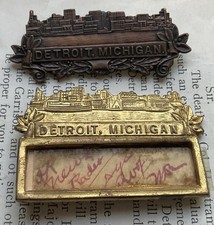
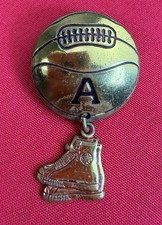
Celluloid pinback buttons customized employee badges, medals, and law enforcement insigniaMetal fobs, paperweights, pocket knives, and token coinsLithographed tin-over-cardboard advertising signs and brewery tap handles
Bastian Bros. holds a prominent place in American labor history. Shortly after its founding, it became one of the first major factories in Rochester to organize completely as a Union Shop. They proudly stamped their products with union bugs, making them the primary manufacturer for political campaign buttons, labor union pins, and civil rights groups who demanded union-made promotional items.
By 1915—just two years after your letter was written—the business had grown so large that they constructed a massive, state-of-the-art facility spread across 11 acres to house over 700 employees. The facility was highly celebrated at the time for its advanced worker amenities, including integrated air conditioning and dedicated athletic fields.
The company successfully adapted through the 20th century and continues to operate today as the Bastian Company (now located in Phelps, NY), still manufacturing high-quality metal emblematic jewelry and corporate awards
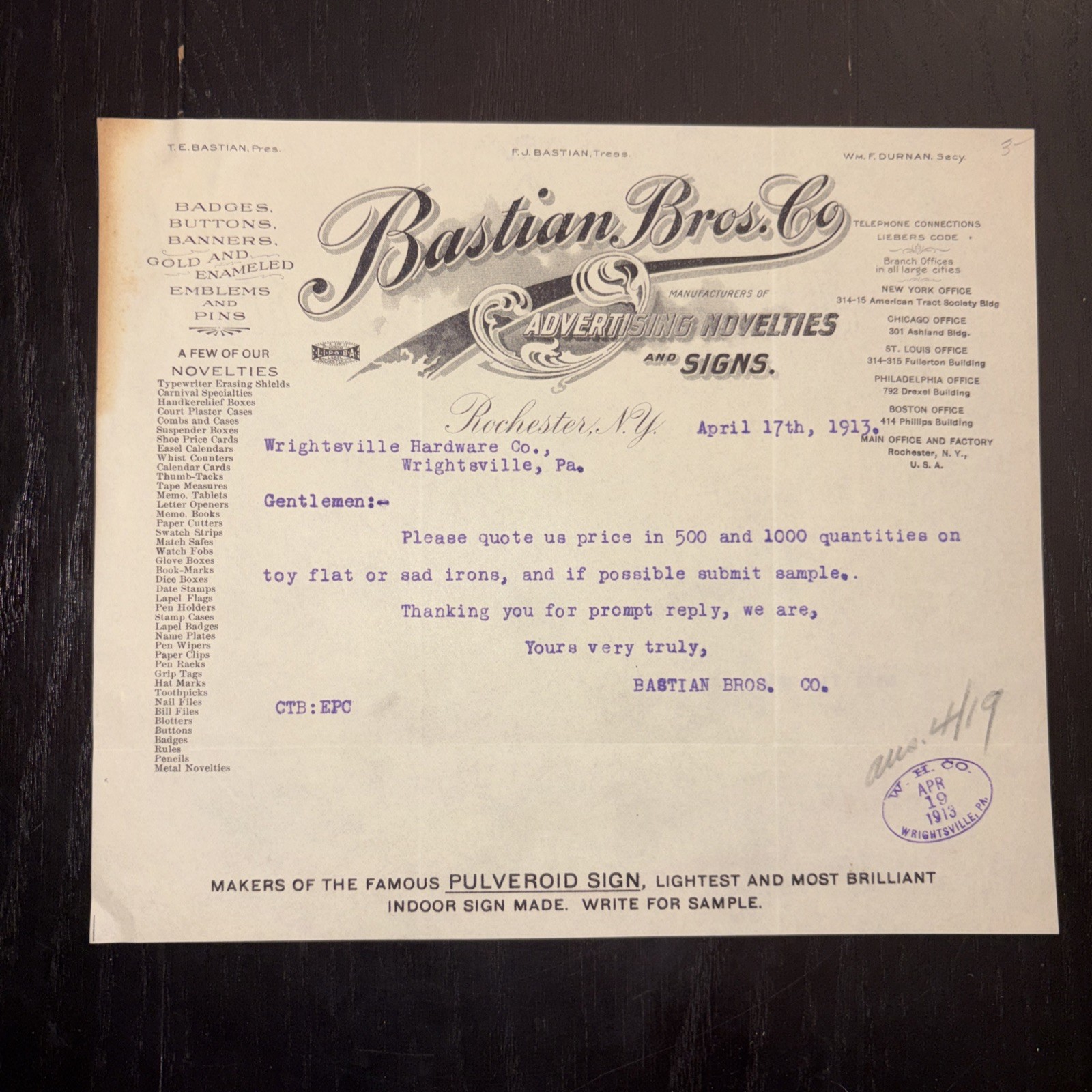
B The 1913 letter shows Bastian Bros. writing to the Wrightsville Hardware Co. in Wrightsville, Pennsylvania. Wrightsville Hardware was a famous cast-iron foundry active in the late 19th and early 20th centuries, widely known for manufacturing domestic hardware and cast-iron toys. Bastian Bros. was requesting price quotes on quantities of 500 and 1,000 "toy flat or sad irons." A "sad iron" (where "sad" is an Old English term meaning heavy or solid) was a flat clothing iron heated over a stove. Miniature or "toy" versions were incredibly popular during this era—both as children's playthings and as salesman samples. Bastian Bros. likely intended to purchase these raw iron toys from the foundry to paint, brand, or package them as custom advertising novelties for one of their own corporate clients.


 ABOUT
ABOUT