When you click on links to various merchants on this site and make a purchase, this can result in this site earning a commission. Affiliate programs and affiliations include, but are not limited to, the eBay Partner Network.
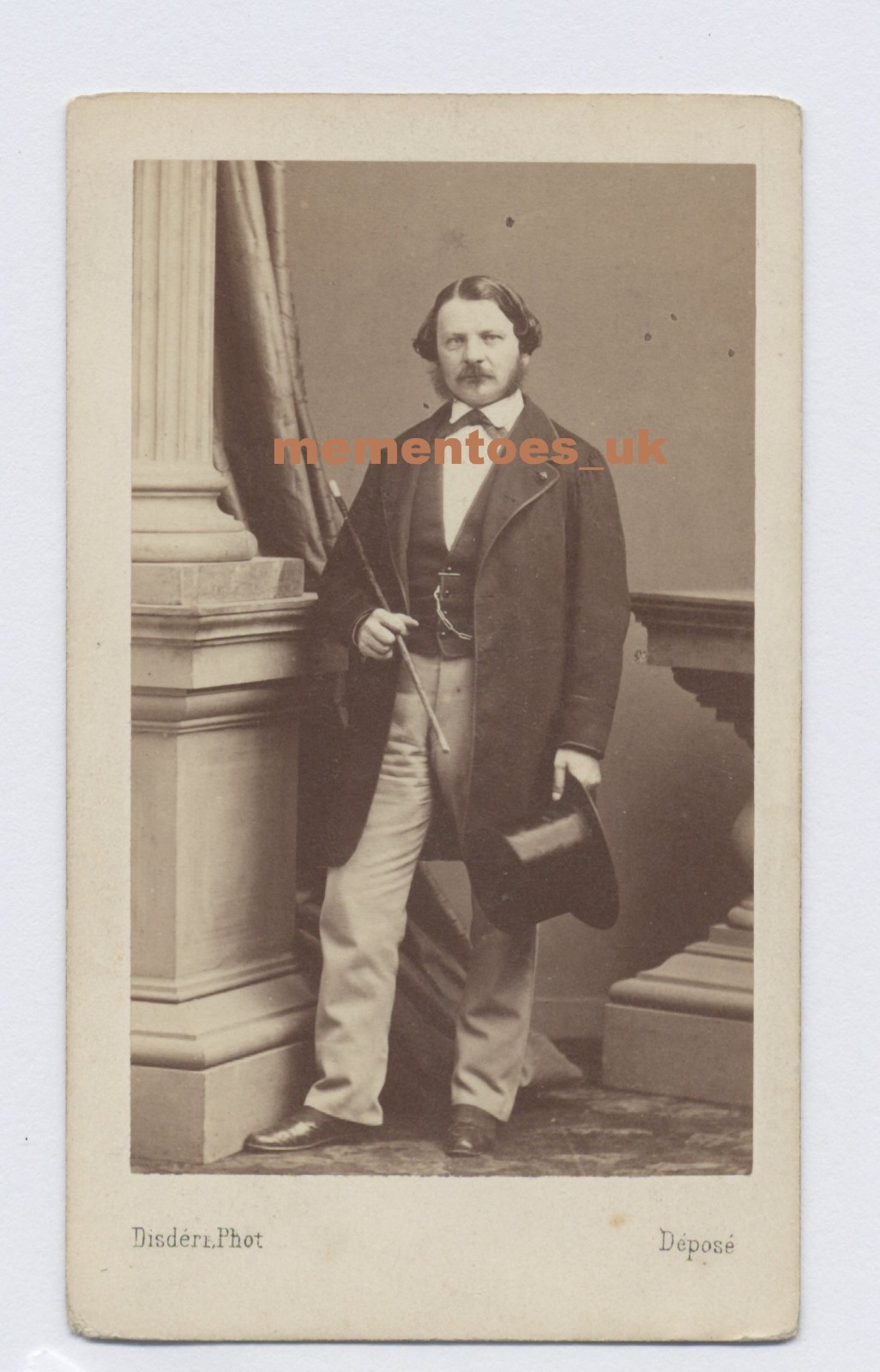
Original, vintage, c1860's, carte de visite photograph of Italian Baritone Francesco Graziani(1828-1901), see below.
Photograph by the famous photographer André Disdéri, Paris, France (see below).
Size is 6cm x 10.5cm approx.
Condition is good for its age, (please see scans).
Pleasenote, the ‘mementoes’ logo is not on the actual item.
Postage
UK FREE - 48 Hour Tracked with signature
Europe £10 -Royal Mail International Tracked
Worldwide £15 -Royal Mail International Tracked
Allitems are professionally packaged in board backed envelopes or paddedenvelopes, both with extra backing card etc. inside to ensure safe arrival ofyour items.
ALL NON UK CUSTOMERS PLEASE NOTE:-
ANYIMPORT TAXES/DUTIES ETC DUE MUST BE PAID BY CUSTOMERS UPON DELIVERY TO YOURCOUNTRY, PLEASE CHECK WITH YOUR OWN COUNTRY’S CUSTOMS DEPT. ABOUT RATES ETC.
We docombine postage (free postage for each additional eligible item), on ‘Buy itNow’ items please add the items required to your eBay shopping basket and thediscount should automatically be applied, if not please contact us forassistance.
Somenon UK bidders may have to access the listings by logging into the UK eBay site(rather than their own country’s eBay site) to be able to see the ‘eBay basket’and therefore take advantage of postage combining by using the ‘Add to Basket’facility.
Anyproblems please contact us for assistance.
Earlylife and career
Grazianiwas born in 1828 in Fermo, Italy. His older brother, Lodovico Graziani(1820–1885), was a dramatic tenor.
He studiedwith Cellini and made his debut in Italy in 1851 at Ascoli Piceno inDonizetti's Gemma di Vergy. The next season, he sang in Macerata, performingFrancesco in Verdi's I masnadieri.
Grazianialso appeared at the Salle Ventadour with the Théâtre-Italien from 1853 to1861, where he particularly excelled in the operas of Verdi, creating for Paristhe role of Count di Luna in Il trovatore and also singing Germont in Latraviata, the title role in Rigoletto, and Renato in Un ballo in maschera.
In thesummer of 1854, he performed with Max Maretzek's Italian opera company atCastle Garden in New York City.
Heappeared at the Royal Opera House, Covent Garden from 1855 to 1880. His debutwas on 26 April as Carlo in Verdi's Ernani, followed by Count di Luna inVerdi's Il Trovatore on 10 May, Riccardo in Bellini's I puritani on 17 May,Alfonso in Donizetti's La favorita on 24 May, and Iago in Rossini's Otello on 7August. He performed the role of Nelusco in the 1865 London premiere of GiacomoMeyerbeer's L'Africaine. Among the other roles he sang in London were the titlerole in Rigoletto, Renato in Un ballo in maschera, Posa in Don Carlo, andAmonasro in Aida (all by Verdi). His last performance at the house was asGermont in La traviata with Adelina Patti on 17 July in the final performanceof the 1880 season.
At StPetersburg, on 10 November 1862, he had cemented a spot in operatic history bycreating the role of Don Carlos in the first performance of Verdi's La forzadel destino.
The rangeof Graziani's voice extended up to A4 and it was much praised by contemporarycritics for its smoothness, beauty and ease of production, but his histrionicskills were said to be of a less compelling standard.
He died on30 June 1901, at his birthplace, Fermo, in Italy.
Disdériand the carte de visite
Thenovelty quickly spread throughout the world. According to a German visitor,Disdéri's studio became "really the Temple of Photography - a place uniquein its luxury and elegance. Daily he sells three to four thousand francs worthof portraits".
The factthat these photos could be reproduced inexpensively and in great quantitybrought about the decline of the daguerreotype and ushered in a carte de visitecraze as they became enormously popular throughout Europe and the UnitedStates. So great was the publicity that all of Paris wanted portraits.
Disdérialso invented the twin-lens reflex camera.
The greatFrench photographer Nadar, who was Disdéri's competitor, wrote about the newinvention in his autobiographical "Quand j'étais photographe","about the appearance of Disdéri and Carte de Visite... It spelleddisaster. Either you had to succumb - that is to say, follow the trend - orresign."
Lateryears and death
At thepinnacle of his career, Disdéri was extremely wealthy and renowned; but likeanother famous photographer, Mathew Brady, he is reported to have died in nearpoverty.
By the endof his life, Disdéri had become penniless. He died on 4 October 1889 in theHôpital Ste. Anne in Paris, "an institution for indigents, alcoholics, andthe mentally ill". He was a victim of his own invention. The system whichhe invented and popularised was so easy to imitate that photographers all overthe world took advantage of it.


 ABOUT
ABOUT