When you click on links to various merchants on this site and make a purchase, this can result in this site earning a commission. Affiliate programs and affiliations include, but are not limited to, the eBay Partner Network.
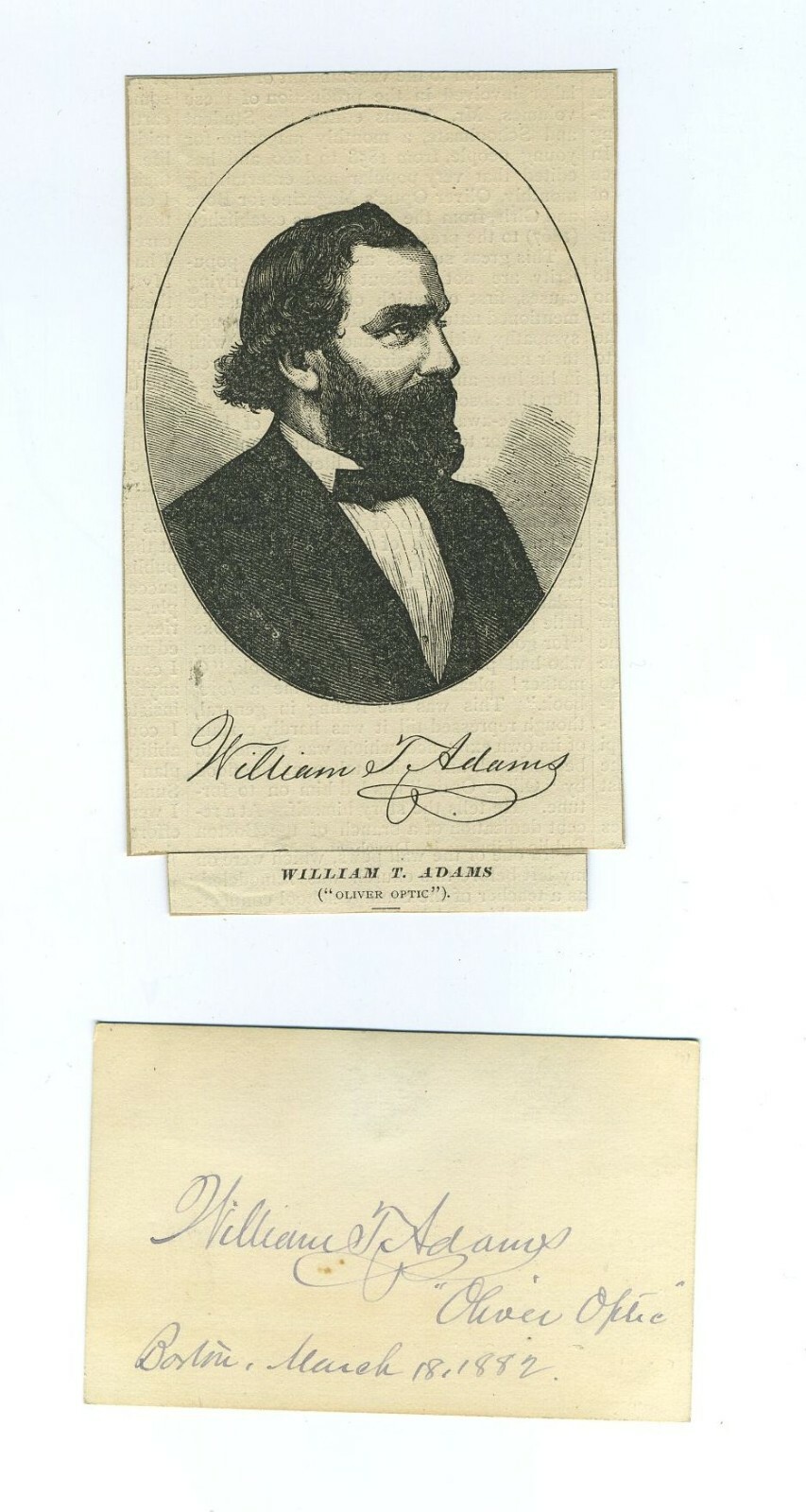
Oliver Optic small signed card from 1882 signed in Boston March 18,1882 in tan inkWilliam Taylor Adams (July 30, 1822 – March 27, 1897), pseudonym Oliver Optic, was a noted academic, author, and a member of the Massachusetts House of Representatives.Contents1 Early life2 Teaching career3 Family life4 School committee service5 Member of the Massachusetts House of Representatives6 Career as an author7 List of works7.1 Books for both boys and girls7.1.1 Riverdale Stories (subtitled : A Story for Little Folks, all 1862)7.1.2 Woodville7.2 Series for boys7.2.1 Boat Club7.2.2 Army and Navy7.2.3 Young America Abroad - first series7.2.4 Young America Abroad - second series7.2.5 Starry Flag7.2.6 Upward and Onward7.2.7 Yacht Club7.2.8 Lake Shore7.2.9 Great Western7.2.10 Boat-Builder7.2.11 Blue and the Gray Afloat7.2.12 Blue and the Gray on Land7.2.13 All Over the World - first series7.2.14 All Over the World - second series7.2.15 All Over the World - third series7.2.16 Non-series titles7.3 Books for adults8 References9 External linksEarly lifeAdams was born in Medway, Massachusetts, in 1822 to Captain Laban Adams and Catherine Johnson Adams.
Teaching careerAdams became a teacher in the Lower Road School in Dorchester, Massachusetts, in 1843,[7] he resigned from his position as master of the school in 1846 in order to assist his father and brother in the management of their new hotel in Boston, the Adams House hotel.[8] Adams decided that he preferred teaching so in 1848 he returned to teaching this time at the Boylston School in Boston.[8] In 1860, Adams was promoted to the position of master of the Boylston School.[8] When the Bowditch School was founded, Adams transferred to that school as its master, a position he held until he resigned from teaching in 1865.[8] This experience naturally brought him closely into contact with boys, and he learned much of what interested them, which had a good deal to do with his eventual success as an author. Extensive travel abroad and a deep knowledge of boats, farming, and practical mechanics were other factors that gave his works reality.
Family lifeIn 1846, Adams married Sarah Jenkins, with whom he had two daughters.
School committee serviceAdams served as a member of the school board of the town of Dorchester, Massachusetts, and later of the city of Boston, for 14 years.
Member of the Massachusetts House of RepresentativesAdams served as a member of the Massachusetts House of Representatives, for the 5th Norfolk District, from January 6, 1869,[1] to January 5, 1870.[3]
Career as an authorAdams first began to write at the age of 28, and his first book, Hatchie, the Guardian Slave (1853), was published under the pseudonym of Warren T. Ashton. It was only a modest success, but Adams was undaunted. In 1854 Adams produced his first real hit, the initial volume in the Boat Club series. Adams continued to write until he died in Dorchester, March 27, 1897.[9] Among his best-known works were the two \"Blue & Gray\" series, which were set during the Civil War.[10]
Adams wrote well over 100 books in total, most of them for a boy audience, and the majority of these in series of four to six volumes. He never wrote under his own name. Though \"Oliver Optic\" was the pseudonym he used most, his work also appeared under the bylines \"Irving Brown,\" \"Clingham Hunter, M.D.,\" and \"Old Stager.\" Like many children\'s authors of his day, he was additionally an editor, and many of his works first appeared in Oliver Optic\'s Magazine.[11]
Adams\' writing was criticized by Louisa May Alcott, among others. Alcott used her story Eight Cousins to deplore Adams\' use of slang, his cast of bootblacks and newsboys, and his stories of police courts and saloons. Adams responded in kind, pointing out Alcott\'s own use of slang and improbable plot twists.[12]
List of works
Oliver Optic\'s All Adrift (Boston: Lee & Shepard, 1892)Books for both boys and girlsRiverdale Stories (subtitled : A Story for Little Folks, all 1862)The Little MerchantThe Young VoyagersThe Christmas GiftDolly and IUncle BenThe Birthday PartyProud and LazyCareless KateRobinson Crusoe, Jr.The Picnic PartyThe Gold ThimbleThe Do-Somethings(Around 1864 this series was reprinted in a uniform edition of two series, the \"Riverdale Story Books\" and \"Flora Lee Stories\", each of six volumes)
WoodvilleRich and Humble; or, The Mission of Bertha Grant (1863)In School and Out; or, The Conquest of Richard Grant (1863)Watch and Wait; or, The Young Fugitives (1864)Work and Win; or, Noddy Newman on a Cruise (1865)Hope and Have; or, Fanny Grant Among the Indians (1866)Haste and Waste; or, The Young Pilot of Lake Champlain (1866)Series for boysBoat ClubThe Boat Club; or, The Bunkers of Rippleton (1854)All Aboard; or, Life on the Lake (1856)Now or Never; or, The Adventures of Bobby Bright (1856)Try Again; or, The Trials and Triumphs of Harry West (aka The Boy Who Did Right) (1857)Poor and Proud; or, The Fortunes of Katy Redburn (1858)Little by Little; or, The Cruise of the Flyaway (1860)Army and NavyThe Soldier Boy; or, Tom Somers in the Army (1863)The Sailor Boy; or, Jack Somers in the Navy (1863)The Young Lieutenant; or, The Adventures of an Army Officer (1865)The Yankee Middy; or, The Adventures of a Naval Officer (1865)Fighting Joe; or, The Fortunes of a Staff Officer (1865)Brave Old Salt; or, Life on the Quarter Deck (1866)(#1, 3, 5 were later republished as the Soldier Boy Series; #2, 4, 6, as the Sailor Boy series.)
Young America Abroad - first seriesOutward Bound; or, Young America Afloat (1866)Shamrock and Thistle; or, Young America in Ireland and Scotland (1867)Red Cross; or, Young America in England and Wales (1867)Dikes and Ditchs; or Young America in Holland and Belgium (1868)Palace and Cottage; or Young America in France and Switzerland (1868)Down the Rhine; or, Young America in Germany (1869)Young America Abroad - second seriesUp the Baltic; or, Young America in Norway, Sweden and Denmark (1871)Northern Lands; or, Young America in Russia and Prussia (1872)Cross and Crescent; or, Young America in Turkey and Greece (1872)Sunny Shores; or, Young America in Italy and Austria (1874)Vine and Olive; or, Young America in Spain and Portugal (1876)Isles of the Sea; or, Young America Homeward Bound (1877)Starry FlagThe Starry Flag; or, The Young Fisherman of Cape Ann (1867)Breaking Away; or, The Fortunes of a Student (also known as The Way to Succeed, 1867)Seek and Find; or, The Adventures of a Smart Boy (1867)Freaks of Fortune; or, Half Round the World (1868)Make or Break; or, The Rich Man\'s Daughter (1868)Down the River; or, Buck Bradford and His Tyrants (1868)Upward and OnwardField and Forest; or, The Fortunes of a Farmer (1870)Plane and Plank; or, The Mishaps of a Mechanic (1870)Desk and Debit; or, The Catastrophes of a Clerk (1871)Cringle and Cross-tree; or, The Sea Swashes of a Sailor (1871)Bivouac and Battle; or, The Struggles of a Soldier (1871)Sea and Shore; or, The Tramps of a Traveller (1872)Yacht ClubLittle Bobtail; or, The Wreck of the Penobscot (1872)The Yacht Club; or, The Young Boat-Builder (1873)Money-Maker; or, The Victory of the Basilisk (1873)The Coming Wave; or, The Hidden Treasure of High Rock (1874)The Dorcas Club; or, Our Girls Afloat (1874)Ocean-Born; or, The Cruise of the Clubs (1875)Lake ShoreThrough by Daylight; or, The Young Engineer of the Lake Shore Express (1869, vice versa 1887?)Lightning Express; or, The Rival Academies (1869, repr 1998 as Duty Bound; or, The Lightning Express (1998))On Time; or, The Young Captain of the Ucayga Steamer (also published as Bound to Get There, 1869; reprinted 1998 as Forgive and Forget; or, The Young Captain of the Ucayga Steamer)Switch Off; or, The War of the Students (aka ..., When Danger Threatens, 1869; repr 1998 as Heaping Coals of Fire; or, The War of the Students)Brake Up; or, The Young Peacemakers (aka ..., A Roving Commission, 1870)Bear and Forbear; or, The Young Skipper of Lake Ucayga (1870)Great WesternGoing West; or, The Perils of a Poor Boy (1875)Out West; or, Roughing It on the Great Lakes (1877)Lake Breezes; or, The Cruise of the Sylvania (1878)Going South; or, Yachting on the Atlantic Coast (1879)Down South; or, Yacht Adventures in Florida (1880)Up the River; or, Yachting on the Mississippi (1881)Boat-BuilderAll Adrift; or, The Goldwing Club (1882)Snug Harbor; or, The Champlain Mechanics (1883)Square and Compasses; or, Building the House (1884)Stem to Stern; or, Building the Boat (1885)All Taut; or, Rigging the Boat (1886)Ready About; or, Sailing the Boat (1887)Blue and the Gray AfloatTaken by the Enemy (1883)Within the Enemy\'s Lines (1889)On the Blockade (1891)Stand by the Union (1891)Fighting for the Right (1892)A Victorious Union (1893)Blue and the Gray on LandBrother against Brother; or, The War on the Border (1894)In the Saddle (1895)A Lieutenant at Eighteen (1895)On the Staff (1896)At the Front (1897)An Undivided Union (1899, completed by Edward Stratemeyer after Adams\'s death)All Over the World - first seriesA Missing Million; or, The Adventures of Louis Belgrave (1891)A Millionaire at Sixteen; or, The Cruise of the \"Guardian-Mother\" (1892)A Young Knight-Errant;or, Cruising in the West Indies (1893)Strange Sights Abroad; or, A Voyage in European Waters (1893)All Over the World - second seriesAmerican Boys Afloat; or, Curising in the Orient (1893)The Young Navigators; or, The Foreign Cruise of the Maud (1893)Up and Down the Nile; or, Young Adventurers in Africa (1894)Asiatic Breezes; or, Students on the Wing (1894)All Over the World - third seriesAcross India; or, Live Boys in the Far East (1895)Half Round the World; or, Among the Uncivilized (1895)Four Young Explorers; or, Sight-Seeing in the Tropics (1896)Pacific Shores; or, Adventures in Eastern Seas (1897)Non-series titlesA Spelling-Book For Advanced Classes (1873)Always in Luck, or Working for a Living (1887)Among the Missing, or The Boy They Could Not Beat (1890)Breaking Away, or Pluck Brings Luck (1887)Building Himself Up, or A Fight for the Right (1881)The Casket of Diamonds, or Hope Everton\'s Inheritance (1902)The Coming Wave, or The Hidden Treasure of High Rock (1874)The Cruise of the Dandy, or Doing His Best (1880)Every Inch a Boy; or, Fighting for a Hold (1884)Freaks of Fortune, or Saved from Himself (1863)Getting an Indorser, and Other Stories (1875)The Great Bonanza: An Illustrated Narrative of Adventure and Discovery in Gold Mining, Silver Mining, Among the Raftsmen, In the Oil Regions, Whaling, Hunting, Fishing, and Fighting (1876)His Own Helper; or, By Sheer Pluck (1913)Honest Kit Dunstable, or The Boy Who Earned Money (1887)In Doors and Out; or, Views from the Chimney Corner (1854, 1876)Louis Chiswick\'s Mission; or, Going With the Current (aka ..., Up the Ladder of Success) (1883)Lyon Hart\'s Heroism; or, Courage Wins (1883)Making a Man of Himself, or, Right Makes Might (1884)Marrying a Beggar, or The Angel in Disguise, and Other Tales (1859)Our Standard-Bearer; or The Life of General Ulysses S. Grant: His Youth, His Manhood, His Campaigns, and His Eminent Services in the Reconstruction of the Nation His Sword Has Redeemed (1868)The Prisoners of the Cave, or By Sheer Will Power (1888)The Professor\'s Son, or Against All Odds (1884)Royal Tarr\'s Pluck, or The Boy Who Fought Fair (1883)Sports and Pastimes for Indoors and Out (1914)Striving for His Own (1885)Three Young Silver Kings, or At Fortune\'s Call (aka ...In Search of Treasure, 1887)Tried and True, or The Young Peacemakers (1998)Books for adultsHatchie, the guardian slave; or, The heiress of Bellevue. A tale of the Mississippi and the South-west (as by Warren T. Ashton, 1853)Living Too Fast, or The Confessions of a Bank Officer (1876)The Voyage of Life: An Allegory (1887)The Way of the World: A Novel (1867)WILLIAM T. ADAMS (OLIVER OPTIC) (1822-1897)William Taylor Adams, better known by his pen name \"Oliver Optic,\" was born in Medway, Massachusetts, July 30, 1822. His father, Laban Adams, was at that time the proprietor of a tavern in Boston, but in 18 38 he moved to a farm in West Roxbury. William received his schooling first in Boston and later obtained what he could while doing farm work. He then traveled for a year in the South and upon his return assisted his father
in the management of the \"Adams House,\" built on the site of the former tavern. After a short time, however, he obtained the principalship of the grammar school at Dorchester, at that time a village but now a suburb of Boston, and while there was married, in 1846, to Sarah Jenkins, by whom he had two daughters. He continued to teach in various Boston schools for twenty years, and at the same time wrote many short stories and books. In 1865 he resigned to devote his entire time to literature, although he retained his interest in the public schools. He was a member of the Massachusetts State Legislature for one year but declined a renomination. He died March 27, 1897, at his home in Dorchester.
His first book was written in 1853 under the pen name \"Warren T. Ashton.\"1 It was called \"Hatchie, the Guardian Slave; or, The Heiress of Bellevue. A Tale of the Mississippi and the South-West,\" and for it he received $37.50[!] from a Boston publisher. Most of his short stories and books were written for boys. His style was so pleasing, his plots so interesting, and the action so lively, that he was very successful and had a very large following of youthful readers. He had the ability of writing stories that were so natural and everyday in their setting that his boy readers unconsciously became in imagination the heroes themselves. Adams\' style is, in some cases, rather
careless, but he was a natural story teller, and while his heroes performed wonders, the action was at least possible if not probable. Above all things, his books are clean and moral, and the reader\'s sympathy is never with the villain of the story.
All in all, Adams wrote perhaps a thousand short stories and over 125 books. Having a reading knowledge of German, Italian, Spanish, and French, and having traveled some twenty times to Europe as well as to the Mediterranean coasts of Africa and Asia, he had firsthand information available for his stories. He always carefully outlined his plots before beginning to write, then filled in the details from the voluminous notes which he had made on his travels or which he had entered in his note books from many sources. Five hours of writing was his regular day\'s work. He was one of the best-paid authors of his time. For two stories in 1873 the Fireside Companion paid him $5,000.(2)
Many of Optic\'s books, like his Boat Club series, Lake Shore series, Great Western series, Army and Navy series, Onward and Upward series, Yacht Club series, etc., were written in sets of six volumes�companion rather than continued stories. Besides writing short stories and novels, he also was successively editor of Student and Schoolmate, Our Little Ones, and Oliver Optic\'s Magazine (Our Boys and Girls), and in these magazines many of his stories, which were later issued in book form, first appeared. Two volumes for older readers fell flat: \"The Way of the World\" and \"Living Too Fast.\"
The pen name \"Oliver Optic\" was first used in 1851. It was taken from the principal character, \"Doctor Optic,\" in a burlesque being played in Boston at that time. The name Oliver was added for euphony. In a few cases it was written \"Oliver Optic, M.D.\"(3) Besides \"Oliver Optic\" and \"Warren T. Ashton,\" he also used the names \"Irving Brown,\"(4) \"Clingham Hunter, M.D.\"(5) \"Gale Winterton,\"(6) \"Brooks McCormick,\"(7) and \"Old Stager.\"(8) The only story that I have found under his own name was a short story, \"The Whaleman\'s Daughter; or, The Mysterious Pilot,\" which appeared in the Yankee Privateer, volume VI, September 19, 1857.
REFERENCES: Allibone, Supplement, I; Scribner\'s Dict. Amer. Biog., I, 102-3; Nat. Cyc. Amer. Biog., I, 1898, 203, with portrait; Kunitz and Haycraft, Amer. Authors, 1938, 12-13, with portrait; Young New Yorker, March 3, 1879, with a good woodcut; Munsey\'s Magazine, VIII, Oct., 1892, 58-59, with a good woodcut; American Bookseller, XXIII, 1888, 289-90, XXIV, 1888, 8-11, with a fine steel engraving; Book News (Philadelphia), XV, 1897, 465; Midland Monthly, December, 1897; Critic, XXX, 242-43, April 3, 1897, with portrait; Literary Digest, XIV, April 10, 1897, 700; Golden Days, XVIII, 1897, 376; New York Evening Post, March 27, 1897; New York Herald, March 28, 1897; New Press, March 28, 1897. †\"Roy B. Van Devier: \'Oliver Optic,\' Dime Novel Round-Up, XXV, No. 298, July, 1957, 51�54. With a portrait of an older man than shown above.\"


 ABOUT
ABOUT