When you click on links to various merchants on this site and make a purchase, this can result in this site earning a commission. Affiliate programs and affiliations include, but are not limited to, the eBay Partner Network.
IMPORTANT ARCHIVAL GROUP — THE 1933 GERMAN SHECHITA CRISIS
A fascinating group of rabbinic papers concerning one of the great halachic controversies of prewar European Jewry: the Nazi German prohibition of traditional Jewish shechita and the question of whether pre-stunning could ever be permitted in order to enable shechita to continue.
Provenance: from the personal library/papers of Dayan Eliezer Posen (1892-1969) of London, a leading dayan of the Union of Orthodox Hebrew Congregations and a member of an important German rabbinic family (his father was Dayan Gershon Posen (1852-1932), Av Beit Din of Frankfurt, Germany; his younger brother was Rav Shimon Posen (1894-1969), the Szoproner Rav, later Rosh Yeshiva of Satmar, Williamsburg NY).
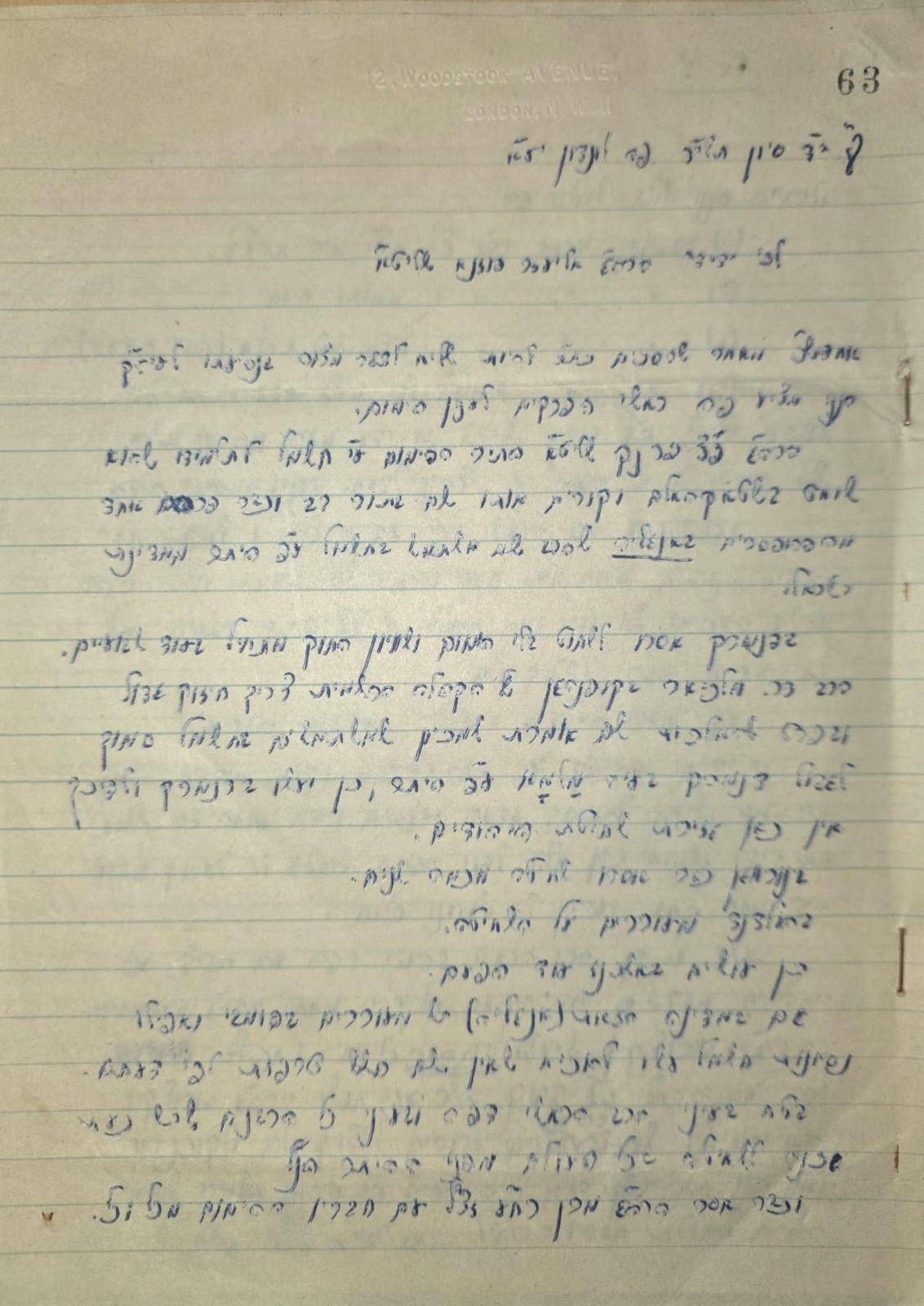
The collection includes early duplicated/transcribed copies of correspondence relating to Rav Chaim Ozer Grodzinski (1859-1940) of Vilna,and the German shechita crisis, together with a handwritten letter from Rav Eliyahu (Eli) Munk (1899-1978) of London to Dayan Posen, dated Sivan 5714 [1954].
The papers provide an extraordinary window into a halachic controversy that began almost immediately after the Nazis came to power.
In 1933, the Nazi regime prohibited shechita without prior stunning. German Orthodox Jewry consequently faced an agonizing question: could some form of stunning be reconciled with halacha, or must traditional shechita remain unchanged even if the practical consequence was that kosher meat became unavailable?
The issue was submitted to the greatest halachic authorities of the period, including Rav Chaim Ozer Grodzinski, the preeminent Lithuanian posek and rabbinic leader of Vilna. Surviving correspondence demonstrates his direct involvement in the international rabbinic deliberations surrounding the German anti-shechita legislation. In a 1933 letter concerning electrical stunning, for example, R. Chaim Ozer cautioned that nothing should be published before further consultation because the matter raised serious concerns.
The controversy is particularly significant because of the involvement of Rav Yechiel Yaakov Weinberg (1884–1966), author of Seridei Eish, then one of the leading Orthodox rabbis in Berlin.
R. Weinberg investigated whether stunning before shechita might be halachically defensible under the desperate circumstances confronting German Jewry. He later explained that he had inclined toward a lenient position but knew that the senior rabbinic authorities of Lithuania, Poland and international Orthodoxy were unlikely to sanction such a fundamental alteration to traditional shechita.
Central to the German side of the controversy was Rabbi Dr. Esriel (Ezra) Munk (1867–1940), one of the leading representatives of German Orthodox Jewry. A student of the Berlin Rabbinical Seminary, he succeeded Rabbi Azriel Hildesheimer as rabbi of Berlin's Adass Yisroel congregation in 1900. He was deeply involved in the defense of traditional shechita and firmly opposed electrical stunning. He left Germany for Jerusalem in 1938 and died there in 1940.
His son, Rav Eli Munk, came to Britain in 1930 and became founder and longtime rabbi of the Golders Green Beth Hamedrash, serving the important German Orthodox émigré community in London. He held rabbinic ordination as well as a doctorate from the University of Marburg. He continued his father's involvement with the defense of shechita and was an important figure in postwar Anglo-Jewish Orthodoxy.
The handwritten material included here comes from Rav Eli Munk to Dayan Eliezer Posen in Sivan 1954, giving this group an important direct association between the German Orthodox rabbinic world in which the original shechita controversy took place and its continuation among German rabbinic refugees in postwar London.
Dayan Eliezer Posenwas himself a distinguished German-trained rabbinic authority. He had served as a dayan in Frankfurt before escaping Nazi Germany and settling in Britain. During the war years he lived in Dorking, Surrey, where he organized the first Jewish services in the town in 1941. He subsequently became a dayan of London's Adath Yisroel/Union of Orthodox Hebrew Congregations and a major figure in the transplanted German Orthodox community.
CONTENTS
The group offered here consists of:
- Duplicated/transcribed rabbinic correspondence concerning the 1933 shechita crisis, including material of Rav Chaim Ozer Grodzinski and the contemporary debate surrounding government restrictions on shechita.
- Material bearing contemporary rabbinic names and references relating to the controversy.
- Two manuscript pages in Hebrew from Rav Eli Munk to Dayan Eliezer Posen, written on stationery embossed “12 Woodstock Avenue, London N.W.11.”
- Additional duplicated rabbinic correspondence preserved with the group, including material relating to the broader European campaign surrounding restrictions on shechita.
These are not represented as autograph letters of Rav Chaim Ozer Grodzinski. The R. Chaim Ozer material consists of contemporary or early ha'atakot / duplicated copies or transcripts preserved among these rabbinic papers.
An unusual surviving documentary collection relating to the confrontation between halacha, animal-slaughter legislation, German Orthodoxy and the earliest anti-Jewish measures of the Nazi era.
Condition: As shown. Papers exhibit age toning, folds, edge wear, occasional tears/chipping, old staples and other signs of handling and preservation. Manuscript pages remain clearly legible. Please inspect all photographs carefully; they form an integral part of the condition description.
Sold as an historical archival collection exactly as pictured.


 ABOUT
ABOUT