When you click on links to various merchants on this site and make a purchase, this can result in this site earning a commission. Affiliate programs and affiliations include, but are not limited to, the eBay Partner Network.
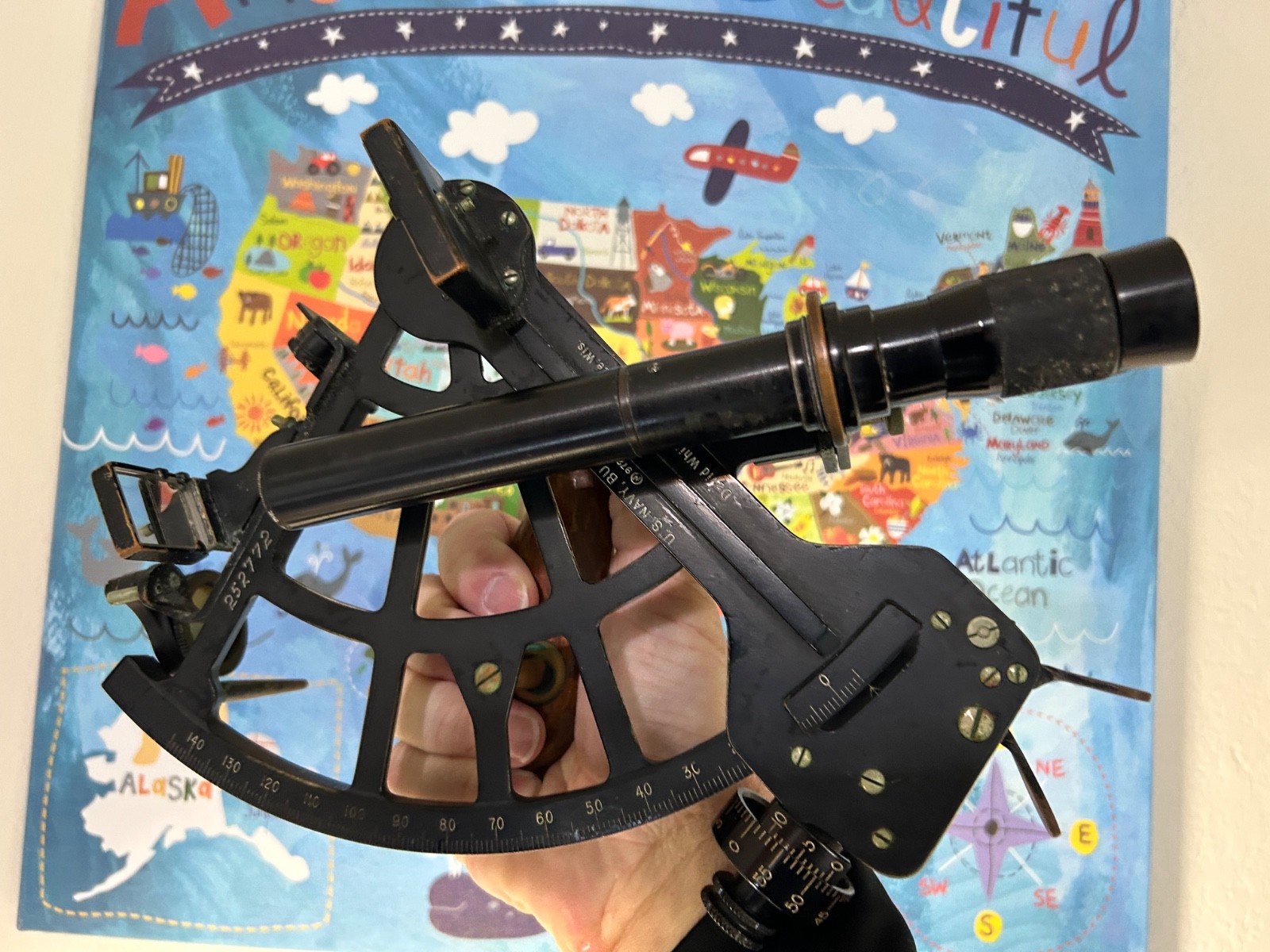
This is Pre-WWII (1940) Vintage David White Naval Sextant with Case is a rare and valuable piece of maritime history. Made in the United States before the US entry into World War II, this sextant is a vintage original by the renowned maker David White Co. from Milwaukee, Wisconsin. It is a navigational instrument used by sailors to determine their position at sea, making it a unique and sought-after collectible for maritime enthusiasts and history buffs. The sextant comes with an original case painted black by the crew, adding to its authenticity and charm as a piece of wartime memorabilia.
Because 1940 as etched on the Sextant arm, it predates the massive industrial scaling of U.S. involvement in World War II, a verified 1940 sextant is more desirable to military collectors than the highly common 1943–1945 iterations.The case shows a 1983 U.S. Naval Observatory certificate inside a 1940 David White sextant is a fantastic detail that changes its story—and actively supports its value. This date indicates that the sextant waskept in active military or government service for over 40 years. It is highly common for WWII-era Mark II sextants to remain in naval inventory or aboard vessels for decades, being sent back to the U.S. Naval Observatory (or a Navy calibration lab) periodically for re-certification and mirror alignments.
Here themismatched serial number between the 1983 paper and the 1940 sextant arcis a classic sign of an "active duty mix-up." But shows that a1940 sextant that was still being trusted by the Navy in 1983 proves it wasn't just sitting in a closet; it was a reliable, working instrument through the mid-to-late Cold War era.
During the mid-to-late Cold War, Navy supply rooms and calibration labs handled hundreds of these standard Mark II units simultaneously. When instruments were sent in groups to theU.S. Naval Observatoryor the Long Beach Naval Shipyard Optical Shop for calibration, it was incredibly common for a technician to accidentally put Sextant A back into Box B during re-packing.TheSextant was finally declared surplus and retired in 1990 from the USS Mahlon S. Tisdale (FFG-27), when given to the current owner by the ship's Senior Chief Quartermaster upon departure from the ship.
Finally, the telescope glass and lenses are relatively clear and appear to be in working order.


 ABOUT
ABOUT