When you click on links to various merchants on this site and make a purchase, this can result in this site earning a commission. Affiliate programs and affiliations include, but are not limited to, the eBay Partner Network.
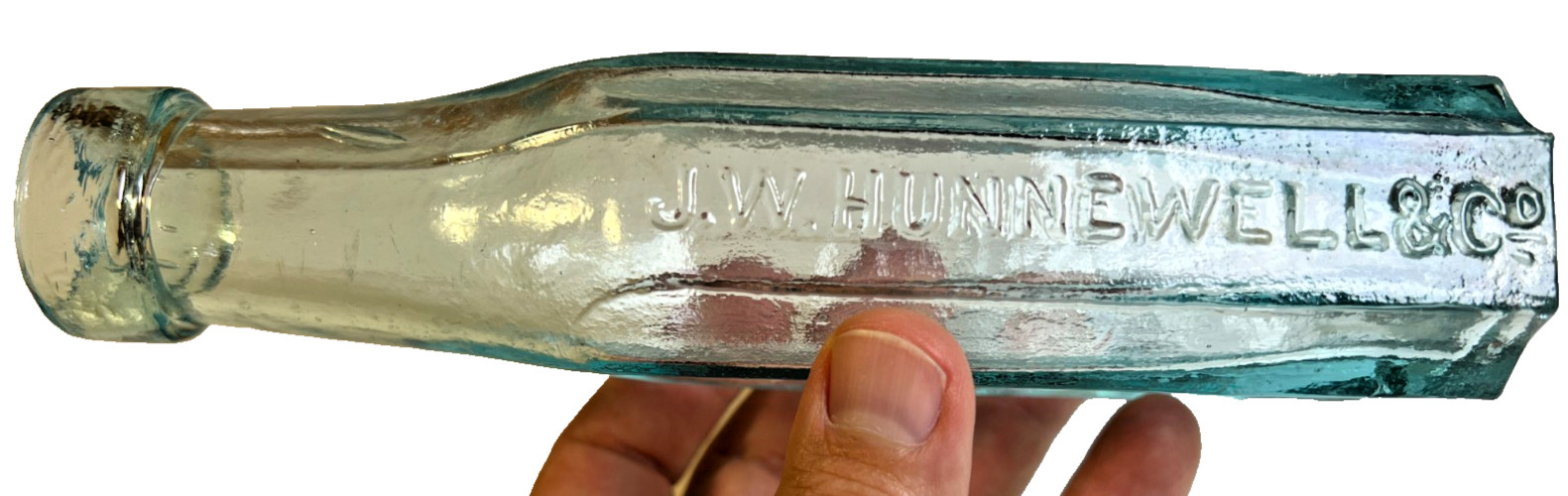
The bottle’s broad shoulders, relatively wide mouth, and imposing paneled form suggest that it most likely held a prepared condiment such as chow-chow, pickled vegetables, relish, table sauce, or possibly mustard. Although spice merchants sold dry spices, this is much larger and more accessible than a typical ground-spice bottle. A chunky product intended to be poured or removed with a utensil is the more convincing original use.
Precise Date
Circa 1880—most likely made between approximately 1875 and 1885.
The hand-applied collar top, smooth indented base, bold mold-blown lettering, heavy aqua glass, and lack of machine-production characteristics all support this narrow late-1870s/early-1880s date. It is distinctly earlier than the standardized machine-made condiment bottles that became common around the turn of the century.
J. W. Hunnewell & Co.
J. W. Hunnewell & Co. appears to have been a Boston food merchant or packer selling prepared grocery products under its own name. The expensive custom mold was itself a form of permanent advertising: even after the paper label disappeared, the glass continued to proclaim the company’s identity.
At a time when national food brands were only beginning to emerge, shoppers often relied on the name and reputation of a local merchant. The strong vertical embossing made the Hunnewell name conspicuous on a grocer’s shelf and discouraged another packer from casually reusing the bottle for its own merchandise.
The bottle likely originally carried a colorful paper label on one of its broad unembossed panels, describing the contents and perhaps including serving claims such as “pure,” “choice,” or “prepared from selected ingredients”—favorite marketing language of the Victorian grocery trade.
Boston in the Bottle’s Era
Boston around 1880 was balancing centuries-old streets and horse-drawn traffic with startling new technology. Alexander Graham Bell made the first successful telephone call in Boston in 1876, and the telephone quickly began changing how businesses communicated. Electric lighting was still a novelty; most homes and shops depended on gas or oil illumination.
Medicine was also changing. Germ theory and antiseptic surgery were gaining acceptance, but patent medicines and household remedies remained enormously popular. Food processing was not yet federally regulated, so shoppers placed considerable trust in the name embossed on a bottle. The federal Pure Food and Drug Act would not arrive until 1906.
Politically, the country was emerging from Reconstruction. The disputed presidential election of 1876 placed Rutherford B. Hayes in office, while Boston remained an important center of reform, education, publishing, and immigration.
The city itself had recently endured the devastating Great Boston Fire of 1872, which destroyed hundreds of buildings in the commercial district. Boston also expanded dramatically through the annexation of neighboring communities during the 1870s. By the time this bottle reached a grocer’s shelf, rebuilt commercial blocks, busy railroad terminals, harbor traffic, and the first telephones were reshaping daily life.
Condition
Displays as an exceptionally attractive bright, clean, and shiny aqua bottle with crisp, prominent embossing.
In full disclosure:
- Two small, faint patches of light hairline scratching appear on the back panel. These are difficult to notice under normal conditions.
- There is a small, shallow chip/flake along one side of the heel/bottom; It is inconspicuous when the bottle is standing.
- A faint vertical content stain or water line crosses part of the BOSTON embossing.
- Expected bubbles, texture, irregularities, and tooling marks from early glass manufacture are present.
Despite these minor imperfections, the color, strong embossing, applied top, and dramatic eight-sided form give it excellent shelf presence. It looks exactly as an early Boston bottle ought to look—substantial, handmade, and just a little theatrical.


 ABOUT
ABOUT