When you click on links to various merchants on this site and make a purchase, this can result in this site earning a commission. Affiliate programs and affiliations include, but are not limited to, the eBay Partner Network.
Ancient Judaean / Levantine Bronze Club-Headed Toggle or Votive Pin, Circa 1000–600 BC. Certified Authentic Ancient Artifact
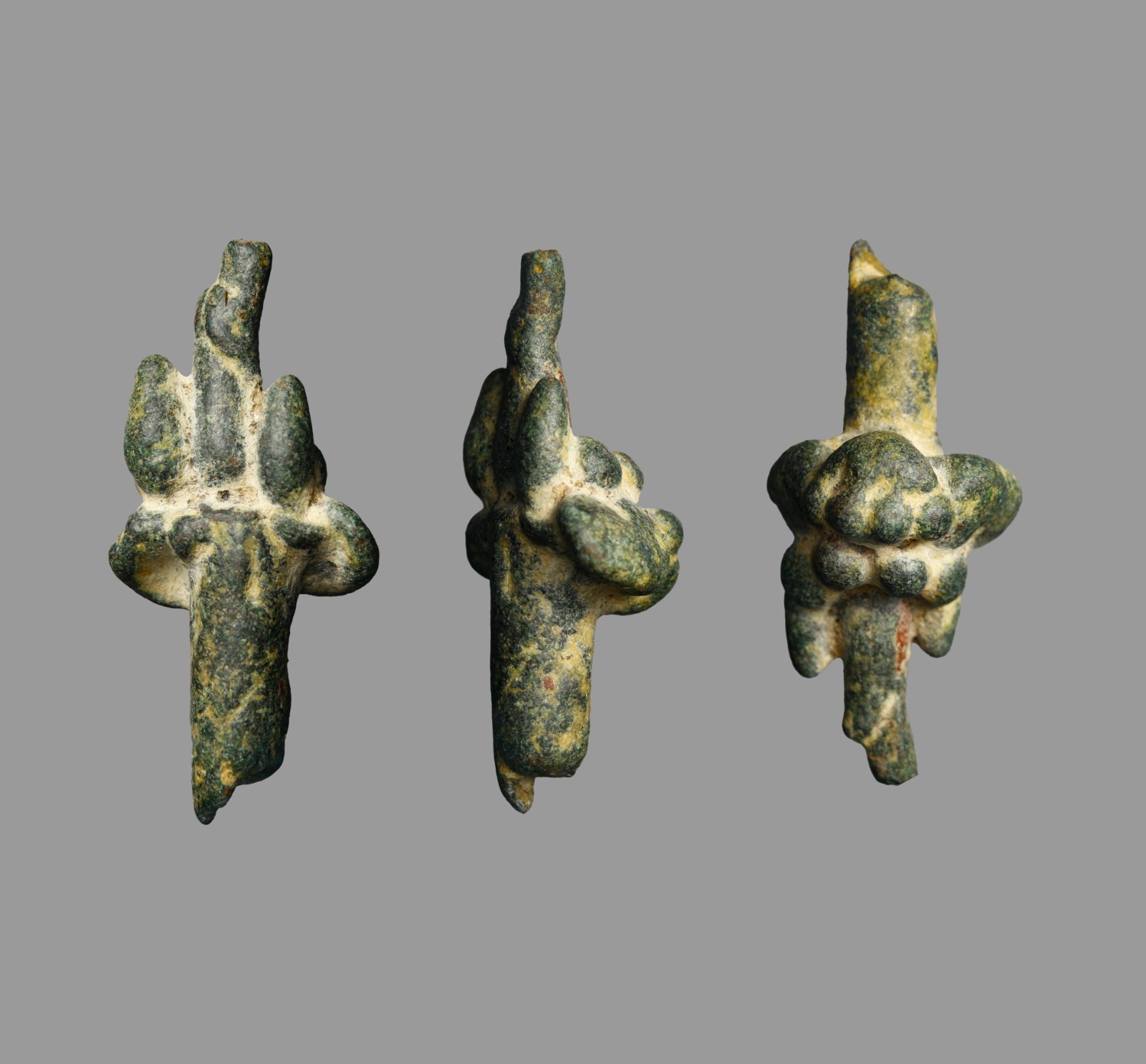
Item: 06Culture: Iron Age Judaean / PhoenicianDate: Circa 1000–600 BCMaterial: BronzeType: "Mace-Head" style toggle or heavy dress pin fragmentSize: 40 mmProvenance: Holy Land find; Private collection; acquired by me in 2024
Description:
A curious and rare bronze artifact from the Iron Age Levant. This 40mm object features a central shaft surmounted by a bulbous, multi-knobbed head, closely resembling the form of a ceremonial mace or "club." Historically, these objects served dual purposes: functionally, they acted as heavy-duty toggles or garment fasteners for thick wool or leather cloaks; symbolically, they represented power and authority, mimicking the weaponry of the period in miniature form.
The "knobbed" design is a classic Near Eastern motif, often associated with the storm god Ba'al or regional warrior deities who were frequently depicted carrying maces. The heavy casting and distinct geometry suggest this was an item of personal status, possibly belonging to a military officer or a person of high social standing.
Authentication Notes (Ancient Surface and Tool Assessment):
Crystallized Patina: The surface exhibits a superb, deep forest-green "malachite" patina with localized areas of desert-sand calcification. This multi-toned oxidation is indicative of centuries of burial in varying soil pH levels.
Lost-Wax Casting: The asymmetric placement of the "knobs" on the head indicates a hand-modeled wax original, a technique standard in Iron Age Levantine workshops.
Structural Integrity: The break at the base of the shaft shows ancient mineralized edges, proving the damage occurred in antiquity rather than recently.
Surface Pitting: Authentic ancient bronze develops microscopic "cupping" or pitting beneath the patina due to the leaching of tin over millennia—a feature clearly visible on the shaft of this piece.
Cultural and Artistic Context:
Knobbed bronze objects are found throughout the Levant and Mesopotamia, often appearing in temple "hoards" or as votive offerings. In the Iron Age II period (the time of the Kings of Judah and Israel), such items reflected the militaristic nature of the society. Small-scale "mace" toggles provided the wearer with a constant symbol of protection and martial prowess, functioning as both a tool and an amulet.
Museum Parallels:
The Metropolitan Museum of Art, 1989.281.14 (Ancient Near Eastern knobbed bronze fasteners).
British Museum, BM 123456 (Levantine Iron Age bronze garment pins).
Israel Museum, Jerusalem (Iron Age II decorative bronzes from Tel Hazor/Megiddo).
Academic References:
Moorey, P.R.S., Ancient Mesopotamian Materials and Industries, Section: Bronze Votive Objects, p. 260–263.
Mazar, A., Archaeology of the Land of the Bible, Section: Iron Age Metalwork and Personal Ornament.
Condition:
Very fine archaeological condition. The bronze is stable and the patina is exceptionally vibrant and well-preserved. Guaranteed authentic.
7-4


 ABOUT
ABOUT