When you click on links to various merchants on this site and make a purchase, this can result in this site earning a commission. Affiliate programs and affiliations include, but are not limited to, the eBay Partner Network.
🚂 What Do You Call the Railroad That Ruled America From a Green-Bordered Certificate? 🏔️
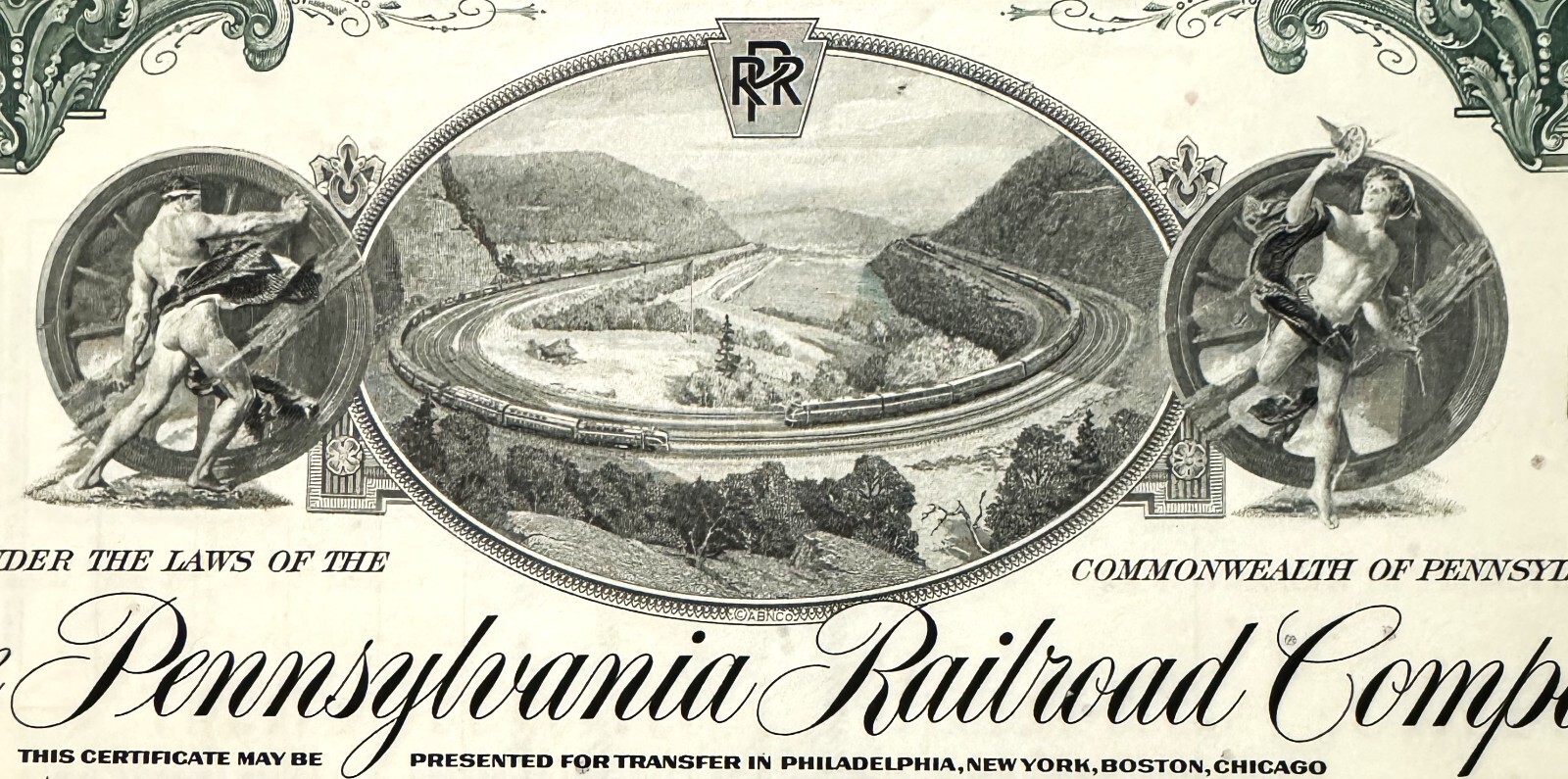
Ask any old-school train collector to picture the single most photographed curve of track in American railroading history, and nine times out of ten they'll describe this exact scene — a ribbon of rail bending back on itself through a mountain gap, a passenger train stretched around the bend like a toy on a table. That's not an artist's imagination. That's the Horseshoe Curve, and it's engraved right into the heart of this certificate.
This is an original stock certificate issued by The Pennsylvania Railroad Company, printed and engraved by the American Bank Note Company, and dated at Philadelphia, Pennsylvania in 1963. It represents 100 shares of PRR capital stock, and it comes to you as a genuine issued survivor: completed in ink, countersigned and registered, and cancelled at the end of its working life.
The artwork is where this certificate earns its keep. Steel-plate intaglio engraving in deep green and black sits on cream stock, with the ornate acanthus-leaf corner scrollwork typical of American Bank Note Company's finest security printing. Front and center, framed in an oval border of fine geometric guilloché work, sits the vignette every railroad-scripophily collector recognizes on sight: the Horseshoe Curve itself, rendered with a train wrapping the great bend through the Allegheny mountain gap, river and valley laid out below. Above it perches the instantly recognizable PRR keystone — a nod to Pennsylvania's own nickname as the Keystone State. Flanking the central oval, two classical allegorical figures are worked into railroad-wheel medallions, straining and forging in the muscular, mythological style American Bank Note Company favored for its most important corporate issues — figures meant to evoke industry, power, and progress, the same visual language you'll find on the finest 19th- and early-20th-century American securities. Below it all, the ornate PRR seal anchors the signatures of the company's officers, along with the printed notation of Irving Trust Company as registrar and the Pennsylvania Railroad's own New York office as transfer agent.
🏔️ The Curve That Made the Railroad
The Horseshoe Curve wasn't chosen for this certificate by accident — it was, quite simply, the PRR's calling card. Built through the Allegheny Mountains west of Altoona, Pennsylvania, the curve was engineered to let trains climb the steep grade between the eastern seaboard and the Ohio Valley without a punishing direct ascent, bending the track back on itself in a broad horseshoe so a train could gain elevation gradually instead of fighting the mountain head-on. It opened in the 1850s and became, almost immediately, one of the great engineering spectacles of American railroading — a fixture of postcards, calendars, and yes, stock certificates like this one, for the better part of a century.
Local legend around Altoona holds that during the Second World War, the Curve was considered such a vital artery of American industry — feeding coal, steel, and war material east and west — that it was named among the strategic targets of a wartime sabotage plot against U.S. infrastructure. Whether or not any agent ever got close enough to do harm, the story has been passed down for generations as proof of just how much the nation's fortunes ran through that one bend of track. Old-timers in the region still tell it as a point of local pride: the curve that was too important to lose.
🛤️ "The Standard Railroad of the World"
The Pennsylvania Railroad was chartered by the Commonwealth of Pennsylvania on April 13, 1846 — the date proudly printed across the top of this certificate, marking not when the certificate itself was issued, but the founding charter the company never stopped citing on its stock for over a century afterward. From that the period charter, the PRR grew into what railroad men of the era simply called "The Standard Railroad of the World" — for decades the largest, best-capitalized, and most influential railroad corporation in the country, its rails stitching together Philadelphia, Pittsburgh, New York, and Chicago into a single commercial artery. Collectors of railroad scripophily will recognize the PRR keystone as one of the most collected corporate marks in American finance — a company so dominant that its stock was a fixture on trading floors from Philadelphia to Boston, which is exactly why this certificate lists all four cities as valid transfer points.
By the time this particular certificate was printed in 1963, the PRR was entering its final chapter as an independent company — folding, a few years later, into the ill-fated Penn Central merger with its old rival the New York Central, a marriage of convenience that collapsed into one of the largest corporate bankruptcies the country had yet seen. That collapse, in turn, reshaped American rail history entirely, giving rise to Conrail and eventually feeding into Amtrak's passenger network. Every PRR certificate from this era, in other words, is a snapshot of a giant in its last independent years — a corporate name that had ruled American railroading for well over a century, on the cusp of disappearing into history.
🖋️ The Engraver's Hand — American Bank Note Company
The precision of the lathe-cut border work, the fine cross-hatching in the mountain shading, the crispness of the lettering — all of it is the signature of the American Bank Note Company, the security printing house responsible for engraving currency, postage stamps, bonds, and corporate stock for the biggest names in American finance and industry for well over a century. Collectors of scripophily prize American Bank Note Company work specifically because the engraving quality rivaled that of paper currency itself — no surprise, since many of the same engravers moved between currency work and corporate securities. A PRR certificate carrying the ABNCo imprint represents the pairing of two American institutions at their peak: the railroad that built the nation's freight and passenger backbone, and the printing house trusted to put that company's name on paper worth trusting.
🏙️ Philadelphia's Railroad
Philadelphia was more than a headquarters address for the PRR — it was the city whose merchants and civic leaders pushed the charter through the legislature in the first place, determined not to lose commerce to Baltimore and New York. For generations, the Pennsylvania Railroad and the city of Philadelphia were spoken of almost interchangeably in business circles, the railroad's fortunes and the city's civic identity rising together. That's the Philadelphia stamped across the top of this certificate — not a printing location chosen for convenience, but the actual seat of one of the most consequential corporations in American industrial history.
🖼️ Display Ideas
- 🚂 Frame it alongside model train layouts or Lionel PRR rolling stock for a railroad room centerpiece
- 🏔️ Pair it with vintage Horseshoe Curve postcards or photographs for a themed Pennsylvania railroading wall
- 💼 Matted in a shadow box for a finance or Wall Street history office display
- 🖋️ Framed solo to let the engraving and allegorical figures stand as fine graphic art in their own right
- 🎁 Given as a gift to a train collector or railroad-history enthusiast building out a collection
- 📜 Displayed with other scripophily pieces from the golden age of American railroads
🎁 Who Collects These
Scripophily collectors — those who collect antique stock and bond certificates for their engraving, history, and company pedigree — seek out Pennsylvania Railroad certificates specifically for the Horseshoe Curve vignette, widely considered one of the finest and most recognizable scenes ever put on an American security. Railroad historians and model railroaders collect them as tangible artifacts of the PRR's corporate identity. Collectors of American Bank Note Company engraving prize them for the printing craft alone. And with the certificate's own place at the end of the PRR's independent era, it appeals to anyone drawn to the story of American railroading's great consolidation years — the last stock certificates issued before one of the country's most storied companies disappeared into merger and bankruptcy.
❓ FAQ
Is this a real, issued stock certificate or a reproduction?
It's an original certificate from the Pennsylvania Railroad Company, engraved by the American Bank Note Company — genuine period printing that was actually issued and put to work.
What does the "1846" date on the certificate mean?
That's the date the Pennsylvania Railroad was originally chartered by the Commonwealth of Pennsylvania — it appears on PRR stock certificates for over a century afterward as the company's founding date, not the date this particular certificate was printed. This series carries a 1963 Philadelphia dateline.
What is the scene in the oval vignette?
It's the Horseshoe Curve, the PRR's famous mountain-grade engineering feat near Altoona, Pennsylvania, shown with a passenger train wrapping the bend — the railroad's signature image, used on its stock, its advertising, and its public identity for generations.
Does this certificate still carry any value as a security?
No — the Pennsylvania Railroad ceased to exist as an independent company decades ago following its 1960s-era merger and the collapse that followed. These certificates are collected today purely for their history, engraving, and place in American railroad and financial history, not as active securities.
How big is the certificate?
It measures 12 x 8 inches (approximately 30.5 x 20.3 cm).
Who are the figures worked into the wheel medallions on either side of the vignette?
They're classical allegorical figures — a common device in American Bank Note Company engraving — meant to symbolize industry, strength, and progress, the visual shorthand banks and railroads favored on their most important printed securities.
These are issued instruments rather than blanks. Certificates of this type were filled in for a holder in ink, countersigned by the transfer agent and registered by the registrar, then punch- or cut-cancelled when they were redeemed and retired. Expect financial writings, markings, stamps, hole punches and staple holes as part of the life of the instrument: endorsements and signatures, transfer-agent and registrar stamps, revenue or documentary tax stamps, cancellation punches, staple holes from being bound into a transfer book, pencil ledger notations. That is the paper trail of a security that actually did its job, and it is what separates a document that lived from a blank that never did. No two are alike: share counts, holder details, serial numbers, dates, signatures, stamps and punch patterns vary from example to example, so the photographs show the type rather than the exact sheet that ships.


 ABOUT
ABOUT