When you click on links to various merchants on this site and make a purchase, this can result in this site earning a commission. Affiliate programs and affiliations include, but are not limited to, the eBay Partner Network.
Size: 12 x 8 inches
Ever hold a piece of paper that once represented real ownership in the biggest company on Earth? 🚂
I still get a little charge every time one of these crosses my desk. There's something about holding a genuine stock certificate — heavy, engraved, cross-hatched with lines too fine for a modern printer to fake — knowing that somewhere in Philadelphia, nearly a century ago, a clerk dipped a pen and made someone a part-owner of the Pennsylvania Railroad. That's not a reproduction. That's not a "railroad-themed" print made for a gift shop. That's the genuine article, and it's one of my favorite categories to pass along to the next keeper.
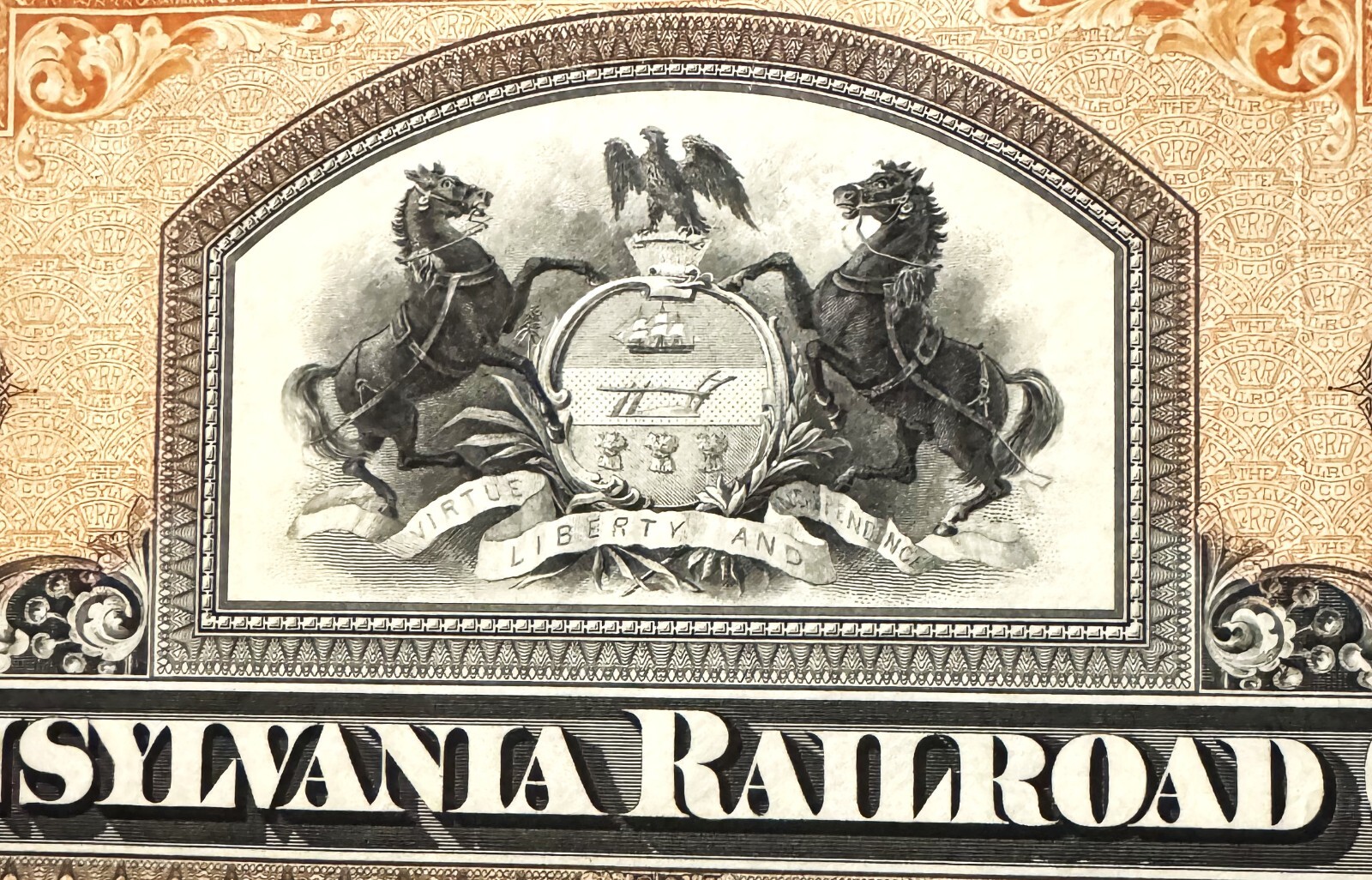
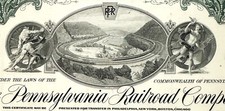
This is an original Pennsylvania Railroad Company capital stock certificate, engraved and printed by the American Bank Note Company at its Philadelphia office, issued from the company's Philadelphia headquarters during the late 1920s. It went into circulation on the open market and came back out again — decades of handling, banking transfers and estate settlements are exactly the story these PRR certificates carry. The design is a showpiece of American security engraving: a warm orange guilloché border wound in tight wave patterns too intricate to counterfeit, framing a black-and-cream central panel where two rearing horses flank the Pennsylvania coat of arms beneath a perched eagle, all resting on a banner reading "VIRTUE LIBERTY AND INDEPENDENCE." Below that, in bold black-letter type against the orange field, runs the company's full name, and beneath it the engrossed script of the certificate body itself — the kind of penmanship that simply doesn't get taught anymore. It's printed on the heavy, textured stock that bank note companies used specifically because it was difficult to imitate and built to last.
🚂 The Pennsylvania Railroad — "The Standard Railroad of the World"
The Pennsylvania Railroad Company was incorporated under the laws of the Commonwealth of Pennsylvania on April 13, 1846 — a date you'll find printed right on this certificate's letterhead, and one worth knowing the story behind. Philadelphia's merchants were watching, with real alarm, as Baltimore's B&O Railroad pushed westward toward Cumberland and threatened to steal the lucrative trade of the Ohio Valley and the Great Lakes right out from under them. The charter fight that followed produced the PRR, built specifically to connect Philadelphia to Pittsburgh and keep the city in the transportation game.
It worked better than anyone in 1846 could have imagined. By 1882 the Pennsylvania Railroad was the largest railroad, the largest transportation enterprise, and by some measures the largest corporation of any kind in the entire world. Along the way it absorbed, merged with, or held stakes in more than 800 other rail lines and companies, stitching together a network that touched nearly every major industrial center in the Northeast and Midwest. Old-timers in the business used to call it "the standard railroad of the world" — not as a boast, but because for decades it genuinely set the benchmark: for punctuality, for engineering, for sheer scale of operation. At its peak it was said to be the single largest employer of men and women anywhere in the United States, private or public.
The company's Tuscan red passenger cars, its keystone herald, and its famous Broadway Limited running between New York and Chicago became fixtures of American rail travel and popular memory. This certificate dates from the height of that golden era — the interwar 1920s — before the Depression years tested the railroad's finances and long before the pressures that eventually led to the 1968 Penn Central merger and the difficult bankruptcy years that followed. In 1927, when this certificate left the printer, the Pennsylvania Railroad was about as blue-chip as American industry got.
🦅 Reading the Coat of Arms — Virtue, Liberty, and Independence
Take a close look at that central vignette, because it isn't generic railroad artwork — it's the actual coat of arms of the Commonwealth of Pennsylvania, borrowed by the railroad as its corporate seal because the company so thoroughly identified itself with the state it was chartered to serve. The shield at the center shows a ship in full sail, a plow, and three sheaves of wheat — commerce, agriculture, and industry, the three pillars the state's founders considered essential to prosperity. Flanking the shield, two rearing draft horses represent labor and strength; above it all, an eagle perches on a stump, a nod to the American eagle and to Pennsylvania's forests. And running beneath the whole design, that ribboned motto: "Virtue, Liberty, and Independence" — Pennsylvania's official state motto since colonial days, adopted in place of a monarch's crest the way a young republic insisted on doing everything differently. The railroad wrapping itself in this imagery wasn't subtle. It was a company that wanted every investor holding this piece of paper to feel they were buying into something as solid and as American as the Commonwealth itself.
🖋️ American Bank Note Company — The Engravers Behind the Curtain
Look at the fineness of those lines and you're looking at the work of the American Bank Note Company's Philadelphia office — a firm whose roots in the security-printing trade trace back to 1795, when Robert Scot, the first chief engraver of the United States Mint, founded an engraving house in Philadelphia with a handful of partners. The modern American Bank Note Company took its present name and corporate form in 1858, when several competing engraving houses merged into a single firm, and by the early twentieth century it operated offices in New York, Boston, and Philadelphia, engraving currency, postage stamps, bonds, and stock certificates for governments and corporations across the country. This wasn't decorative flourish for its own sake — that dense wave-pattern border and the hand-cut vignette work were deliberate anti-counterfeiting technology, the same engraving craft used on paper currency of the era, applied here to protect a shareholder's investment in one of the country's largest companies.
🏦 A Dating Fingerprint Only a Collector Would Notice
Here's the kind of detail that separates a real find from a guess, and it's one I always point out to fellow collectors: look at the registrar's name printed along the left edge — "American Exchange Irving Trust Company." That specific name only existed on the books for a few short years. Irving Trust acquired the American Exchange-Pacific Bank in 1926 and briefly operated under the combined "American Exchange Irving Trust Company" name before shortening it to simply Irving Trust Company in 1929. That narrow window — 1926 to 1929 — is baked right into this issue, and it lines up exactly with the era this certificate comes from. It's the kind of small printed detail that tells a collector far more than a big flashy vignette ever could.
🏙️ Philadelphia — Where the Pennsy Called Home
Philadelphia wasn't just where the railroad was chartered — it was the city the PRR built its entire identity around. The railroad's headquarters, its flagship 30th Street and Broad Street terminals, and its executive offices all sat in Philadelphia, and the American Bank Note Company's own Philadelphia branch — the very office named on this certificate — had been printing financial instruments in that city since at least the 1840s. For a century, "the Pennsylvania Railroad" and "Philadelphia" were nearly synonymous in the American business press, the way "General Motors" and "Detroit" would become for a later generation.
💭 The Shareholders Behind the Signatures
Certificates like this one were issued to individual shareholders across the country — ordinary investors, often women managing family savings or an inheritance, entrusting their money to a company widely regarded as one of the safest, steadiest holdings an American could own. Collectors and railroad-stock enthusiasts often refer to shares like these as "widow-and-orphan stock" — a phrase passed down in the trade to describe the kind of rock-solid, dividend-paying blue chip that conservative investors and trustees favored for exactly that reason. Each certificate bears the engraved signatures of the company's president and treasurer along with a live countersignature from a transfer clerk and registrar — a layered chain of verification typical of major early-twentieth-century corporate stock, meant to make forgery or improper transfer all but impossible.
🎲 A Legacy That Outlived the Railroad Itself
Here's a bit of lore every railroad-stock collector eventually hears, and it's worth passing along: the Pennsylvania Railroad's fame ran so deep in American popular culture that when Parker Brothers designed the Monopoly board in the 1930s, they gave the Pennsylvania Railroad its own space — one of four railroads on the board, and by most accounts the one most players actually recognized by name. That's the kind of cultural staying power a company earns only after decades of being a genuine household name, not just a line item in a stock ledger. Long after the physical railroad disappeared into Penn Central and then Conrail, that little board-game square kept the Pennsylvania Railroad's name in front of new generations who never rode a single one of its trains.
🖼️ Display Ideas
- 🖼️ Framed alone under glass, letting that orange guilloché border and the coat-of-arms vignette carry the whole wall
- 🚂 Grouped with vintage railroad ephemera — timetables, ticket stubs, or a model locomotive — for a themed shadow box
- 💼 Displayed on a home office or study wall as a conversation-starting piece of American finance history
- 🏛️ Paired with other Pennsylvania or Philadelphia memorabilia for a regional history corner
- 🎓 Given as a gift to a history buff, genealogist, or someone with railroad or Philadelphia roots
- 📚 Tucked into a scrapbook or archive of Americana alongside other early-1900s financial documents
🎁 Who Collects These
Scripophily — the collecting of antique stock and bond certificates — has a devoted following, and Pennsylvania Railroad certificates sit near the top of most collectors' want lists thanks to the company's outsized place in American industrial history. Railroad historians, Americana collectors, Philadelphia and Pennsylvania regional-history buffs, genealogists tracing an ancestor's investments, and anyone drawn to the golden age of engraved financial art all find their way to pieces like this one. It's equally at home in a serious archive or simply framed on a wall for the sheer beauty of the engraving.
❓ FAQ
Is this a real, original stock certificate — not a reprint?
Yes. This is a genuine Pennsylvania Railroad Company certificate engraved and printed by the American Bank Note Company's Philadelphia office, from the company's original stock issue of the late 1920s.
Was this certificate ever cashed in or is it still "active" stock?
The Pennsylvania Railroad ceased to exist as an independent company decades ago, following its 1968 merger into Penn Central. This certificate has no monetary redemption value today — its worth is entirely historical and collectible.
What does the imagery in the center actually show?
It's the coat of arms of the Commonwealth of Pennsylvania — a ship, a plow, and wheat sheaves on a shield, flanked by two rearing horses and topped by an eagle, above the state motto "Virtue, Liberty, and Independence." The railroad adopted it as its own corporate seal.
Who printed it, and how can you tell it's genuine?
The American Bank Note Company, working out of its Philadelphia office, engraved and printed this issue. The dense guilloché border patterns and fine intaglio vignette work are hallmarks of genuine bank-note-grade security engraving from that firm.
How is the certificate's era confirmed?
The certificate's printed registrar, "American Exchange Irving Trust Company," was only used under that combined name for a brief window in the late 1920s before the bank shortened its name — a detail that independently confirms this issue's era.
Does the name and share count on my certificate matter for value?
Each certificate was issued to an individual shareholder with its own share amount and serial number, which naturally vary from copy to copy. What stays constant — and what collectors prize — is the issue itself: the company, the era, the engraving, and the artwork.
What condition will mine be in?
This is an original issued certificate from this Pennsylvania Railroad issue, preserved as an excellent example of early-twentieth-century Americana and financial engraving.
These are issued instruments rather than blanks. Certificates of this type were filled in for a holder in ink, countersigned by the transfer agent and registered by the registrar, then punch- or cut-cancelled when they were redeemed and retired. Expect financial writings, markings, stamps, hole punches and staple holes as part of the life of the instrument: endorsements and signatures, transfer-agent and registrar stamps, revenue or documentary tax stamps, cancellation punches, staple holes from being bound into a transfer book, pencil ledger notations. That is the paper trail of a security that actually did its job, and it is what separates a document that lived from a blank that never did. No two are alike: share counts, holder details, serial numbers, dates, signatures, stamps and punch patterns vary from example to example, so the photographs show the type rather than the exact sheet that ships.


 ABOUT
ABOUT