When you click on links to various merchants on this site and make a purchase, this can result in this site earning a commission. Affiliate programs and affiliations include, but are not limited to, the eBay Partner Network.
🚂 What Did It Feel Like to Actually Own a Piece of "The Standard Railroad of the World"?
Long before anyone thought of stock certificates as wall art, they were the real thing — paper proof that you owned a sliver of an empire. And if there was one railroad empire every American of the mid-20th century would have recognized on sight, it was the Pennsylvania Railroad. Say "Pennsy" to anyone who grew up playing board games around the family table, and they'll likely think of the orange-and-black railroad squares on a Monopoly board before they think of an actual locomotive — but this certificate is the real deal behind that deed card, the genuine corporate instrument that once represented ownership in one of the largest, richest, and most powerful transportation companies the country ever produced. Holding one is about as close as a collector gets to shaking hands with the golden age of American railroading.
📜 What You're Looking At
This is an original Pennsylvania Railroad Company capital stock certificate, issued from the company's Philadelphia headquarters and engraved by the American Bank Note Company's Philadelphia office — the same caliber of security printer trusted with currency-grade work for railroads, banks, and industrial giants across the country. These certificates date to the postwar era of American railroading, and this one comes to you as genuine issued corporate paper — executed, countersigned, registered, and cancelled when it was surrendered. It measures a substantial 12 x 8 inches, giving the engraving plenty of room to breathe.
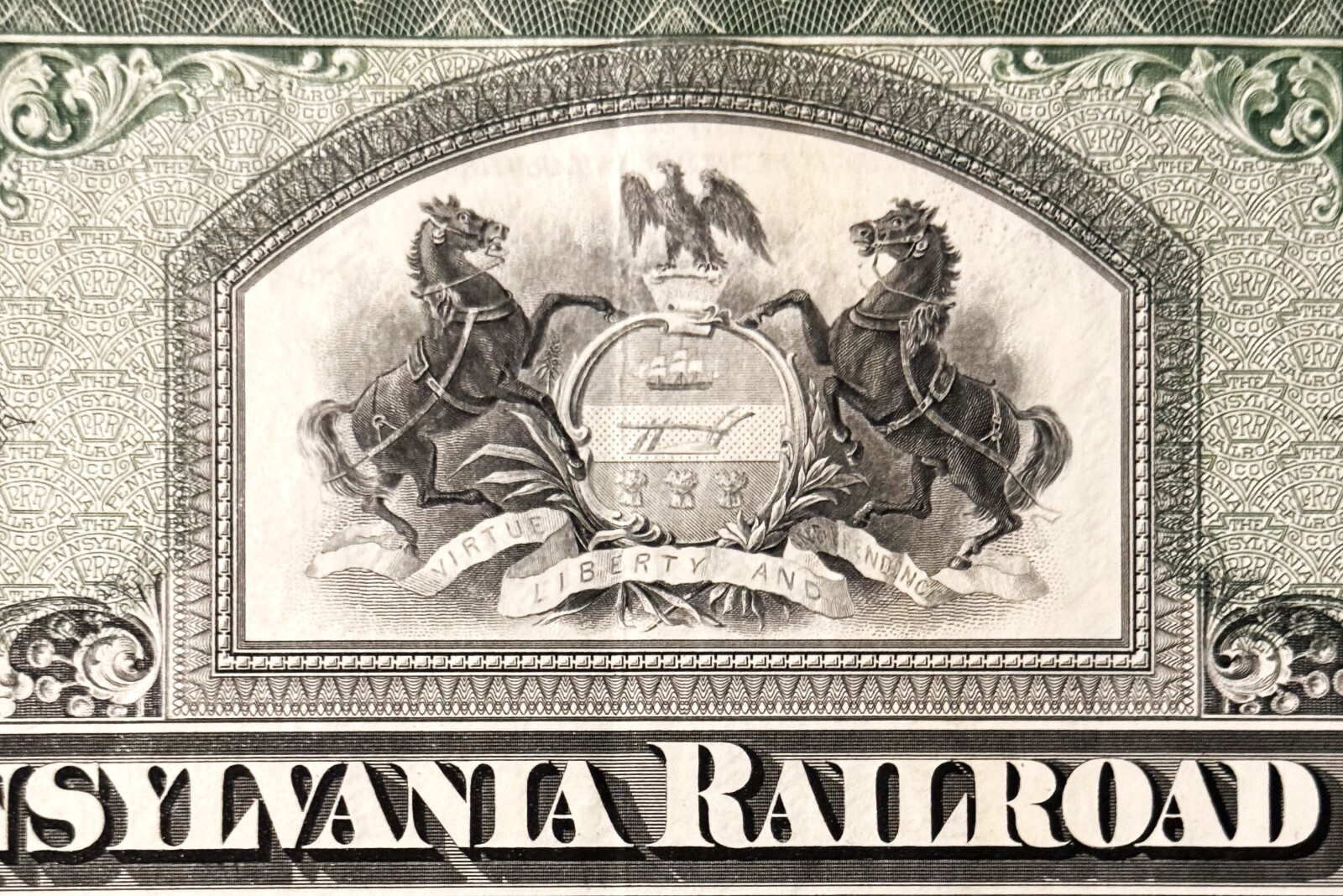
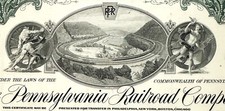
The artwork is where this certificate really earns its keep. Across the top runs a deep green guilloché border — that dense, lathe-cut, wave-on-wave pattern of interlocking lines that banknote engravers used specifically because it's nearly impossible to forge by hand. Tucked into that border, if you look closely, the pattern itself spells out "PENNSYLVANIA RAILROAD CO" and "THE" over and over in a repeating security motif — a lovely, easy-to-miss detail once you know to look for it. Centered beneath an arched frame sits the certificate's crown jewel: the Pennsylvania coat of arms, rendered in fine black-and-white engraving. Two rearing black horses stand as supporters on either side of a shield, an eagle perched proudly atop the crest, and within the shield itself a small sailing ship, a sheaf of wheat, and a plow — the commonwealth's traditional emblems of commerce, agriculture, and industry. Below, a ribboned banner reads "VIRTUE LIBERTY AND INDEPENDENCE" — Pennsylvania's own state motto, worked directly into the railroad's corporate seal. An embossed green company seal anchors the lower portion of the document, and the paper carries the cancellation perforations typical of certificates that completed their working life in a transfer agent's ledger — small round punches through the signature block and seal that mark this piece as formally retired from active trading, a certificate that did its job before it became a collectible. The whole design plays out in a restrained palette of green, black, and cream/off-white — elegant, serious, exactly what you'd expect from a company that liked to call itself the standard by which all other railroads were measured.
🏛️ The Pennsylvania Railroad — Empire on Rails
The certificate itself carries the date April 13, 1846 printed right into its text — the day the Commonwealth of Pennsylvania chartered the company. That's the event being commemorated on the document, not the date of this particular certificate, but it's worth telling the story anyway, because it's a genuinely great one. The PRR was chartered to build a rail line from Harrisburg west to Pittsburgh, giving Philadelphia merchants a fighting chance against Baltimore's B&O Railroad and New York's Erie Canal, both of which were siphoning western trade away from the City of Brotherly Love. Construction rolled forward through the late 1840s and early 1850s, and from that modest beginning the Pennsylvania Railroad grew, through relentless construction, leasing, and acquisition of smaller lines, into a rail network stretching to New York, Washington D.C., Chicago, and St. Louis.
By the turn of the century the PRR wasn't just a railroad — it was an institution, and it knew it. The company marketed itself, without much argument from anyone, as "The Standard Railroad of the World." Its keystone-shaped herald became one of the most recognized corporate logos in American industry, stamped on everything from locomotive tenders to letterhead to, yes, certificates just like this one. Old-timers along the line still talk about the PRR's fleet of named passenger trains — the Broadway Limited chief among them — and about the engineering feat at Horseshoe Curve near Altoona, a sweeping bend blasted and graded through the Allegheny Mountains in the 1850s that remains, to this day, one of the most celebrated pieces of railroad engineering in the country. Collectors of railroadiana will also tell you the Pennsylvania Railroad pushed electrification of its Northeast Corridor trackage further than almost any American road of its era, a technical ambition that outlived the company itself and quietly became the backbone of Amtrak's busiest routes decades later.
And then there's the detail every collector of this certificate seems to enjoy most: the Pennsylvania Railroad's square on the Monopoly board. Along with the B&O, the Reading, and the Short Line, "Pennsylvania Railroad" is one of the four rail properties players buy, trade, and mortgage in the classic American board game — meaning a genuine PRR stock certificate is about as literal a real-world Monopoly deed as a collector will ever hold in their hands.
🏙️ Philadelphia — Headquarters of an Empire
The Pennsylvania Railroad was a Philadelphia institution through and through, headquartered there for the entirety of its independent existence, historically out of the grand Broad Street Station in the heart of Center City. By the mid-1950s — the very era this certificate belongs to — the PRR found itself at the center of one of the boldest urban redevelopment projects in the city's history. The railroad's own elevated viaduct through downtown, an imposing structure locals had nicknamed the "Chinese Wall" for the way it walled off Center City from the rest of Philadelphia, was torn down to make way for Penn Center, a new complex of modern office towers built jointly with the city under famed planner Edmund Bacon. It's a striking bit of timing: while investors were holding certificates exactly like this one, the company itself was literally reshaping the skyline of its home city — tearing down its own iron wall to help build the Philadelphia of the future.
👔 The Hands Behind the Paper
Every detail printed on this certificate points to the machinery of a genuinely enormous corporation. The American Bank Note Company, whose imprint runs along the bottom of the document, was one of the preeminent security engravers in the country — a firm built from a lineage of earlier bank-note printers and trusted with the kind of intricate steel-plate engraving work used for currency, government bonds, and blue-chip corporate stock precisely because it was so difficult to counterfeit. That the company maintained a dedicated Philadelphia office to produce certificates like this one, rather than farming the job out from New York, tells you something about how much business a railroad the size of the Pennsylvania could bring to a printer's door.
The certificate also names Irving Trust Company of New York as registrar — a storied Wall Street trust bank whose roots reached back to the mid-19th century and whose headquarters at 1 Wall Street was, and remains, a landmark of the Financial District. Serving as registrar and transfer agent for the stock of major industrial and railroad companies was standard business for institutions like Irving Trust, a quiet but essential piece of the machinery that let shares like these change hands legally across state lines. The certificate itself even spells out just how far that reach extended, noting it could be presented for transfer in Philadelphia, New York, Boston, Chicago, and London — a small printed line that speaks volumes about how thoroughly the PRR's ownership base, and its ambitions, stretched across the Atlantic.
📉 The Long Arc — Rise, Merger, and What's Left Today
No history of the Pennsylvania Railroad is complete without its ending, because it's one of the most dramatic in American corporate history. Postwar competition from trucking, private automobiles, and the rise of commercial air travel steadily ate into the railroad's freight and passenger business, while heavy regulation kept the company from adjusting rates fast enough to compensate. In 1968, the once-mighty Pennsylvania Railroad merged with its longtime rival, the New York Central, to form the Penn Central Transportation Company — at the time, the largest corporate merger in United States history. It didn't last. Penn Central collapsed into bankruptcy in 1970, the largest corporate bankruptcy the country had ever seen up to that point, and its rail lines were eventually folded into the federally created Conrail in 1976, with many of its passenger routes and electrified corridors ultimately inherited by Amtrak.
That whole arc — an 1846 charter, a century of empire-building, a headline merger, and a spectacular collapse — is exactly why certificates like this one hold such lasting appeal for collectors today. The hobby even has a name for it: scripophily, the collecting of historic stock and bond certificates, prized as much for their engraving artistry as for the corporate stories they carry. A Pennsylvania Railroad certificate sits near the top of that hobby's wish list, because so few American companies ever grew as large, meant as much to their home city, or fell as dramatically as the Pennsy did.
🖼️ Display Ideas
- 🖋️ Framed on its own in a home office or study, matted to let that green guilloché border and the coat-of-arms vignette take center stage
- 🚂 Displayed in a dedicated train room alongside vintage Pennsylvania Railroad timetables, photographs, or model equipment
- 🎲 Paired with a vintage Monopoly board for a playful nod to the real railroad behind the game piece
- 🗺️ Hung alongside period railroad maps or route diagrams for a coordinated wall of transportation history
- 🏙️ Grouped with Philadelphia memorabilia to tell the story of a company that shaped its home city's skyline
- 🎁 Given as a gift to a railroad enthusiast, finance history buff, or anyone with roots in Pennsylvania
🎁 Who Collects These
Scripophily collectors chase Pennsylvania Railroad certificates precisely because the company was so large, so long-lived, and so visually rewarding to engrave — few American corporations left behind paper this ornate. Railroad historians and model railroaders love pairing a genuine certificate with their layouts and libraries. Philadelphia natives and Pennsylvania history buffs are drawn to the coat-of-arms imagery and the state motto worked right into the design. Monopoly collectors appreciate the real-world tie to the board game's most famous rail property. And more than a few buyers are simply looking for a handsome, historically rich gift for the train lover, business history enthusiast, or nostalgia collector in their life — a genuine artifact rather than a reproduction print.
❓ FAQIs this an original certificate or a reprint?
It's a genuine, original Pennsylvania Railroad Company stock certificate — real issued corporate paper from the company's own issue, not a modern reproduction.
Is this still an active, tradable share of stock?
No. The certificate carries cancellation perforations through the signature block and seal, marking it as formally retired by the transfer agent — it's a historical collectible now, not a live financial instrument.
What do the horses, eagle, and ship in the center image represent?
That's the Pennsylvania coat of arms, worked into the railroad's own corporate seal — the eagle and rearing horses are traditional state supporters, while the ship, sheaf of wheat, and plow within the shield stand for commerce, agriculture, and industry, under the state's own motto, "Virtue, Liberty and Independence."
Will the certificate I receive look exactly like the one pictured?
The design, engraving, colors, and imagery are consistent across this issue, but details unique to each individual certificate — its serial number, the exact date within the issue, the number of shares, and the name it was originally issued to — will vary from copy to copy, since each one was completed by hand for a different original shareholder.
How big is the certificate?
It measures 12 x 8 inches (roughly 30.5 x 20 cm), giving the engraving a substantial, wall-worthy presence.
Who printed it?
The American Bank Note Company's Philadelphia office, a leading security engraver known for currency-grade steel-plate printing on stocks, bonds, and other corporate instruments.
Why does the Pennsylvania Railroad matter to collectors beyond railroading itself?
Beyond its status as one of the largest and most storied railroads in American history, the Pennsylvania Railroad is also one of the four rail properties on the classic Monopoly board — giving this certificate a rare crossover appeal between railroad history collectors and game-and-nostalgia collectors alike.
These are issued instruments rather than blanks. Certificates of this type were filled in for a holder in ink, countersigned by the transfer agent and registered by the registrar, then punch- or cut-cancelled when they were redeemed and retired. Expect financial writings, markings, stamps, hole punches and staple holes as part of the life of the instrument: endorsements and signatures, transfer-agent and registrar stamps, revenue or documentary tax stamps, cancellation punches, staple holes from being bound into a transfer book, pencil ledger notations. That is the paper trail of a security that actually did its job, and it is what separates a document that lived from a blank that never did. No two are alike: holder details, serial numbers, dates, signatures, stamps and punch patterns vary from example to example, so the photographs show the type rather than the exact sheet that ships.


 ABOUT
ABOUT